











Direct synthesis of highly functionalized furans from donor–acceptor cyclopropanes via DBU-mediated ring expansion reactions
Literature Information
Publication Date
2019-07-08
DOI
10.1039/C9OB01308C
Impact Factor
3.876
Authors
Zhenjie Su, Zengyang Xie, Shan Wang, Naili Luo, Cunde Wang
View Original
Abstract
A DBU-mediated, unprecedented formal ring expansion reaction of 2-acyl-3-arylcyclopropane-1,1-dicarbonitriles for the synthesis of multisubstituted furan derivatives is reported. This transformation represents the regioselective ring-opening reaction of cyclopropane-1,1-dicarbonitriles and annulation using an intramolecular addition cascade reaction protocol for the synthesis of fully substituted furans includes use of readily available starting materials, mild reaction conditions, and it is transition-metal catalyst free, has good functional tolerance, and broad substrate scope.
Related Literature
A continuous-flow approach for the multi-gram scale synthesis of C2-alkyl- or β-amino functionalized 1,3-dicarbonyl derivatives and ondansetron drug using 1,3-dicarbonyls
Nirmala Mohanta, Krishna Nair, Dasharath Vishambar Sutar, Boopathy Gnanaprakasam
2020-06-19
Paper
DOI: 10.1039/D0RE00171F
Synthesis of 1,4-polybutadiene-g-poly(ethylene oxide) via the macromonomer approach by ROMP
Dao Le, Véronique Montembault, Sagrario Pascual, Floraine Collette, Valérie Héroguez, Laurent Fontaine
2013-01-23
Paper
DOI: 10.1039/C3PY21103G
Synthesis of poly(dithienogermole-2,6-diyl)s
Joji Ohshita, Masayuki Miyazaki, Daiki Tanaka, Yasushi Morihara, Yuki Fujita, Yoshihito Kunugi
2013-03-26
Paper
DOI: 10.1039/C3PY00253E
pH degradable dendron-functionalized poly(2-ethyl-2-oxazoline) prepared by a cascade “double-click” reaction
Sebla Onbulak, Amitav Sanyal, Richard Hoogenboom
2013-03-15
Paper
DOI: 10.1039/C3PY00258F
Dual pH and temperature responsive helical copolymer libraries with pendant chiral leucine moieties
Kamal Bauri, Shashank Pant, Saswati Ghosh Roy, Priyadarsi De
2013-05-07
Paper
DOI: 10.1039/C3PY00434A
Inorganic nanoparticle synthesis in flow reactors – applications and future directions
Olga Długosz, Marcin Banach
2020-08-06
Review Article
DOI: 10.1039/D0RE00188K
Hybrid materials consisting of an all-conjugated polythiophene backbone and grafted hydrophilic poly(ethylene glycol) chains
Luminita Cianga, Luis J. del Valle, Ioan Cianga
2013-03-01
Paper
DOI: 10.1039/C3PY00029J
Pyrroloindacenodithiophene polymers: the effect of molecular structure on OFET performance
Jenny E. Donaghey, Raja Shahid Ashraf, Thomas D. Anthopoulos, Scott E. Watkins, Kigook Song, Charlotte K. Williams, Iain McCulloch
2013-04-26
Paper
DOI: 10.1039/C3PY00335C
You might also like
Compound Q&A
What is 1-(2,4,6-Trifluorophenyl)ethanol (CAS: 1250113-83-7)?
1-(2,4,6-Trifluorophenyl)ethanol is an organic compound with the CAS number 1250...
1250113-83-71-(2,4,6-Trifluoroph...
Compound Q&A
Is 1-(2,4-Dimethoxybenzyl)-4-(hydroxymethyl)-2-pyrrolidinone (CAS: 919111-34-5) safe?
1-(2,4-Dimethoxybenzyl)-4-(hydroxymethyl)-2-pyrrolidinone (CAS: 919111-34-5) is ...
919111-34-51-(2,4-Dimethoxybenz...
Compound Q&A
What are the physical and chemical properties of (7S,15R)-6β,15-Diacetoxy-7α,20-epoxy-7-hydroxykaura-2,16-dien-1-one (CAS: 51419-51-3)?
(7S,15R)-6β,15-Diacetoxy-7α,20-epoxy-7-hydroxykaura-2,16-dien-1-one is a crystal...
51419-51-3(7S,15R)-6β,15-Diace...
Compound Q&A
What regulatory guidelines apply to rac-ethyl (1r,4r)-4-hydroxycyclohexane-1-carboxylate, trans (CAS: 3618-04-0)?
The compound rac-ethyl (1r,4r)-4-hydroxycyclohexane-1-carboxylate, trans (CAS: 3...
3618-04-0rac-ethyl (1r,4r)-4-...
Compound Q&A
What is the market or research trend for 2-(2,4-Difluorophenoxy)-3-nitropyridine (CAS: 175135-62-3)?
The market for 2-(2,4-Difluorophenoxy)-3-nitropyridine (CAS: 175135-62-3) is cur...
175135-62-32-(2,4-Difluoropheno...
Compound Q&A
What are the main uses of 6-Diazo-5-oxo-L-norleucine (CAS: 157-03-9)?
The main uses of 6-Diazo-5-oxo-L-norleucine (CAS: 157-03-9) include research in ...
157-03-96-Diazo-5-oxo-L-norl...
Compound Q&A
What precautions should be taken when handling 2-Aminoethyl-mono-amide-DOTA-tris(tBu ester) (CAS: 173308-19-5)?
When handling 2-Aminoethyl-mono-amide-DOTA-tris(tBu ester) (CAS: 173308-19-5), i...
173308-19-52-Aminoethyl-mono-am...
Compound Q&A
How is 5-Methylimidazo[1,2-a]pyridine-3-carbaldehyde (CAS: 178488-37-4) typically synthesized?
5-Methylimidazo[1,2-a]pyridine-3-carbaldehyde (CAS: 178488-37-4) can be synthesi...
178488-37-45-Methylimidazo[1,2-...
Compound Q&A
Are there alternatives to 2,4,6-Trihydroxyisophthalaldehyde (CAS: 4396-13-8) in synthesis?
There are alternative reagents that can be used in the synthesis of 2,4,6-Trihyd...
4396-13-82,4,6-Trihydroxyisop...
Compound Q&A
What is (2Z)-3-(5-Fluoro-1H-indol-3-yl)-2-sulfanylacrylic acid (CAS: 179461-52-0)?
(2Z)-3-(5-Fluoro-1H-indol-3-yl)-2-sulfanylacrylic acid is a chemical compound wi...
179461-52-0(2Z)-3-(5-Fluoro-1H-...
Source Journal
Organic & Biomolecular Chemistry

CiteScore:
3.4
Self-citation Rate:
10.3%
Articles per Year:
1041
Organic & Biomolecular Chemistry (OBC) publishes original and high impact research and reviews in organic chemistry. We welcome research that shows new or significantly improved protocols or methodologies in total synthesis, synthetic methodology or physical and theoretical organic chemistry as well as research that shows a significant advance in the organic chemistry or molecular design aspects of chemical biology, catalysis, supramolecular and macromolecular chemistry, theoretical chemistry, mechanism-oriented physical organic chemistry, medicinal chemistry or natural products. Articles published in the journal should report new work which makes a highly-significant impact in the field. Routine and incremental work is generally not suitable for publication in the journal. More details about key areas of our scope are below. In all cases authors should include in their article clear rationale for why their research has been carried out.
Recommended Compounds

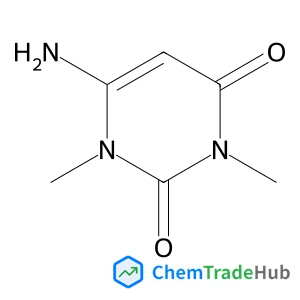
6-amino-1,3-dimethyl-1,2,3,4-tetrahydropyrimidine-2,4-dione
CAS Number:
6642-31-5
Molecular Formula:
C6H9N3O2
![1,1',1'',1'''-[Disulfanediylbis(carbonothioylnitrilo)]tetraethane structure](https://static.chemtradehub.com/structs/97-/97-77-8-f3e4.webp "1,1',1'',1'''-[Disulfanediylbis(carbonothioylnitrilo)]tetraethane structure")
1,1',1'',1'''-[Disulfanediylbis(carbonothioylnitrilo)]tetraethane
CAS Number:
97-77-8
Molecular Formula:
C10H20N2S4
Recommended Suppliers






Disclaimer
This page provides academic journal information for reference and research purposes only. We are not affiliated with any journal publishers and do not handle publication submissions. For publication-related inquiries, please contact the respective journal publishers directly.
If you notice any inaccuracies in the information displayed, please contact us at support@chemtradehub.com. We will promptly review and address your concerns.