












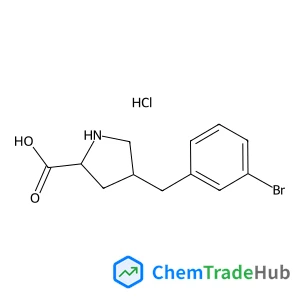
(2S,4R)-4-(3-Bromobenzyl)pyrrolidine-2-carboxylic acid hydrochloride
CAS Number:
1049734-10-2
Molecular Formula:
C12H15BrClNO2
Chuan-Jun Lu, Xin Yu, Dong-Kai Chen, Hong Wang, Qing-Bao Song, Jian-Rong Gao
A method for the allylic alkylation of aminophenol with alkynes was developed using a palladium-catalysed allylation reaction with 100% atom economy. A series of structurally diverse N-allylic substituted allylamines were synthesized in good yields with high chemo-, regio-, and stereoselectivities under mild conditions.
Hans-Gert Korth, Peter Mulder, Thomas Paul
DOI: 10.1039/C6CP04187F
V. K. Sharma, E. Mamontov, M. Ohl
DOI: 10.1039/C6CP06202D
D. Houdoux, J. Houplin, L. Amiaud, A. Lafosse, C. Dablemont
DOI: 10.1039/C6CP03328H
A. V. Gorbunov, X. Meng, I. Urbanaviciute, T. Putzeys, M. Wübbenhorst, R. P. Sijbesma
DOI: 10.1039/C6CP08015D
Dongxia Ma, Congjie Zhang, Zhe-Ning Chen, Xin Xu
DOI: 10.1039/C6CP06215F
Hyung Cheoul Shim, Donghan Kim, Dongwook Shin, Seungmin Hyun, Chang-Su Woo, Taehwan Yu, Jae-Pyoung Ahn
DOI: 10.1039/C6CP07574F
Facundo C. Herrera, Martín Mizrahi, Cristina Navío, Ramón Bernardo-Gavito, Daniel Granados, Félix G. Requejo
DOI: 10.1039/C6CP06982G
K. Ragavendran, H. Xia, P. Mandal, A. K. Arof
DOI: 10.1039/C6CP07289E
Daniel Bellinger, Christoph Brüning, Volker Engel, Bernd Engels
DOI: 10.1039/C6CP07673D
DOI: 10.1039/C6CP06735B
2-(2-Chloroacetamido)-3-phenylpropanoic acid (CAS: 7765-11-9) is generally consi...
2-(Benzyloxy)-5-bromobenzoic acid can be handled safely if appropriate precautio...
(4-Methyl-1,2,5-oxadiazol-3-yl)methanamine hydrochloride is a chemical compound ...
2-(5-Hexylthiophen-2-yl)-4,4,5,5-tetramethyl-1,3,2-dioxaborolane (CAS: 917985-54...
While 4-(8-Methyl-9H-1,3-dioxolo[4,5-h][2,3]benzodiazepin-5-yl)benzenamine (CAS:...
The market for tert-butyl 3-hydroxy-4,5,7,8-tetrahydro-2H-pyrazolo[3,4-d]azepine...
Waste containing 3,5-Diamino-1H-pyrazole-4-carbonitrile (CAS: 6844-58-2) should ...
(6-Fluoro-3-pyridinyl)boronic acid can be synthesized through the reaction of 6-...
Dibenzyl carbonimidoylbiscarbamate (CAS: 10065-79-9) finds applications in vario...
The market for (beta,beta,2,3,4,5,6-~2~H_7_)Phenylalanine (CAS: 74228-83-4) is g...

Organic & Biomolecular Chemistry (OBC) publishes original and high impact research and reviews in organic chemistry. We welcome research that shows new or significantly improved protocols or methodologies in total synthesis, synthetic methodology or physical and theoretical organic chemistry as well as research that shows a significant advance in the organic chemistry or molecular design aspects of chemical biology, catalysis, supramolecular and macromolecular chemistry, theoretical chemistry, mechanism-oriented physical organic chemistry, medicinal chemistry or natural products. Articles published in the journal should report new work which makes a highly-significant impact in the field. Routine and incremental work is generally not suitable for publication in the journal. More details about key areas of our scope are below. In all cases authors should include in their article clear rationale for why their research has been carried out.
![Ethyl ({[(2-methyl-2-propanyl)oxy]carbonyl}amino)(2-pyridinyl)acetate structure](https://static.chemtradehub.com/structs/313/313490-90-3-dd15.webp "Ethyl ({[(2-methyl-2-propanyl)oxy]carbonyl}amino)(2-pyridinyl)acetate structure")




