













DNAzyme-based biosensor as a rapid and accurate verification tool to complement simultaneous enzyme-based media for E. coli detection
Literature Information
Publication Date
2019-10-22
DOI
10.1039/C9EW00795D
Impact Factor
4.251
Authors
Noor Zaouri, Zhengfang Cui, Ana Sol Peinetti, Yi Lu, Pei-Ying Hong
View Original
Abstract
Simultaneous enzyme-based media can be used to identify both coliforms and E. coli faster than lactose-based fermentation protocols. However, these media can be prone to false-positive results and would require verification tests to confirm the presence of E. coli. These verification tests (e.g. indole or oxidase tests) work based on identifying specific phenotypic traits in bacteria, and hence are also prone to inaccuracies. This study aimed to achieve rapid verification test of E. coli using DNAzyme-based biosensor. The biosensor was first tested for four E. coli strains against more than 90 non-E. coli strains routinely causing false positive results and showed high specificity towards E. coli strains. The biosensor was then determined for its detection sensitivity. It was observed that a single E. coli colony would generate a robust fluorescence signal after 2 h of sub-culturing. With this short incubation time, non-E. coli strains were unable to generate any apparent fluorescence signal, hence further improving the detection specificity of biosensor. Lastly, we further demonstrate that the biosensor can be applied to different commercial brands of simultaneous enzyme-based agar to consistently identify the presence of E. coli. The biosensor was able to rapidly denote presence of discrete E. coli colonies by binding on to protein targets possibly of DNA replication or motility functions that were predominantly specific to E. coli.
Recommended Journals
Related Literature
Solvation structure of lanthanide(iii) bistriflimide salts in acetonitrile solution: a molecular dynamics simulation and EXAFS investigation
Valentina Migliorati, Adriano Filipponi, Francesco Sessa, Alessandra Serva, Paola D'Angelo
2019-05-28
Paper
DOI: 10.1039/C9CP01417A
On-surface synthesis of 2D COFs on Cu(111) via the formation of thermodynamically stable organometallic networks as the template
Cheng-Xin Wang, Jian-Le Chen, Chen-Hui Shu, Ke-Ji Shi, Pei-Nian Liu
2019-05-31
Paper
DOI: 10.1039/C9CP01843C
Atomic-level crystallization in selective laser melting fabricated Zr-based metallic glasses
Yue Zhang, Haishun Liu, Jinyong Mo, Mingzi Wang, Zhe Chen, Yezeng He, Chunguang Tang
2019-05-15
Paper
DOI: 10.1039/C9CP02181G
The performance of adsorption, dissociation and diffusion mechanism of hydrogen on the Ti-doped ZrCo(110) surface
Qingqing Wang, Xianggang Kong, Huilei Han, Ge Sang, Guanghui Zhang, Tao Gao
2019-05-15
Paper
DOI: 10.1039/C9CP02491C
Strategies for the analysis of the elemental metal fraction of Ir and Ru oxides via XRD, XANES, and EXAFS
Anita Hamar Reksten, Andrea E. Russell, Peter W. Richardson, Stephen J. Thompson, Karina Mathisen, Frode Seland, Svein Sunde
2019-05-25
Paper
DOI: 10.1039/C9CP01758E
Oxygen transport and surface exchange mechanisms in LSCrF–ScCeSZ dual-phase ceramics
Zonghao Shen, Stephen J. Skinner, John A. Kilner
2019-05-24
Paper
DOI: 10.1039/C9CP02175B
Infrared multiple photon dissociation action spectroscopy of protonated glycine, histidine, lysine, and arginine complexed with 18-crown-6 ether
Christopher P. McNary, Y.-W. Nei, Philippe Maitre, M. T. Rodgers, P. B. Armentrout
2019-05-20
Paper
DOI: 10.1039/C9CP02265A
X-ray radiation-induced amorphization of metal–organic frameworks
Remo N. Widmer, Giulio I. Lampronti, Nicola Casati, Stefan Farsang, Thomas D. Bennett, Simon A. T. Redfern
2019-05-29
Paper
DOI: 10.1039/C9CP01463B
A time-resolved photoelectron imaging study on isolated tolane: observation of the biradicalic 1Au state
Marco Flock, Lea Bosse, Dustin Kaiser, Bernd Engels, Ingo Fischer
2019-06-03
Paper
DOI: 10.1039/C9CP02222H
Comparative study of the crowding-induced collapse effect in hard-sphere, flexible polymer and rod-like polymer systems
Anpu Chen, Nanrong Zhao
2019-05-16
Paper
DOI: 10.1039/C9CP01731C
You might also like
Compound Q&A
What are the main uses of 1H-Indazole-6-carbonitrile (CAS: 141290-59-7)?
1H-Indazole-6-carbonitrile finds applications in pharmaceuticals, where it serve...
141290-59-71H-Indazole-6-carbon...
Compound Q&A
How should waste containing Dioctyl (2E)-2-butenedioate (CAS: 2997-85-5) be handled?
Waste containing Dioctyl (2E)-2-butenedioate (CAS: 2997-85-5) should be collecte...
2997-85-5Dioctyl (2E)-2-buten...
Compound Q&A
What industries use Sodium [(1,2-benzoxazol-3-ylmethyl)sulfonyl]azanide (CAS: 68291-98-5)?
Sodium [(1,2-benzoxazol-3-ylmethyl)sulfonyl]azanide is primarily used in pharmac...
68291-98-5Sodium [(1,2-benzoxa...
Compound Q&A
Are there alternatives to Dimethyl 4-(4,4,5,5-tetramethyl-1,3,2-dioxaborolan-2-yl)-2,6-pyridinedicarboxylate (CAS: 741709-66-0) in synthesis?
Dimethyl 4-(4,4,5,5-tetramethyl-1,3,2-dioxaborolan-2-yl)-2,6-pyridinedicarboxyla...
741709-66-0Dimethyl 4-(4,4,5,5-...
Compound Q&A
How should waste containing 2-Fluoro-6-hydrazinopyridine (CAS: 80714-39-2) be handled?
Waste containing 2-Fluoro-6-hydrazinopyridine (CAS: 80714-39-2) should be manage...
80714-39-22-Fluoro-6-hydrazino...
Compound Q&A
What is 6-Formyl-2-pyridinecarboxylic acid (CAS: 499214-11-8)?
6-Formyl-2-pyridinecarboxylic acid is an organic compound with the molecular for...
499214-11-86-Formyl-2-pyridinec...
Compound Q&A
What is the market or research trend for 3-(3,4-dimethoxyphenyl)-2,5-dimethyl-N-(2-morpholin-4-ylethyl)pyrazolo[1,5-a]pyrimidin-7-amine (CAS: 900874-91-1)?
Research trends for this compound indicate a focus on its potential applications...
900874-91-13-(3,4-dimethoxyphen...
Compound Q&A
How is 9H-Tribenzo[b,d,f]azepine (CAS: 29875-73-8) typically synthesized?
9H-Tribenzo[b,d,f]azepine is typically synthesized via a multi-step process invo...
29875-73-89H-Tribenzo[b,d,f]az...
Compound Q&A
How is 1-Cyclopropyl-7-ethoxy-6-fluoro-8-methoxy-4-oxo-1,4-dihydro-3-quinolinecarboxylic acid (CAS: 1797982-51-4) typically synthesized?
1-Cyclopropyl-7-ethoxy-6-fluoro-8-methoxy-4-oxo-1,4-dihydro-3-quinolinecarboxyli...
1797982-51-41-Cyclopropyl-7-etho...
Compound Q&A
How should waste containing Methyl 3-oxo-1,2,3,4-tetrahydro-6-quinoxalinecarboxylate (CAS: 671820-52-3) be handled?
Waste containing Methyl 3-oxo-1,2,3,4-tetrahydro-6-quinoxalinecarboxylate (CAS: ...
671820-52-3Methyl 3-oxo-1,2,3,4...
Source Journal
Environmental Science: Water Research & Technology

CiteScore:
0
Self-citation Rate:
0%
Articles per Year:
0
Recommended Compounds



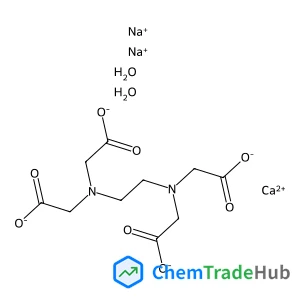
EthylenediaminetetraaceticacidcalciumDisodiumsalthydrate
CAS Number:
23411-34-9
Molecular Formula:
C10H16CaN2Na2O10
Recommended Suppliers





Disclaimer
This page provides academic journal information for reference and research purposes only. We are not affiliated with any journal publishers and do not handle publication submissions. For publication-related inquiries, please contact the respective journal publishers directly.
If you notice any inaccuracies in the information displayed, please contact us at support@chemtradehub.com. We will promptly review and address your concerns.