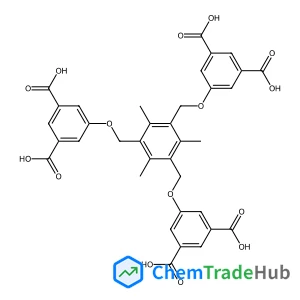
5,5',5''-(((2,4,6-Trimethylbenzene-1,3,5-triyl)tris(methylene))tris(oxy))triisophthalic acid
CAS Number:
1159974-70-5
Molecular Formula:
C36H30O15
Pavan Kumar Behara, Michel Dupuis
We describe a new computer implementation of electron transfer (ET) theory in extended systems treated by periodic density functional theory (DFT), including the calculation of the electronic coupling transition element VAB. In particular, the development opens up the full characterization of electron transfer in the solid state. The approach is valid for any single-determinant wavefunction with localized character representing the electronic structure of the system, from Hartree–Fock (HF) theory, to density functional theory (DFT), hybrid DFT theory, DFT+U theory, and constrained DFT (cDFT) theory. The implementation in CP2K reuses the high-performance functions of the code. The computational cost is equivalent to only one iteration of an HF calculation. We present test calculations for electron transfer in a number of systems, including a 1D-model of ferric oxide, hematite Fe2O3, rutile TiO2, and finally bismuth vanadate BiVO4.

Environmental Toxicology and Pharmacology

Molecular Diversity

Journal of Medical Biochemistry

Mini-Reviews in Medicinal Chemistry

Current Pharmaceutical Biotechnology

Nature Reviews Drug Discovery

Photochemical & Photobiological Sciences

Journal of Enzyme inhibition and Medicinal Chemistry

Molecules

Physical Chemistry Chemical Physics
C. E. Ekuma, T. C. Chibueze, L. A. Fomin, I. V. Malikov, L. Zadeng, D. P. Rai
DOI: 10.1039/D1CP00418B
Federico Raffone, Filippo Savazzi, Giancarlo Cicero
DOI: 10.1039/D1CP00134E
YongChao Wang, YinBo Zhu, HengAn Wu
DOI: 10.1039/D1CP00617G
Kristina M. Herman, Joseph P. Heindel
DOI: 10.1039/D1CP00409C
Xia Xu, Jianxiong Dai, Xing Guo, Cheng Qian, Pei Zhang, Yixiang Duan, Yonghui Tian
DOI: 10.1039/D1CP00903F
Marie-Christine Record, Pascal Boulet
DOI: 10.1039/D1CP00270H
Y. Belkhodja, J. Loreau, A. van der Avoird, Y. Berger, P. Asselin
DOI: 10.1039/D1CP00316J
DOI: 10.1039/D0CP06002J
Mengyang Li, Yaoxiao Zhao, Zhibin Gao, Kun Yuan, Xiang Zhao
DOI: 10.1039/D1CP01307F
Waste containing N-Methoxy-N-methyl-1,3-thiazole-5-carboxamide (CAS: 898825-89-3...
N-(4-Biphenylyl)dibenzo[b,d]furan-4-amine should be stored in a tightly sealed c...
The market for 3-Acetamido-5-amino-2,4,6-triiodobenzoic acid (CAS: 1713-07-1) is...
Benzyl 2-O-acetyl-3,4,6-tri-O-benzyl-beta-D-galactopyranoside (CAS: 61820-03-9) ...
2-Ethylpiperazine dihydrochloride (CAS: 438050-52-3) is regulated under the Glob...
1,1'-[1,3-Phenylenebis(methylene)]bis(3-methyl-1H-pyrrole-2,5-dione) (CAS: 11946...
Several alternatives can be used in the synthesis of 5-Fluoro-2-(1-pyrrolidinyl)...
Proper personal protective equipment (PPE) must be worn when handling this compo...
When handling 6-Bromoimidazo[1,2-a]pyridin-8-amine, it is important to wear appr...
Alternatives to (2S,4R)-4-(4-Nitrobenzyl)pyrrolidine-2-carboxylic acid hydrochlo...
Physical Chemistry Chemical Physics (PCCP) is an international journal co-owned by 19 physical chemistry and physics societies from around the world. This journal publishes original, cutting-edge research in physical chemistry, chemical physics and biophysical chemistry. To be suitable for publication in PCCP, articles must include significant innovation and/or insight into physical chemistry; this is the most important criterion that reviewers and Editors will judge against when evaluating submissions. The journal has a broad scope and welcomes contributions spanning experiment, theory, computation and data science. Topical coverage includes spectroscopy, dynamics, kinetics, statistical mechanics, thermodynamics, electrochemistry, catalysis, surface science, quantum mechanics, quantum computing and machine learning. Interdisciplinary research areas such as polymers and soft matter, materials, nanoscience, energy, surfaces/interfaces, and biophysical chemistry are welcomed if they demonstrate significant innovation and/or insight into physical chemistry. Joined experimental/theoretical studies are particularly appreciated when complementary and based on up-to-date approaches.
![2-Methyl-2-propanyl {3-[4-(4,4,5,5-tetramethyl-1,3,2-dioxaborolan-2-yl)phenyl]-3-oxetanyl}carbamate structure](https://static.chemtradehub.com/structs/127/1279090-25-3-1b84.webp "2-Methyl-2-propanyl {3-[4-(4,4,5,5-tetramethyl-1,3,2-dioxaborolan-2-yl)phenyl]-3-oxetanyl}carbamate structure")
![2-(7,7-Difluorobicyclo[4.1.0]hept-1-yl)ethanamine structure](https://static.chemtradehub.com/structs/209/2098065-08-6-ff24.webp "2-(7,7-Difluorobicyclo[4.1.0]hept-1-yl)ethanamine structure")