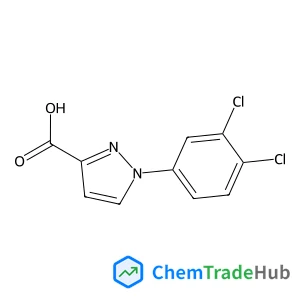
1-(3,4-Dichlorophenyl)-1H-pyrazole-3-carboxylic acid
CAS Number:
1152949-12-6
Molecular Formula:
C10H6Cl2N2O2
Herein, to get rid of aggregation-caused quenching (ACQ) in the solid phase, which is generally observed in π-conjugated planar molecules, a new chiral nonconjugated molecule with the propeller-shaped blue emitter property was prepared and characterized, and its photoluminescence behavior in the solid and solution phases were investigated through single crystal X-ray crystallography and photophysical studies. To further understand the aggregation-induced enhanced emission process (AIEE), concentration effect and solvent effect on the fluorescence properties of the solution phase and fluorescence quantum yield measurements in the solid and solution states were performed. In addition, thermal gravimetric analysis (TGA), cyclic voltammogram measurements (CV) and theoretical analysis of the molecule were carried out. According to the results of the experimental work done, the molecule showed aggregation-induced enhanced blue emission (AIEE) in the crystal state, which arose from the strong J-type π⋯π stacking interactions between the adjacent rings of the molecules, and the restricted intramolecular rotation process (RIR). The solvent polarity-dependent emission also verified the AIEE process. Therefore, combining the advantages of nonconjugation and chirality properties in the synthesis of the molecule afforded a new, unusual AIEE material and provided a new way for the design of a nonconjugated chiral fluorescent optoelectronic material.
DOI: 10.1039/C5CP02595H
Max Schütz, Sebastian Schlücker
DOI: 10.1039/C5CP03189C
Chandan Sahu, Deepanwita Ghosh, Kaushik Sen, Abhijit K. Das
DOI: 10.1039/C5CP02442K
Yang You, Chuan-Lu Yang, Qing-Qing Zhang, Mei-Shan Wang, Xiao-Guang Ma, Wen-Wang Liu
DOI: 10.1039/C6CP01618A
Biao Liu, Li-Juan Wu, Yu-Qing Zhao, Lin-Zhi Wang
DOI: 10.1039/C6CP03903K
J. M. Bermúdez-García, J. M. Vicent-Luna, S. Yáñez-Vilar, S. Hamad, M. Sánchez-Andújar, S. Castro-García, S. Calero, M. A. Señarís-Rodríguez
DOI: 10.1039/C6CP02477G
Mitsunori Kitta, Riki Kataoka, Masanori Kohyama
DOI: 10.1039/C6CP03379B
Marius Kadek, Lukas Konecny, Bin Gao, Michal Repisky, Kenneth Ruud
DOI: 10.1039/C5CP03712C
Yongjin Lee, Alexander J. Pak, Gyeong S. Hwang
DOI: 10.1039/C6CP04388G
Waste containing N-Methoxy-N-methyl-1,3-thiazole-5-carboxamide (CAS: 898825-89-3...
N-(4-Biphenylyl)dibenzo[b,d]furan-4-amine should be stored in a tightly sealed c...
The market for 3-Acetamido-5-amino-2,4,6-triiodobenzoic acid (CAS: 1713-07-1) is...
Benzyl 2-O-acetyl-3,4,6-tri-O-benzyl-beta-D-galactopyranoside (CAS: 61820-03-9) ...
2-Ethylpiperazine dihydrochloride (CAS: 438050-52-3) is regulated under the Glob...
1,1'-[1,3-Phenylenebis(methylene)]bis(3-methyl-1H-pyrrole-2,5-dione) (CAS: 11946...
Several alternatives can be used in the synthesis of 5-Fluoro-2-(1-pyrrolidinyl)...
Proper personal protective equipment (PPE) must be worn when handling this compo...
When handling 6-Bromoimidazo[1,2-a]pyridin-8-amine, it is important to wear appr...
Alternatives to (2S,4R)-4-(4-Nitrobenzyl)pyrrolidine-2-carboxylic acid hydrochlo...

Physical Chemistry Chemical Physics (PCCP) is an international journal co-owned by 19 physical chemistry and physics societies from around the world. This journal publishes original, cutting-edge research in physical chemistry, chemical physics and biophysical chemistry. To be suitable for publication in PCCP, articles must include significant innovation and/or insight into physical chemistry; this is the most important criterion that reviewers and Editors will judge against when evaluating submissions. The journal has a broad scope and welcomes contributions spanning experiment, theory, computation and data science. Topical coverage includes spectroscopy, dynamics, kinetics, statistical mechanics, thermodynamics, electrochemistry, catalysis, surface science, quantum mechanics, quantum computing and machine learning. Interdisciplinary research areas such as polymers and soft matter, materials, nanoscience, energy, surfaces/interfaces, and biophysical chemistry are welcomed if they demonstrate significant innovation and/or insight into physical chemistry. Joined experimental/theoretical studies are particularly appreciated when complementary and based on up-to-date approaches.
![2-Methyl-2-propanyl {3-[4-(4,4,5,5-tetramethyl-1,3,2-dioxaborolan-2-yl)phenyl]-3-oxetanyl}carbamate structure](https://static.chemtradehub.com/structs/127/1279090-25-3-1b84.webp "2-Methyl-2-propanyl {3-[4-(4,4,5,5-tetramethyl-1,3,2-dioxaborolan-2-yl)phenyl]-3-oxetanyl}carbamate structure")