












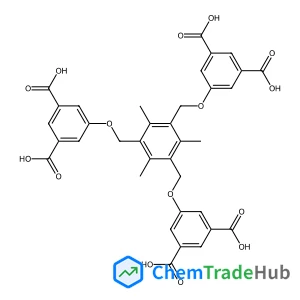
5,5',5''-(((2,4,6-Trimethylbenzene-1,3,5-triyl)tris(methylene))tris(oxy))triisophthalic acid
CAS Number:
1159974-70-5
Molecular Formula:
C36H30O15
YongChao Wang, YinBo Zhu, HengAn Wu
Disordered graphene networks (DGNs) can be regarded as the three-dimensional (3D) assembly of graphene-like fragments at the nanoscale, in which some intrinsic topological features are usually hidden in these formless fragments without clear understanding. Although some high-resolution structural patterns have been observed in pyrolytic carbons and flash graphene experimentally, it is still hard to characterize the topology and texture of DGNs considering continuous 3D connectivity. Toward this end, starting from the annealing process, we herein performed molecular dynamics simulations to investigate the formation and topological structure of DGNs. Three typical stages are found during the formation of DGNs, that is, the formation of polyaromatic fragments, formation of a disordered framework, and further graphitization. The topology of the obtained DGNs was then investigated, including topological defects, stacking behavior, and global curvature. Several typical in-plane and out-of-plane topological defects are found to connect the 3D network of graphene-like layers. The computed X-ray diffraction and angular defects demonstrate that a high-density DGN tends to form a randomly stacked structure with more connections, while a low-density DGN exhibits more bowl-shaped layers and a less distorted curvature. At low annealing temperatures, the local curvature of DGNs is highly distorted, and the structure seems to lack graphitization compared to high-temperature ones.
Florian Thöle, Liwen F. Wan, David Prendergast
DOI: 10.1039/C5CP03046C
Xiaoyong Luo, Yi Gu
DOI: 10.1039/C5CP90128F
Carsten Hennig, Stefan Schmatz
DOI: 10.1039/C6CP02799G
Hongbo Gu, Jiang Guo, Mojammel Alam Khan, David P. Young, T. D. Shen, Suying Wei, Zhanhu Guo
DOI: 10.1039/C6CP02694J
DOI: 10.1039/C5CP02689J
Wenwen Cui, Alfonso San-Miguel
DOI: 10.1039/C6CP03263J
Myeongjin Kim, Jaeho Choi, Ilgeun Oh, Jooheon Kim
DOI: 10.1039/C6CP03064E
Anu Tresa Sunny, Poornima Vijayan P., Rameshwar Adhikari
DOI: 10.1039/C6CP02361D
Waste containing N-Methoxy-N-methyl-1,3-thiazole-5-carboxamide (CAS: 898825-89-3...
N-(4-Biphenylyl)dibenzo[b,d]furan-4-amine should be stored in a tightly sealed c...
The market for 3-Acetamido-5-amino-2,4,6-triiodobenzoic acid (CAS: 1713-07-1) is...
Benzyl 2-O-acetyl-3,4,6-tri-O-benzyl-beta-D-galactopyranoside (CAS: 61820-03-9) ...
2-Ethylpiperazine dihydrochloride (CAS: 438050-52-3) is regulated under the Glob...
1,1'-[1,3-Phenylenebis(methylene)]bis(3-methyl-1H-pyrrole-2,5-dione) (CAS: 11946...
Several alternatives can be used in the synthesis of 5-Fluoro-2-(1-pyrrolidinyl)...
Proper personal protective equipment (PPE) must be worn when handling this compo...
When handling 6-Bromoimidazo[1,2-a]pyridin-8-amine, it is important to wear appr...
Alternatives to (2S,4R)-4-(4-Nitrobenzyl)pyrrolidine-2-carboxylic acid hydrochlo...

Physical Chemistry Chemical Physics (PCCP) is an international journal co-owned by 19 physical chemistry and physics societies from around the world. This journal publishes original, cutting-edge research in physical chemistry, chemical physics and biophysical chemistry. To be suitable for publication in PCCP, articles must include significant innovation and/or insight into physical chemistry; this is the most important criterion that reviewers and Editors will judge against when evaluating submissions. The journal has a broad scope and welcomes contributions spanning experiment, theory, computation and data science. Topical coverage includes spectroscopy, dynamics, kinetics, statistical mechanics, thermodynamics, electrochemistry, catalysis, surface science, quantum mechanics, quantum computing and machine learning. Interdisciplinary research areas such as polymers and soft matter, materials, nanoscience, energy, surfaces/interfaces, and biophysical chemistry are welcomed if they demonstrate significant innovation and/or insight into physical chemistry. Joined experimental/theoretical studies are particularly appreciated when complementary and based on up-to-date approaches.

![4-Chloro-2-{[(2-chlorophenoxy)acetyl]amino}benzoic acid structure](https://static.chemtradehub.com/structs/351/351424-20-9-9467.webp "4-Chloro-2-{[(2-chlorophenoxy)acetyl]amino}benzoic acid structure")
![[5-fluoro-2-(morpholine-4-carbonyl)phenyl]boronic acid structure](https://static.chemtradehub.com/structs/121/1217501-26-2-505c.webp "[5-fluoro-2-(morpholine-4-carbonyl)phenyl]boronic acid structure")
![[(5-Methyl-1,3,4-thiadiazol-2-yl)sulfanyl]acetic acid structure](https://static.chemtradehub.com/structs/509/50918-26-8-4ce8.webp "[(5-Methyl-1,3,4-thiadiazol-2-yl)sulfanyl]acetic acid structure")




