












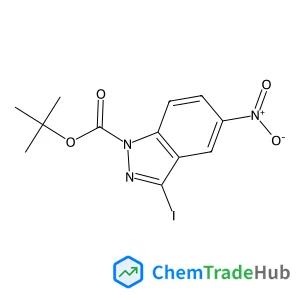
Tert-butyl 3-iodo-5-nitro-1H-indazole-1-carboxylate
CAS Number:
459133-69-8
Molecular Formula:
C12H12IN3O4
Ping-Ping Sun, Devesh R. Kripalani
Fe-Based bulk metallic glasses (BMGs) with a composition of Fe48Cr15Mo14C15B6Y2 have recently been reported with good application performance due to their excellent mechanical and chemical properties, showing excellent corrosion resistance, remarkable forming and processing ability, ultrahigh yield strength and large elasticity. Here, we report on a new functional application for such Fe-based BMGs, which can exhibit better catalytic performance than the pristine Fe surface. The hydrogen evolution and dissociation processes of one and two H2O molecules on both BMG and pristine Fe surfaces are investigated using first-principles calculations. The energy barriers of the dissociation processes on the BMG surface are lower than those on the pristine Fe surface. Moreover, the structural configurations along the dissociation path during hydrogen evolution show that it is easier for H2O molecules to dissociate into H2 on the surface of the BMG, rendering it a more active catalyst than the pristine Fe surface. Analyses on the electronic structures show further evidence that the BMG surface has a stronger ability to facilitate charge transfer at the interface and is more inclined to accept transferred charges, thereby promoting its catalytic activity. These findings shed light on understanding the functional applications of BMGs and are anticipated to be highly meaningful for further experimental investigations.
Scott T. Iacono, Ashwani Vij, Wade Grabow, Dennis W. Smith, Jr., Joseph M. Mabry
DOI: 10.1039/B712976A
Wei Jiang, Qingquan Fu, Hongyou Fan, Wei Wang
DOI: 10.1039/B712377A
Yalin Hao, Konstantin Hadjiivanov, Bruce C. Gates, Helmut Knözinger
DOI: 10.1039/B713106B
Scott J. Dalgarno, Jian Tian, John E. Warren, Thomas E. Clark, Mohamed Makha, Colin L. Raston, Jerry L. Atwood
DOI: 10.1039/B712621B
Tomoo Mizugaki, Makoto Murata, Sayaka Fukubayashi, Takato Mitsudome, Koichiro Jitsukawa
DOI: 10.1039/B710860E
Motoki Toganoh, Tomoyuki Kimura, Hiroyuki Furuta
DOI: 10.1039/B713845H
LiNa Loo, Richard H. Guenther, Steven A. Lommel, Stefan Franzen
DOI: 10.1039/B714748A
Sheng-Run Zheng, Qing-Yuan Yang, Yong-Ru Liu, Jian-Yong Zhang, Ye-Xiang Tong, Cun-Yuan Zhao
DOI: 10.1039/B711457E
Elaine A. Medlycott, Garry S. Hanan
DOI: 10.1039/B711765E
Guohua Liu, Mei Yao, Fang Zhang, Yan Gao, Hexing Li
DOI: 10.1039/B714575F
When handling 4-Methyl-6-(trifluoromethyl)quinoline (CAS: 40716-16-3), safety go...
4-(3,5-Difluorophenyl)aniline is an aromatic organic compound with the CAS numbe...
5-{[4-(Trifluoromethyl)phenyl]sulfanyl}-1,2,3-thiadiazole-4-carboxylic acid can ...
The market for 4-Benzylaniline hydrochloride (CAS: 6317-57-3) is steadily growin...
[3-(Diethylsulfamoyl)phenyl]boronic acid is generally considered safe when handl...
3-Bromo-2,5-dimethoxyaniline is mainly used in the pharmaceutical and chemical i...
N-Methyl-1-(5-methyl-1H-indol-3-yl)methanamine (CAS: 915922-67-7) is subject to ...
This compound is primarily used in the pharmaceutical industry for the synthesis...
2-Methyl-2-propanyl [(1S,3R)-3-aminocyclohexyl]carbamate (CAS: 1298101-47-9) sho...
Ethyl 2-bromo-4,4,4-trifluorobutanoate (CAS: 367-33-9) is utilized in the pharma...

Physical Chemistry Chemical Physics (PCCP) is an international journal co-owned by 19 physical chemistry and physics societies from around the world. This journal publishes original, cutting-edge research in physical chemistry, chemical physics and biophysical chemistry. To be suitable for publication in PCCP, articles must include significant innovation and/or insight into physical chemistry; this is the most important criterion that reviewers and Editors will judge against when evaluating submissions. The journal has a broad scope and welcomes contributions spanning experiment, theory, computation and data science. Topical coverage includes spectroscopy, dynamics, kinetics, statistical mechanics, thermodynamics, electrochemistry, catalysis, surface science, quantum mechanics, quantum computing and machine learning. Interdisciplinary research areas such as polymers and soft matter, materials, nanoscience, energy, surfaces/interfaces, and biophysical chemistry are welcomed if they demonstrate significant innovation and/or insight into physical chemistry. Joined experimental/theoretical studies are particularly appreciated when complementary and based on up-to-date approaches.
![6,7-Dihydro-5H-pyrrolo[1,2-a]imidazole-6-carboxylic acid structure](https://static.chemtradehub.com/structs/136/1369160-12-2-6524.webp "6,7-Dihydro-5H-pyrrolo[1,2-a]imidazole-6-carboxylic acid structure")
![N-{3-[Benzyl(methyl)amino]propyl}-9-chloro-5,6,7,8-tetrahydro-2-acridinecarboxamide structure](https://static.chemtradehub.com/structs/142/1426944-49-1-1e4c.webp "N-{3-[Benzyl(methyl)amino]propyl}-9-chloro-5,6,7,8-tetrahydro-2-acridinecarboxamide structure")






