












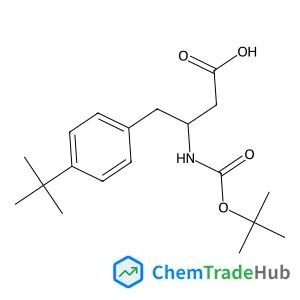
(S)-3-((tert-Butoxycarbonyl)amino)-4-(4-(tert-butyl)phenyl)butanoic acid
CAS Number:
403661-85-8
Molecular Formula:
C19H29NO4
Elaine A. Medlycott, Garry S. Hanan
A dicopper(I) double helicate oxidizes and rapidly reorganises to form a stable pentadentate dicopper(II) double helicate due to the proximity of pendant pyridyl rings as studied by electrochemical and structural analyses.
Fendy Chen, Di Liu, Jie Zhang, P. Hu, Xue-Qing Gong, Guanzhong Lu
DOI: 10.1039/C2CP41281K
DOI: 10.1039/C2CP41820G
Katharina Chevalier, Matthias M. N. Wolf, Andreas Funk, Marko Andres, Markus Gerhards, Rolf Diller
DOI: 10.1039/C2CP41077J
Ross Anderson, Martin Fowles, Tim Hyde, Richard Smith, Sergey Nikitenko, Wim Bras
DOI: 10.1039/C2CP43307A
Xinxin Zhang, Yanchao Wang, Yanming Ma
DOI: 10.1039/C2CP42734F
Venubabu Kotikam, Moneesha Fernandes, Vaijayanti Anil Kumar
DOI: 10.1039/C2CP42770B
Timm Bredtmann, Beate Paulus
DOI: 10.1039/C2CP42494K
Emna El Hammi, Chantal Houée-Lévin, Jan Řezáč, Bernard Lévy, Isabelle Demachy, Laura Baciou, Aurélien de la Lande
DOI: 10.1039/C2CP41261F
Fanbin Meng, Wei Yan, Dunyou Wang
DOI: 10.1039/C2CP41917C
Antonio Bauzá, David Quiñonero, Pere M. Deyà, Antonio Frontera
DOI: 10.1039/C2CP42672B
When handling 4-Methyl-6-(trifluoromethyl)quinoline (CAS: 40716-16-3), safety go...
4-(3,5-Difluorophenyl)aniline is an aromatic organic compound with the CAS numbe...
5-{[4-(Trifluoromethyl)phenyl]sulfanyl}-1,2,3-thiadiazole-4-carboxylic acid can ...
The market for 4-Benzylaniline hydrochloride (CAS: 6317-57-3) is steadily growin...
[3-(Diethylsulfamoyl)phenyl]boronic acid is generally considered safe when handl...
3-Bromo-2,5-dimethoxyaniline is mainly used in the pharmaceutical and chemical i...
N-Methyl-1-(5-methyl-1H-indol-3-yl)methanamine (CAS: 915922-67-7) is subject to ...
This compound is primarily used in the pharmaceutical industry for the synthesis...
2-Methyl-2-propanyl [(1S,3R)-3-aminocyclohexyl]carbamate (CAS: 1298101-47-9) sho...
Ethyl 2-bromo-4,4,4-trifluorobutanoate (CAS: 367-33-9) is utilized in the pharma...

ChemComm publishes urgent research which is of outstanding significance and interest to experts in the field, while also appealing to the journal’s broad chemistry readership. Our communication format is ideally suited to short, urgent studies that are of such importance that they require accelerated publication. Our scope covers all topics in chemistry, and research at the interface of chemistry and other disciplines (such as materials science, nanoscience, physics, engineering and biology) where there is a significant novelty in the chemistry aspects. Major topic areas covered include: Analytical Chemistry Catalysis Chemical Biology and medicinal chemistry Computational Chemistry and Machine Learning Energy and sustainable chemistry Environmental Chemistry Green Chemistry Inorganic Chemistry Materials Chemistry Nanoscience Organic Chemistry Physical Chemistry Polymer Chemistry Supramolecular Chemistry
![N-{3-[Benzyl(methyl)amino]propyl}-9-chloro-5,6,7,8-tetrahydro-2-acridinecarboxamide structure](https://static.chemtradehub.com/structs/142/1426944-49-1-1e4c.webp "N-{3-[Benzyl(methyl)amino]propyl}-9-chloro-5,6,7,8-tetrahydro-2-acridinecarboxamide structure")




