


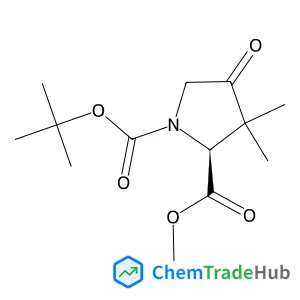
2-Methyl 1-(2-methyl-2-propanyl) (2S)-3,3-dimethyl-4-oxo-1,2-pyrrolidinedicarboxylate
CAS Number:
478698-30-5
Molecular Formula:
C13H21NO5
S. Oberli, J. González-Vázquez, E. Rodríguez-Perelló, M. Sodupe, A. Picón
The new capacity of X-ray free-electron laser (XFEL) facilities to produce multi-color X-ray femtosecond pulses paves the way to explore ultrafast phenomena in matter induced by X-ray photons. In the present study, we exploit the site-selectivity and the high temporal resolution of a two-color X-ray femtosecond pump–probe sequence to investigate the isomerization of formamide. The pump pulse excites a particular atomic site in the molecule, while the probe pulse captures changes in the chemical environment at a remote atomic site. The response of the system is found to strongly depend on the nature of the excited site, and the core excitation provides selective control over chemical bond breaking. In particular, we show that the N1s → π* transition can induce the isomerization reaction in formamide and demonstrate the possibility to observe in real time hydrogen migration by measuring the chemical shifts with the X-ray probe pulse. This work opens a unique prospect for X-ray-induced photochemistry at XFEL facilities.

Journal of Chemical Sciences

Medicinal Chemistry Research

Acta Metallurgica Sinica-English Letters

Colloid Journal

Critical Reviews in Solid State and Materials Sciences

Bioorganic & Medicinal Chemistry

Herald of the Russian Academy of Sciences

Biocatalysis and Biotransformation

Chinese Journal of Chemistry

Bioorganic & Medicinal Chemistry Letters
Siriporn Jiwpanich, Britto S. Sandanaraj, S. Thayumanavan
DOI: 10.1039/B815263B
Mark Bartholomä, John Valliant, Kevin P. Maresca, John Babich, Jon Zubieta
DOI: 10.1039/B814903H
Sang Ick Lee, Naoto Chatani
DOI: 10.1039/B812466C
KaKing Yan, Andrew V. Pawlikowski, Chris Ebert, Aaron D. Sadow
DOI: 10.1039/B818630H
Jing Huang, Guorui Li, Zhiguo Wu, Zhibin Song, Yangyang Zhou, Liang Shuai, Xiaocheng Weng, Xiang Zhou, Guangfu Yang
DOI: 10.1039/B819789J
Andrew Mills, Kate McDiarmid, Michael McFarlane, Pauline Grosshans
DOI: 10.1039/B900569B
Daeha Seo, Choong Il Yoo, Bong Hyun Chung, Im Sik Chung, Hyunjoon Song
DOI: 10.1039/B820220F
Bashir Hussain, Didier Savard, Tara J. Burchell, Wolfgang Wernsdorfer, Muralee Murugesu
DOI: 10.1039/B818295G
Samuel Tekobo, Eugene Pinkhassik
DOI: 10.1039/B817598E
(5-Sulfamoyl-3-pyridinyl)boronic acid is primarily used in chemical synthesis, p...
Benzyl 2-methyl-2-(methylsulfonyl)-4-pentenoate is typically synthesized via est...
When handling 8-Fluoroquinolin-6-ol (CAS: 209353-22-0), it is important to use p...
1,3-Dibromo-5-(2-methyl-2-propanyl)benzene (CAS: 129316-09-2) is a crystalline c...
Ethyl 7-chloro-4-oxo-1-(1,3-thiazol-2-yl)-1,4-dihydro-1,8-naphthyridine-3-carbox...
When handling Delta-7-Avenasterol (CAS: 23290-26-8), it is important to wear app...
Proper handling involves the use of personal protective equipment such as gloves...
When handling 2-Methyl-2-proanyl 4-[(2-aminophenyl)amino]-1-piperidinecarboxylat...
N-Methyl-4-chlorobenzylamine hydrochloride (CAS: 65542-24-7) is a organic compou...
[2-(Dodecyloxy)ethoxy]acetic acid (CAS: 27306-90-7) is generally considered safe...

Physical Chemistry Chemical Physics (PCCP) is an international journal co-owned by 19 physical chemistry and physics societies from around the world. This journal publishes original, cutting-edge research in physical chemistry, chemical physics and biophysical chemistry. To be suitable for publication in PCCP, articles must include significant innovation and/or insight into physical chemistry; this is the most important criterion that reviewers and Editors will judge against when evaluating submissions. The journal has a broad scope and welcomes contributions spanning experiment, theory, computation and data science. Topical coverage includes spectroscopy, dynamics, kinetics, statistical mechanics, thermodynamics, electrochemistry, catalysis, surface science, quantum mechanics, quantum computing and machine learning. Interdisciplinary research areas such as polymers and soft matter, materials, nanoscience, energy, surfaces/interfaces, and biophysical chemistry are welcomed if they demonstrate significant innovation and/or insight into physical chemistry. Joined experimental/theoretical studies are particularly appreciated when complementary and based on up-to-date approaches.
![[3-Fluoro-4-(1-pyrrolidinylcarbonyl)phenyl]boronic acid structure](https://static.chemtradehub.com/structs/874/874289-09-5-e3d4.webp "[3-Fluoro-4-(1-pyrrolidinylcarbonyl)phenyl]boronic acid structure")
![4,10-Dihydroxy-3H-pyrano[3,4,5-kl]xanthen-3-one structure](https://static.chemtradehub.com/structs/125/1259330-61-4-de48.webp "4,10-Dihydroxy-3H-pyrano[3,4,5-kl]xanthen-3-one structure")







