












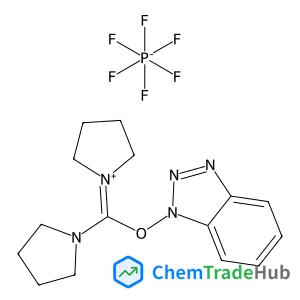
(1H-Benzotriazol-1-yloxy)(di-1-pyrrolidinyl)methylium hexafluorophosphate
CAS Number:
105379-24-6
Molecular Formula:
C15H21F6N5OP
Andreas Erbs Hillers-Bendtsen, Kurt V. Mikkelsen
In this study, we investigate the influence of gold nanoparticles on the nonlinear optical properties of the dihydroazulene/vinylheptafulvene photo- and thermochromic system. The influence is studied using a combined quantum mechanical/molecular mechanical approach wherein the molecules are treated with quantum mechanics. The nanoparticle is modelled using molecular mechanics where the gold atoms are represented by their polarizabilities. The quantum mechanical part of the system, namely the molecules, is described using density functional theory with the long-range corrected functional CAM-B3LYP and the correlation consistent basis set aug-cc-pDVZ. The results of the investigation show that the two photon absorptions of the molecules are indeed affected by the gold nanoparticle. The influence of the nanoparticle is especially large for the vinylheptafulvene molecule when decreasing the molecule–cluster distance. From the results, we observe that the interactions with the gold nanoparticle are very dependent on molecular conformation, relative molecular orientation, and distance between the molecule and the cluster. We conclude that the three studied molecules are affected differently by the nanoparticle, and we suggest that experiments are carried out to further investigate how these molecules coordinate to and interact with gold nanoparticles. This could present a new tool for controlling molecular properties. Furthermore, we see that the results of this study are in good agreement with earlier studies of other properties on the same system.
Stanley Udochukwu Ofoegbu, Tiago L. P. Galvão, José R. B. Gomes, João Tedim, Helena I. S. Nogueira, M. G. S. Ferreira
DOI: 10.1039/C7CP00241F
Masashi Hattori, Keigo Kamata
DOI: 10.1039/C6CP06864B
Kaiqi Wu, Wenfei Li, Lu Yu, Wei Tong, Yue Feng, Shenglong Ling, Longhua Zhang, Xiao Zheng, Maojun Yang
DOI: 10.1039/C6CP08107J
Florent Réal, Paweł Tecmer, André Severo Pereira Gomes, Örs Legeza, Paul W. Ayers, Valérie Vallet
DOI: 10.1039/C6CP05429C
R. Sasai, Y. Kato, W. Soontornchaiyakul, H. Usami, A. Masumori, W. Norimatsu
DOI: 10.1039/C6CP07250J
Han-Shi Hu, Nikolas Kaltsoyannis
DOI: 10.1039/C7CP00113D
Seung-Ik Jo, Young-In An, Kang-Yeong Kim, Seo-Yeong Choi, Jin-Su Kwak, Kyung-Ryul Oh, Young-Uk Kwon
DOI: 10.1039/C6CP07787K
M. Ziatdinov, H. Lim, S. Fujii, K. Kusakabe, M. Kiguchi, T. Enoki, Y. Kim
DOI: 10.1039/C6CP08352H
Vladimir I. Novoderezhkin, Elisabet Romero, Javier Prior, Rienk van Grondelle
DOI: 10.1039/C6CP07308E
G. W. Driver, Y. Huang, A. Laaksonen, T. Sparrman, Y.-L. Wang, P.-O. Westlund
DOI: 10.1039/C6CP05801A
When handling 4-(2-Furylmethyl)thiomorpholine 1,1-dioxide (CAS: 79206-94-3), it ...
When handling 4-Chloro-N-[2-(4-morpholinyl)ethyl]benzamide (CAS: 71320-77-9), it...
Waste containing this compound (CAS: 62921-74-8) should be handled according to ...
Waste containing (S)-Methyl 2-amino-3-cyclohexylpropanoate should be collected i...
This compound can be synthesized using a multi-step process involving the conjug...
There are several alternatives to (2E)-3-(3,4-Dichlorophenyl)acrylic acid in syn...
Ethyl 6-(2-nitrophenyl)imidazo[2,1-b][1,3]thiazole-3-carboxylate (CAS: 925437-84...
Waste containing 2-(1,3-Thiazol-2-yl)ethanamine (CAS: 18453-07-1) should be coll...
Methyl 5-iodo-2-methylbenzoate can be synthesized through the iodination of meth...
5-Chloro[1,2,4]triazolo[1,5-a]pyridine is commonly synthesized via the condensat...

Physical Chemistry Chemical Physics (PCCP) is an international journal co-owned by 19 physical chemistry and physics societies from around the world. This journal publishes original, cutting-edge research in physical chemistry, chemical physics and biophysical chemistry. To be suitable for publication in PCCP, articles must include significant innovation and/or insight into physical chemistry; this is the most important criterion that reviewers and Editors will judge against when evaluating submissions. The journal has a broad scope and welcomes contributions spanning experiment, theory, computation and data science. Topical coverage includes spectroscopy, dynamics, kinetics, statistical mechanics, thermodynamics, electrochemistry, catalysis, surface science, quantum mechanics, quantum computing and machine learning. Interdisciplinary research areas such as polymers and soft matter, materials, nanoscience, energy, surfaces/interfaces, and biophysical chemistry are welcomed if they demonstrate significant innovation and/or insight into physical chemistry. Joined experimental/theoretical studies are particularly appreciated when complementary and based on up-to-date approaches.
![5-Acetyl-2,3-dihydrobenzo[b]furan structure](https://static.chemtradehub.com/structs/908/90843-31-5-eea4.webp "5-Acetyl-2,3-dihydrobenzo[b]furan structure")
![N-[(Benzyloxy)carbonyl]serine structure](https://static.chemtradehub.com/structs/276/2768-56-1-77f7.webp "N-[(Benzyloxy)carbonyl]serine structure")




