



Molecular dynamics simulation of thermo-mechanical behaviour of elastomer cross-linked via multifunctional zwitterions
Literature Information
Publication Date
2019-09-08
DOI
10.1039/C9CP03221E
Impact Factor
3.676
Authors
Naveed Athir, Ling Shi, Sayyed Asim Ali Shah, Zhiyu Zhang, Jue Cheng, Jun Liu, Junying Zhang
View Original
Abstract
Coarse-grained (CG) molecular dynamics simulations have been employed to study the thermo-mechanical response of a physically cross-linked network composed of zwitterionic moieties and fully flexible elastomeric polymer chains. In this work, we used the effective Lennard-Jones interactions for our bead-spring model of zwitterionic cross-linkers (ZCLs). The effects of ZCL functionality, its chain length and the attractive interaction strength (ε) of end-groups on the thermo-mechanical properties are explored. We developed one particular system with versatile functionality of ZCLs at constant molecular weight with variable functional sites, observing that the stress–strain curve is increased with the functionality, evidenced by the bond orientation through the second-order Legendre polynomials. In the case of the length of the tri-functional ZCL, we found that a shorter length leads to a higher modulus and a relatively greater value of glass-transition temperature (Tg). In addition, we found that with the increase of the attractive interaction strength (ε) on the tri-functional ZCL, the stress–strain behaviour and the chain orientation are reinforced, accompanied by an enhancement of Tg. Lastly, we examined the effect of the cross-linker functionality on the tension–recovery process, as well as the fracture behaviour, by performing the typical tri-axial deformation. The results of tension–recovery and tri-axial deformation correspondingly proved the presence of physical linkages of end-groups, and strong attractive forces between end-linking groups were revealed through visual molecular dynamics (VMD) analysis. Generally, we anticipate that our work could provide some guidelines for the rational design and preparation of high performance zwitterionic cross-linked elastomeric materials.
Recommended Journals

Russian Journal of Bioorganic Chemistry

Acta Materialia

Crystallography Reports

Current Opinion in Solid State & Materials Science

Journal of Natural Medicines

Saudi Pharmaceutical Journal

Current Opinion in Colloid & Interface Science

Journal of Saudi Chemical Society

Drug Discovery Today

New Journal of Chemistry
Related Literature
A microwave molecular solution based approach towards high-κ-tantalum(v)oxide nanoparticles: synthesis, dielectric properties and electron paramagnetic resonance spectroscopic studies of their defect chemistry
R. C. Hoffmann, M. Kaloumenos, D. Spiehl, E. Erdem, S. Repp, S. Weber, J. J. Schneider
2015-11-03
Paper
DOI: 10.1039/C5CP05166E
Realizing diverse electronic and magnetic properties in hybrid zigzag BNC nanoribbons via hydrogenation
Yuanhui Sun, Guangtao Yu, Jingwei Liu, Xiaopeng Shen, Xuri Huang, Wei Chen
2015-11-23
Paper
DOI: 10.1039/C5CP06069A
Self-assembly of block copolymers on lithographically patterned template with ordered posts
Dan Xu, Yao-Hong Xue, Yan-Bo Sun
2015-11-03
Paper
DOI: 10.1039/C5CP05449D
Growth mechanisms of Pd nanofilms electrodeposited onto Au(111): an in situ grazing incidence X-ray diffraction study
Maurizio De Santis
2015-12-07
Paper
DOI: 10.1039/C5CP05985B
Surface modified multifunctional ZnFe2O4 nanoparticles for hydrophobic and hydrophilic anti-cancer drug molecule loading
Debabrata Maiti, Arindam Saha, Parukuttyamma Sujatha Devi
2015-10-19
Paper
DOI: 10.1039/C5CP05840F
Protein motions and dynamic effects in enzyme catalysis
Louis Y. P. Luk, E. Joel Loveridge, Rudolf K. Allemann
2015-04-09
Paper
DOI: 10.1039/C5CP00794A
An EPR study of ampullosporin A, a medium-length peptaibiotic, in bicelles and vesicles
Annalisa Dalzini, Fernando Formaggio, Claudio Toniolo, Marina Gobbo, Anna Lisa Maniero
2015-11-19
Paper
DOI: 10.1039/C5CP04136H
Testing the transferability of a coarse-grained model to intrinsically disordered proteins
Gil O. Rutter, David Quigley, Tiffany R. Walsh
2015-11-05
Paper
DOI: 10.1039/C5CP05652G
Rotational dynamics of organic cations in the CH3NH3PbI3 perovskite
Tianran Chen, Benjamin J. Foley, Madhusudan Tyagi, John R. D. Copley, Joshua J. Choi, Seung-Hun Lee
2015-10-28
Paper
DOI: 10.1039/C5CP05348J
You might also like
Compound Q&A
Is 6-(3-Fluorophenyl)picolinic acid (CAS: 887982-40-3) safe?
6-(3-Fluorophenyl)picolinic acid is generally considered safe for laboratory use...
887982-40-36-(3-Fluorophenyl)pi...
Compound Q&A
What industries use (3R)-3-Pyrrolidinol (CAS: 2799-21-5)?
(3R)-3-Pyrrolidinol is used in the pharmaceutical industry as a precursor for dr...
2799-21-5(3R)-3-Pyrrolidinol
Compound Q&A
What precautions should be taken when handling (4R,5R)-4,5-Diethoxycarbonyl-2,2-dimethyldioxolane (CAS: 59779-75-8)?
When handling (4R,5R)-4,5-Diethoxycarbonyl-2,2-dimethyldioxolane (CAS: 59779-75-...
59779-75-8(4R,5R)-4,5-Diethoxy...
Compound Q&A
How is 1-(6-Chloroimidazo[1,2-b]pyridazin-3-yl)ethanone (CAS: 90734-71-7) typically synthesized?
1-(6-Chloroimidazo[1,2-b]pyridazin-3-yl)ethanone is often synthesized via a mult...
90734-71-71-(6-Chloroimidazo[1...
Compound Q&A
What is the market or research trend for N-Ethyl-3,4-dimethylbenzylamine (CAS: 39180-83-1)?
The market for N-Ethyl-3,4-dimethylbenzylamine (CAS: 39180-83-1) remains steady,...
39180-83-1N-Ethyl-3,4-dimethyl...
Compound Q&A
What is Tert-butyl 3-(pyrrolidin-1-yl)azetidine-1-carboxylate (CAS: 1019008-21-9)?
Tert-butyl 3-(pyrrolidin-1-yl)azetidine-1-carboxylate is a chemical compound wit...
1019008-21-9Tert-butyl 3-(pyrrol...
Compound Q&A
What regulatory guidelines apply to 1-Bromo-3-chloro-2,4-dimethoxybenzene (CAS: 1228956-93-1)?
1-Bromo-3-chloro-2,4-dimethoxybenzene (CAS: 1228956-93-1) falls under the classi...
1228956-93-11-Bromo-3-chloro-2,4...
Compound Q&A
Is 8-Bromo-2-methyl-3,4-dihydroisoquinolin-1(2H)-one (CAS: 1368622-07-4) safe?
The safety of 8-Bromo-2-methyl-3,4-dihydroisoquinolin-1(2H)-one (CAS: 1368622-07...
1368622-07-48-Bromo-2-methyl-3,4...
Compound Q&A
Is Benzyl [(3S)-2,6-dioxo-3-piperidinyl]carbamate (CAS: 22785-43-9) safe?
Benzyl [(3S)-2,6-dioxo-3-piperidinyl]carbamate is generally safe when handled wi...
22785-43-9Benzyl [(3S)-2,6-dio...
Compound Q&A
How should 1-{[4-(4,4,5,5-Tetramethyl-1,3,2-dioxaborolan-2-yl)phenyl]sulfonyl}pyrrolidine (CAS: 928657-21-0) be stored?
1-{[4-(4,4,5,5-Tetramethyl-1,3,2-dioxaborolan-2-yl)phenyl]sulfonyl}pyrrolidine s...
928657-21-01-{[4-(4,4,5,5-Tetra...
Source Journal
Physical Chemistry Chemical Physics

CiteScore:
5.5
Self-citation Rate:
10.3%
Articles per Year:
3036
Physical Chemistry Chemical Physics (PCCP) is an international journal co-owned by 19 physical chemistry and physics societies from around the world. This journal publishes original, cutting-edge research in physical chemistry, chemical physics and biophysical chemistry. To be suitable for publication in PCCP, articles must include significant innovation and/or insight into physical chemistry; this is the most important criterion that reviewers and Editors will judge against when evaluating submissions. The journal has a broad scope and welcomes contributions spanning experiment, theory, computation and data science. Topical coverage includes spectroscopy, dynamics, kinetics, statistical mechanics, thermodynamics, electrochemistry, catalysis, surface science, quantum mechanics, quantum computing and machine learning. Interdisciplinary research areas such as polymers and soft matter, materials, nanoscience, energy, surfaces/interfaces, and biophysical chemistry are welcomed if they demonstrate significant innovation and/or insight into physical chemistry. Joined experimental/theoretical studies are particularly appreciated when complementary and based on up-to-date approaches.
Recommended Compounds

![(2E)-4-[(1R,2S,8R,19S,21R)-14-Hydroxy-11-isopropenyl-8,23,23-trimethyl-5-(3-methyl-2-buten-1-yl)-16,20-dioxo-3,7,22-trioxaheptacyclo[17.4.1.1~8,12~.0~2,17~.0~2,21~.0~4,15~.0~6,13~]pentacosa-4(15),5,13
,17-tetraen-21-yl]-2-methyl-2-butenoic acid structure](https://static.chemtradehub.com/structs/173/173867-04-4-d2d3.webp "(2E)-4-[(1R,2S,8R,19S,21R)-14-Hydroxy-11-isopropenyl-8,23,23-trimethyl-5-(3-methyl-2-buten-1-yl)-16,20-dioxo-3,7,22-trioxaheptacyclo[17.4.1.1~8,12~.0~2,17~.0~2,21~.0~4,15~.0~6,13~]pentacosa-4(15),5,13
,17-tetraen-21-yl]-2-methyl-2-butenoic acid structure")
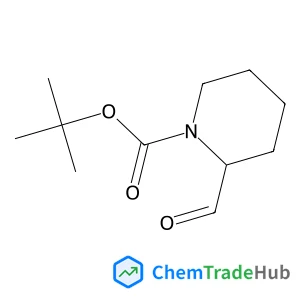
2-Methyl-2-propanyl (2R)-2-formyl-1-piperidinecarboxylate
CAS Number:
134526-69-5
Molecular Formula:
C11H19NO3
Recommended Suppliers





Disclaimer
This page provides academic journal information for reference and research purposes only. We are not affiliated with any journal publishers and do not handle publication submissions. For publication-related inquiries, please contact the respective journal publishers directly.
If you notice any inaccuracies in the information displayed, please contact us at support@chemtradehub.com. We will promptly review and address your concerns.