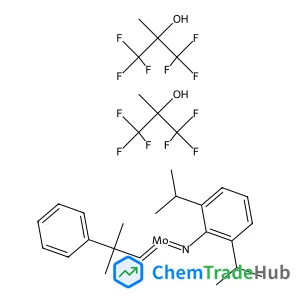
2,6-Diisopropylphenylimidoneophylidene molybdenum(VI) bis(hexafluoro-t-butoxide)
CAS Number:
139220-25-0
Molecular Formula:
C30H37F12MoNO2
Zhansheng Lu
Two-dimensional (2D) superconductors, which can be widely applied in optoelectronic and microelectronic devices, have gained renewed attention in recent years. Based on the crystal structure prediction method and first-principles calculations, we obtain four novel 2D tungsten boride structures of tetr-, hex-, and tri-W2B2 and hex-WB4 and investigate their bonding types, electronic properties, phonon dispersions and electron–phonon coupling (EPC). The results show that both tetr- and hex-W2B2 are intrinsic phonon-mediated superconductors with a superconducting transition temperature (Tc) of 7.8 and 1.5 K, respectively, while tri-W2B2 and hex-WB4 are normal metals. We demonstrate that carrier doping as well as biaxial strain can soften the low-frequency phonon modes and enhance the strength of the EPC. While the Tc of tetr-W2B2 can be increased to 15.4 K under a compressive strain of −2%, the Tc of hex-W2B2 can be enhanced to 5.9 K by a tensile strain of +4%. With the inclusion of spin–orbit couping (SOC), the value of Tc decreases by 38.5% in our systems. Furthermore, we explore the stabilities and mechanical properties of tetr- and hex-W2B2 and indicate that they may be prepared by growing on ZnS(100) and ZnS(111), respectively. Our findings provide novel 2D superconducting materials and will stimulate more efforts in this filed.
Peng Yin, Mingmin Ge, Shiyi Xie, Li Zhang, Shi Kuang, Zhou Nie
DOI: 10.1039/D3SC04957D
Liting Zheng, Qingqing Li, Ying Wu, Lichao Su, Wei Du, Jibin Song, Lanlan Chen, Huanghao Yang
DOI: 10.1039/D3SC04371A
Benjamin Rioux, Louis M. M. Mouterde, Jimmy Alarcan, Matthias J. A. Vink, Jack M. Woolley, Aurélien A. M. Peru, Matthieu M. Mention, Fanny Brunissen, Giel Berden, Jos Oomens, Albert Braeuning, Florent Allais
DOI: 10.1039/D3SC04836E
Werner Theodor Jauslin, Matthias Schild, Thorsten Schaefer, Chiara Borsari, Clara Orbegozo, Lukas Bissegger, Saule Zhanybekova, Danilo Ritz, Alexander Schmidt, Matthias Wymann, Dennis Gillingham
DOI: 10.1039/D3SC04629J
Bartłomiej Sadowski, Daniel T. Gryko
DOI: 10.1039/D3SC05272A
Liming Sun, Yaya Yuan, Xiaoxiao He, Wenwen Zhan, Dong Li, Yanli Zhao, Xiao-Jun Wang, Xiguang Han
DOI: 10.1039/D3SC04328B
Manuel Weh, Olga Anhalt
DOI: 10.1039/D3SC05341E
Jonathan E. Tsang, David A. Nathanson
DOI: 10.1039/D3SC04424F
3-(2-Bromoimidazo[2,1-b]thiazol-6-yl)propanoic acid hydrochloride is typically s...
2-Isopropyl-1,3-dioxane-5-carboxylic acid is typically synthesized by the carbox...
Alisporivir (CAS: 254435-95-5) is an antiviral medication used in the treatment ...
[1,2,4]triazolo[3,4-a]phthalazine (CAS: 234-80-0) is a crystalline compound with...
Regulatory guidelines for (2S)-5-Hydroxy-2-(4-hydroxyphenyl)-4-oxo-3,4-dihydro-2...
2,2-Difluorocyclohexanamine hydrochloride is generally safe when handled under p...
3-Nitro-2-phenylthiophene is primarily used in the synthesis of other organic co...
1-(Trifluoroacetyl)-4-piperidinecarbonitrile (CAS: 77940-79-5) is a colorless to...
Research and market trends for 1,3,6,8-Tetranitro-9H-carbazole (CAS: 4543-33-3) ...
Waste containing Dibenzo[b,d]thiophen-1-ylboronic acid (CAS: 1245943-60-5) shoul...

Physical Chemistry Chemical Physics (PCCP) is an international journal co-owned by 19 physical chemistry and physics societies from around the world. This journal publishes original, cutting-edge research in physical chemistry, chemical physics and biophysical chemistry. To be suitable for publication in PCCP, articles must include significant innovation and/or insight into physical chemistry; this is the most important criterion that reviewers and Editors will judge against when evaluating submissions. The journal has a broad scope and welcomes contributions spanning experiment, theory, computation and data science. Topical coverage includes spectroscopy, dynamics, kinetics, statistical mechanics, thermodynamics, electrochemistry, catalysis, surface science, quantum mechanics, quantum computing and machine learning. Interdisciplinary research areas such as polymers and soft matter, materials, nanoscience, energy, surfaces/interfaces, and biophysical chemistry are welcomed if they demonstrate significant innovation and/or insight into physical chemistry. Joined experimental/theoretical studies are particularly appreciated when complementary and based on up-to-date approaches.