


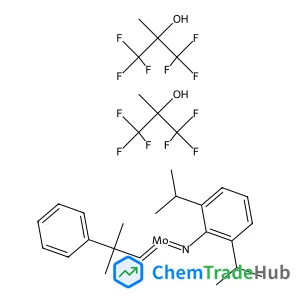
2,6-Diisopropylphenylimidoneophylidene molybdenum(VI) bis(hexafluoro-t-butoxide)
CAS Number:
139220-25-0
Molecular Formula:
C30H37F12MoNO2
Renyi Li, Xianqi Dai, Zhen Feng, Yi Li, Mingyu Zhao, Jing Liu, Huiting Li, Yang Chen, Yaqiang Ma, Yanan Tang
Heme, as the cofactor and active site of Hb, enables Hb to carry out the necessary function required for O2 management for life, that is, reversible O2 binding for transport. In this paper, the microscopic mechanism of heme-associated poisoning has been elucidated from the perspective of electronic interaction by performing first-principles calculations. The results show that the functional groups (–CHO, –COOH, –NO2, –NH2) and CN exhibit a stronger affinity for heme than O2 and are more likely to occupy the O2 binding site, which results in the loss of the ability of heme to carry O2. Moreover, the addition of functional groups, CO and CN to heme at the side site can cause a pronounced enhancement toward the O2 binding characteristics of heme, which prevents heme from releasing O2 to oxygen-consuming tissues as the blood circulates. The reversible O2 binding function of heme is disrupted by the presence of these toxic ligands in the heme binding pocket, which greatly affects O2 transport in the blood. The inability of tissues to obtain O2 leads to tissue hypoxia, which is the main cause of poisoning. Based on the energy, geometry and electronic properties, the hypoxia mechanism proposed by us coincides well with experiment, and the research has the potential to provide a theoretical reference for the relevant areas of bioscience.

Journal of Organometallic Chemistry

Kinetics and Catalysis

Journal of Heterocyclic Chemistry

Science

Journal of Medicinal Chemistry

Planta Medica

Pharmacological Reviews

Journal of Physics and Chemistry of Solids

Proceedings of the National Academy of Sciences of the United States of America

Journal of Catalysis
Ting Yao, Wei Xia, Shitao Han, Shuaiqiang Jia, Xue Dong, Min Wang, Jiapeng Jiao, Dawei Zhou, Jiahao Yang, Xueqing Xing, Chunjun Chen
DOI: 10.1039/D3SC04061E
Corentin Rossi, Giel Muller, Sandesh Gondarry, Paul M. Mayer, Ugo Jacovella
DOI: 10.1039/D3SC03015F
Liming Sun, Yaya Yuan, Xiaoxiao He, Wenwen Zhan, Dong Li, Yanli Zhao, Xiao-Jun Wang, Xiguang Han
DOI: 10.1039/D3SC04328B
Yusheng Chen, Anastasia Kuvayskaya, Maren Pink, Amar H. Flood
DOI: 10.1039/D3SC03685E
Yujin Li, Yu Mei, Roya Momen, Bai Song, Yujie Huang, Xue Zhong, Hanrui Ding, Wentao Deng, Guoqiang Zou, Hongshuai Hou, Xiaobo Ji
DOI: 10.1039/D3SC05593K
Abhijit Chatterjee, Joy Chatterjee, Subrahmanyam Sappati, Riteeka Tanwar, Madan D. Ambhore, Habibul Arfin, Rintu M. Umesh, Mayurika Lahiri, Pankaj Mandal, Partha Hazra
DOI: 10.1039/D3SC04280D
Shen Xu, Jinghang Wu, Xiang Wang
DOI: 10.1039/D3SC04571D
Yi-Qi Tian, Lin-Fang Dai, Wen-Lei Mu, Wei-Dong Yu, Jun Yan, Chao Liu
DOI: 10.1039/D3SC06046B
Jianming Meng, Jing Wang, Peng Hei, Chang Liu, Mengxue Li, Yulai Lin
DOI: 10.1039/D3SC05318K
Yun Zhu, Sangho D. Yun, Tianqi Zhang, Jing-Yuan Chang, Lauren Stover, Arthur Laganowsky
DOI: 10.1039/D3SC04938H
3-(2-Bromoimidazo[2,1-b]thiazol-6-yl)propanoic acid hydrochloride is typically s...
2-Isopropyl-1,3-dioxane-5-carboxylic acid is typically synthesized by the carbox...
Alisporivir (CAS: 254435-95-5) is an antiviral medication used in the treatment ...
[1,2,4]triazolo[3,4-a]phthalazine (CAS: 234-80-0) is a crystalline compound with...
Regulatory guidelines for (2S)-5-Hydroxy-2-(4-hydroxyphenyl)-4-oxo-3,4-dihydro-2...
2,2-Difluorocyclohexanamine hydrochloride is generally safe when handled under p...
3-Nitro-2-phenylthiophene is primarily used in the synthesis of other organic co...
1-(Trifluoroacetyl)-4-piperidinecarbonitrile (CAS: 77940-79-5) is a colorless to...
Research and market trends for 1,3,6,8-Tetranitro-9H-carbazole (CAS: 4543-33-3) ...
Waste containing Dibenzo[b,d]thiophen-1-ylboronic acid (CAS: 1245943-60-5) shoul...

Physical Chemistry Chemical Physics (PCCP) is an international journal co-owned by 19 physical chemistry and physics societies from around the world. This journal publishes original, cutting-edge research in physical chemistry, chemical physics and biophysical chemistry. To be suitable for publication in PCCP, articles must include significant innovation and/or insight into physical chemistry; this is the most important criterion that reviewers and Editors will judge against when evaluating submissions. The journal has a broad scope and welcomes contributions spanning experiment, theory, computation and data science. Topical coverage includes spectroscopy, dynamics, kinetics, statistical mechanics, thermodynamics, electrochemistry, catalysis, surface science, quantum mechanics, quantum computing and machine learning. Interdisciplinary research areas such as polymers and soft matter, materials, nanoscience, energy, surfaces/interfaces, and biophysical chemistry are welcomed if they demonstrate significant innovation and/or insight into physical chemistry. Joined experimental/theoretical studies are particularly appreciated when complementary and based on up-to-date approaches.
![[3-Fluoro-5-(2,2,2-trifluoroethoxy)phenyl]boronic acid structure](https://static.chemtradehub.com/structs/850/850589-55-8-a8ed.webp "[3-Fluoro-5-(2,2,2-trifluoroethoxy)phenyl]boronic acid structure")


