












Single Pt atom supported on penta-graphene as an efficient catalyst for CO oxidation
Literature Information
Publication Date
2019-05-20
DOI
10.1039/C9CP02306B
Impact Factor
3.676
Authors
Ranganathan Krishnan, Shiuan-Yau Wu, Hsin-Tsung Chen
View Original
Abstract
Single-atom catalysts (SACs) have gained special attention due to their unique performances in CO oxidation. Herein, a single Pt atom supported on penta-graphene (Pt/PG) was explored as a SAC towards CO oxidation by applying spin-polarized first-principles calculations. The possible mechanisms for CO oxidation by O2 on Pt/PG, including two traditional mechanisms, Eley–Rideal (ER) and Langmuir–Hinshelwood (LH), and a new tri-molecular Eley–Rideal (TER) mechanism, are illustrated. Our computations revealed that the direct ER pathway (O2 + CO → O + CO2) and TER pathway (2CO + O2 → OCO–OCO → 2CO2) with activation energies of 0.11–0.20 eV and 0.35 eV for the rate-limiting step, respectively, were more preferable than the LH pathway (0.45 eV). The TER pathway was proposed as the most favored pathway since the adsorption of CO was much stronger than the adsorption of O2, allowing for the ER pathway to be restrained. This finding demonstrated that Pt/PG as a single-atom catalyst exhibited an excellent catalytic activity toward CO oxidation and provided a new strategy for the design of single-atom catalysts based on penta-graphene.
Related Literature
Ratiometric co-delivery of doxorubicin and docetaxel by covalently conjugating with mPEG-poly(β-malic acid) for enhanced synergistic breast tumor therapy
Zhe Yu, Hua Li, Yiyang Jia, Youbei Qiao, Chaoli Wang, Qing Zhou, Xin He, Shibin Yu, Tiehong Yang, Hong Wu
2020-09-28
Paper
DOI: 10.1039/D0PY01130D
Preparation of thermoresponsive hydrogels via polymerizable deep eutectic monomer solvents
Yeasmin Nahar, James Horne, Vinh Truong, Alex C. Bissember, Stuart C. Thickett
2020-11-24
Paper
DOI: 10.1039/D0PY01159B
Visible-light reversible photopolymerisation: insights via online photoflow – electrospray ionisation – mass spectrometry
Matthias Van De Walle, Charlotte Petit, James P. Blinco, Christopher Barner-Kowollik
2020-09-30
Communication
DOI: 10.1039/D0PY01119C
High-performance non-volatile resistive switching memory based on a polyimide/graphene oxide nanocomposite
Ju-Young Choi, Jeongjun Lee, Jihyun Jeon, Jaehyuk Im, Junhwan Jang, Seung-Won Jin, Hyeyoung Joung, Hwan-Chul Yu, Kyeong-Nam Nam, Hyeong-Joo Park, Dong-Min Kim, In-Ho Song, Jaesung Yang, Soohaeng Cho, Chan-Moon Chung
2020-11-12
Paper
DOI: 10.1039/D0PY01281E
Chemical recycling of poly(thiourethane) thermosets enabled by dynamic thiourethane bonds
Sijia Huang, Xun Han, Christopher N. Bowman
2020-10-05
Communication
DOI: 10.1039/D0PY01050B
Substituted glycolides from natural sources: preparation, alcoholysis and polymerization
Andrey V. Shlyakhtin, Vladimir V. Bagrov, Pavel D. Komarov, Andrei V. Churakov
2020-10-12
Paper
DOI: 10.1039/D0PY01297A
Photocycloreversions within single polymer chains
Modan Liu, Wolfgang Wenzel
2020-09-22
Paper
DOI: 10.1039/D0PY01062F
You might also like
Compound Q&A
What are the main uses of 1H-Indazole-6-carbonitrile (CAS: 141290-59-7)?
1H-Indazole-6-carbonitrile finds applications in pharmaceuticals, where it serve...
141290-59-71H-Indazole-6-carbon...
Compound Q&A
How should waste containing Dioctyl (2E)-2-butenedioate (CAS: 2997-85-5) be handled?
Waste containing Dioctyl (2E)-2-butenedioate (CAS: 2997-85-5) should be collecte...
2997-85-5Dioctyl (2E)-2-buten...
Compound Q&A
What industries use Sodium [(1,2-benzoxazol-3-ylmethyl)sulfonyl]azanide (CAS: 68291-98-5)?
Sodium [(1,2-benzoxazol-3-ylmethyl)sulfonyl]azanide is primarily used in pharmac...
68291-98-5Sodium [(1,2-benzoxa...
Compound Q&A
Are there alternatives to Dimethyl 4-(4,4,5,5-tetramethyl-1,3,2-dioxaborolan-2-yl)-2,6-pyridinedicarboxylate (CAS: 741709-66-0) in synthesis?
Dimethyl 4-(4,4,5,5-tetramethyl-1,3,2-dioxaborolan-2-yl)-2,6-pyridinedicarboxyla...
741709-66-0Dimethyl 4-(4,4,5,5-...
Compound Q&A
How should waste containing 2-Fluoro-6-hydrazinopyridine (CAS: 80714-39-2) be handled?
Waste containing 2-Fluoro-6-hydrazinopyridine (CAS: 80714-39-2) should be manage...
80714-39-22-Fluoro-6-hydrazino...
Compound Q&A
What is 6-Formyl-2-pyridinecarboxylic acid (CAS: 499214-11-8)?
6-Formyl-2-pyridinecarboxylic acid is an organic compound with the molecular for...
499214-11-86-Formyl-2-pyridinec...
Compound Q&A
What is the market or research trend for 3-(3,4-dimethoxyphenyl)-2,5-dimethyl-N-(2-morpholin-4-ylethyl)pyrazolo[1,5-a]pyrimidin-7-amine (CAS: 900874-91-1)?
Research trends for this compound indicate a focus on its potential applications...
900874-91-13-(3,4-dimethoxyphen...
Compound Q&A
How is 9H-Tribenzo[b,d,f]azepine (CAS: 29875-73-8) typically synthesized?
9H-Tribenzo[b,d,f]azepine is typically synthesized via a multi-step process invo...
29875-73-89H-Tribenzo[b,d,f]az...
Compound Q&A
How is 1-Cyclopropyl-7-ethoxy-6-fluoro-8-methoxy-4-oxo-1,4-dihydro-3-quinolinecarboxylic acid (CAS: 1797982-51-4) typically synthesized?
1-Cyclopropyl-7-ethoxy-6-fluoro-8-methoxy-4-oxo-1,4-dihydro-3-quinolinecarboxyli...
1797982-51-41-Cyclopropyl-7-etho...
Compound Q&A
How should waste containing Methyl 3-oxo-1,2,3,4-tetrahydro-6-quinoxalinecarboxylate (CAS: 671820-52-3) be handled?
Waste containing Methyl 3-oxo-1,2,3,4-tetrahydro-6-quinoxalinecarboxylate (CAS: ...
671820-52-3Methyl 3-oxo-1,2,3,4...
Source Journal
Physical Chemistry Chemical Physics

CiteScore:
5.5
Self-citation Rate:
10.3%
Articles per Year:
3036
Physical Chemistry Chemical Physics (PCCP) is an international journal co-owned by 19 physical chemistry and physics societies from around the world. This journal publishes original, cutting-edge research in physical chemistry, chemical physics and biophysical chemistry. To be suitable for publication in PCCP, articles must include significant innovation and/or insight into physical chemistry; this is the most important criterion that reviewers and Editors will judge against when evaluating submissions. The journal has a broad scope and welcomes contributions spanning experiment, theory, computation and data science. Topical coverage includes spectroscopy, dynamics, kinetics, statistical mechanics, thermodynamics, electrochemistry, catalysis, surface science, quantum mechanics, quantum computing and machine learning. Interdisciplinary research areas such as polymers and soft matter, materials, nanoscience, energy, surfaces/interfaces, and biophysical chemistry are welcomed if they demonstrate significant innovation and/or insight into physical chemistry. Joined experimental/theoretical studies are particularly appreciated when complementary and based on up-to-date approaches.
Recommended Compounds
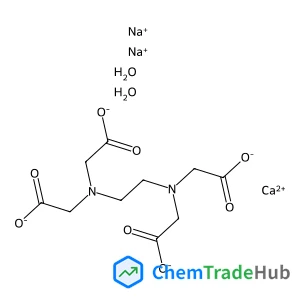
EthylenediaminetetraaceticacidcalciumDisodiumsalthydrate
CAS Number:
23411-34-9
Molecular Formula:
C10H16CaN2Na2O10
Recommended Suppliers



Disclaimer
This page provides academic journal information for reference and research purposes only. We are not affiliated with any journal publishers and do not handle publication submissions. For publication-related inquiries, please contact the respective journal publishers directly.
If you notice any inaccuracies in the information displayed, please contact us at support@chemtradehub.com. We will promptly review and address your concerns.