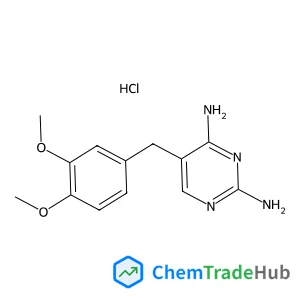
5-(3,4-Dimethoxybenzyl)-2,4-pyrimidinediamine hydrochloride (1:1)
CAS Number:
2507-23-5
Molecular Formula:
C13H17ClN4O2
Craig P. Butts, Michael Green, Thomas N. Hooper, Richard J. Kilby, John E. McGrady, Dimitrios A. Pantazis, Christopher A. Russell
The electronic structure of the 1,2,3-triphosphaindenyl ligand suggests that it should exhibit enhanced π-acceptor properties when compared to the η5-indenyl system; this insight encouraged us to develop a simple synthetic pathway from 1,2-diphosphinobenzene to the 1,2,3-C6H4P3 and 2-As-1,3-C6H4P2 anions, both of which have been structurally characterised by X-ray crystallography; as a bonus from these studies we also obtained the first structurally characterised organo derivative of the P8 unit present in Hittorf’s phosphorus.
Ruobing Wang, Juan Peng, Feng Qiu, Yuliang Yang, Zhiyuan Xie
DOI: 10.1039/B915378K
Hua-You Hu, Hong-Wen Hu, Jian-Hua Xu
DOI: 10.1039/C0OB00299B
Ondřej Páv, Ivana Košiová, Ivan Barvík, Radek Pohl, Miloš Buděšínský, Ivan Rosenberg
DOI: 10.1039/C1OB05488K
Liujuan Chen, Sanzhong Luo, Jiuyuan Li, Xin Li, Jin-Pei Cheng
DOI: 10.1039/B927343C
Min Li, Sergio L. De Rooy, David K. Bwambok, Bilal El-Zahab, John F. DiTusa, Isiah M. Warner
DOI: 10.1039/B917683G
Seiji Kamioka, Sakae Sugiyama, Takashi Takahashi
DOI: 10.1039/C001228A
James Garner, Katrina A. Jolliffe, Margaret M. Harding, Richard J. Payne
DOI: 10.1039/B918021D
Ming Chen, Matthias Häussler, Graeme Moad, Ezio Rizzardo
DOI: 10.1039/C1OB05276D
Zhan Zhang, David Dolphin
DOI: 10.1039/B913231G
Ayellet L. Zelikoff, Jacob Kopilov, Israel Goldberg, Geoffrey W. Coates, Moshe Kol
DOI: 10.1039/B915211C
(1R,3S)-1,3-Cyclopentanediol finds applications in various industries. In the ph...
When handling N'-[4-(Dimethylamino)phenyl]-N,N-dimethyl-1,4-benzenediamine, it i...
There are several alternatives to 5-(2,4-Difluorophenyl)-2-methoxypyrimidine in ...
1-(3-Methoxyphenoxy)propan-2-ol (CAS: 382141-68-6) must comply with the Globally...
Tetrodotoxin Citrate is extremely dangerous and should be handled with extreme c...
2-Methyl-2-propanyl [(1R,3S)-3-hydroxycyclopentyl]carbamate (CAS: 225641-84-9) i...
Waste containing 4-(2-Hydroxyhexafluoroisopropyl)Benzoic Acid (CAS: 16261-80-6) ...
2-Methyl-2-proanyl {(2S)-1-[(benzyloxy)amino]-3-hydroxy-3-methyl-1-oxo-2-butanyl...
Benzeneethanamine, α-ethyl-, hydrochloride (1:1) is an organic compound with the...
In the synthesis of compounds similar to 3-{(E)-[4-(Dimethylamino)phenyl]diazeny...

ChemComm publishes urgent research which is of outstanding significance and interest to experts in the field, while also appealing to the journal’s broad chemistry readership. Our communication format is ideally suited to short, urgent studies that are of such importance that they require accelerated publication. Our scope covers all topics in chemistry, and research at the interface of chemistry and other disciplines (such as materials science, nanoscience, physics, engineering and biology) where there is a significant novelty in the chemistry aspects. Major topic areas covered include: Analytical Chemistry Catalysis Chemical Biology and medicinal chemistry Computational Chemistry and Machine Learning Energy and sustainable chemistry Environmental Chemistry Green Chemistry Inorganic Chemistry Materials Chemistry Nanoscience Organic Chemistry Physical Chemistry Polymer Chemistry Supramolecular Chemistry

![2-{[(1R,2S)-2-Aminocyclohexyl]amino}-4-{[3-(2H-1,2,3-triazol-2-yl)phenyl]amino}-5-pyrimidinecarboxamide structure](https://static.chemtradehub.com/structs/137/1370261-96-3-40df.webp "2-{[(1R,2S)-2-Aminocyclohexyl]amino}-4-{[3-(2H-1,2,3-triazol-2-yl)phenyl]amino}-5-pyrimidinecarboxamide structure")