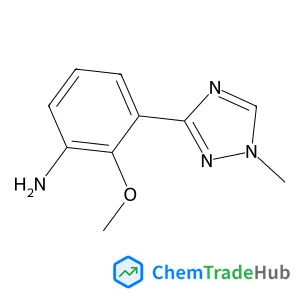
2-Methoxy-3-(1-methyl-1H-1,2,4-triazol-3-yl)aniline
CAS Number:
1609394-10-6
Molecular Formula:
C10H12N4O
Rulin Feng, Eric D. Glendening, Kirk A. Peterson
Gas phase actinyl cation–cation interactions (CCIs) were studied by an accurate composite coupled cluster thermochemical approach for the first time. A number of CCI dimers were constructed from the monomers UO22+, UO2+, NpO22+, NpO2+, PuO2+, and AmO2+. All CCI dimers studied were calculated to be thermodynamically unstable, with dissociation energies ranging from −60 to −90 kcal mol−1, but in many cases kinetic stability was indicated by calculated local minima with well depths as large as ∼15 kcal mol−1. Most of the dimers studied involved a T-shaped geometry, although one side-on dimer, (UO2+)2, was included since it was amenable to coupled cluster methods. In the T-shaped isomers the most stable dimers were calculated to arise when the oxo-group of an An(V) actinyl cation was oriented towards the metal center of an An(VI) actinyl cation. For both mixed-valent An(VI)/An(V) and mono-valent An(V) dimers, the stability as estimated from the depth of the calculated local minimum decreased in the donor series U(V) > Np(V) > Pu(V) > Am(V). These trends correlate well with experimental trends in condensed phase CCIs. A rationale for the bonding in CCIs was investigated by carrying out charge transfer analyses using the natural bond orbital (NBO) method. Augmenting the usual Lewis acid–base explanation, CCIs are the direct result of a competition between charge transfer stabilization, which can be as much as 0.11e or 30.7 kcal mol−1 at equilibrium, and Coulombic repulsive destabilization.
Laura Hannemose Rieger, Max Wilson, Tejs Vegge, Eibar Flores
DOI: 10.1039/D3DD00203A
Samantha Tetef, Ajith Pattammattel, Yong S. Chu, Maria K. Y. Chan, Gerald T. Seidler
DOI: 10.1039/D3DD00146F
Hassan Harb, Sarah N. Elliott, Logan Ward, Ian T. Foster, Stephen J. Klippenstein, Larry A. Curtiss, Rajeev Surendran Assary
DOI: 10.1039/D3DD00123G
Andrew S. Paluch, Marco Lattuada
DOI: 10.1039/D3DD00186E
Xiao Dong, Shoujie Li, Yanfang Song
DOI: 10.1039/D3EE02867D
Jiajun Zhou, Austin Mroz, Kim E. Jelfs
DOI: 10.1039/D3DD00154G
Yuxin Sun, Yuke Zhu, Hao Wu, Nuo Qu, Liangjun Xie, Jianbo Zhu, Zihang Liu, Qian Zhang, Wei Cai, Fengkai Guo, Jiehe Sui
DOI: 10.1039/D3EE03411A
Song Huang, Rong Tang, Xiaoqing Liu, Yufei Zhang, Yongchao Tang, Zhipeng Wen, Minghui Ye, Yang Yang, Cheng Chao Li
DOI: 10.1039/D3EE02945J
Qing Liu, Li Yang, Zhiyuan Mei, Qi An, Kun Zeng, Wenjing Huang, Shimin Wang, Yongjiang Sun
DOI: 10.1039/D3EE03283C
1H-Indazole-6-carbonitrile finds applications in pharmaceuticals, where it serve...
Waste containing Dioctyl (2E)-2-butenedioate (CAS: 2997-85-5) should be collecte...
Sodium [(1,2-benzoxazol-3-ylmethyl)sulfonyl]azanide is primarily used in pharmac...
Dimethyl 4-(4,4,5,5-tetramethyl-1,3,2-dioxaborolan-2-yl)-2,6-pyridinedicarboxyla...
Waste containing 2-Fluoro-6-hydrazinopyridine (CAS: 80714-39-2) should be manage...
6-Formyl-2-pyridinecarboxylic acid is an organic compound with the molecular for...
Research trends for this compound indicate a focus on its potential applications...
9H-Tribenzo[b,d,f]azepine is typically synthesized via a multi-step process invo...
1-Cyclopropyl-7-ethoxy-6-fluoro-8-methoxy-4-oxo-1,4-dihydro-3-quinolinecarboxyli...
Waste containing Methyl 3-oxo-1,2,3,4-tetrahydro-6-quinoxalinecarboxylate (CAS: ...

Physical Chemistry Chemical Physics (PCCP) is an international journal co-owned by 19 physical chemistry and physics societies from around the world. This journal publishes original, cutting-edge research in physical chemistry, chemical physics and biophysical chemistry. To be suitable for publication in PCCP, articles must include significant innovation and/or insight into physical chemistry; this is the most important criterion that reviewers and Editors will judge against when evaluating submissions. The journal has a broad scope and welcomes contributions spanning experiment, theory, computation and data science. Topical coverage includes spectroscopy, dynamics, kinetics, statistical mechanics, thermodynamics, electrochemistry, catalysis, surface science, quantum mechanics, quantum computing and machine learning. Interdisciplinary research areas such as polymers and soft matter, materials, nanoscience, energy, surfaces/interfaces, and biophysical chemistry are welcomed if they demonstrate significant innovation and/or insight into physical chemistry. Joined experimental/theoretical studies are particularly appreciated when complementary and based on up-to-date approaches.
![(3R)-4-(4-Chlorophenyl)-3-({[(2-methyl-2-propanyl)oxy]carbonyl}amino)butanoic acid structure](https://static.chemtradehub.com/structs/218/218608-96-9-f871.webp "(3R)-4-(4-Chlorophenyl)-3-({[(2-methyl-2-propanyl)oxy]carbonyl}amino)butanoic acid structure")
![4-Penten-1-yl 2-[(2-furylmethyl)(1H-imidazol-1-ylcarbonyl)amino]butanoate structure](https://static.chemtradehub.com/structs/101/101903-30-4-ac34.webp "4-Penten-1-yl 2-[(2-furylmethyl)(1H-imidazol-1-ylcarbonyl)amino]butanoate structure")