












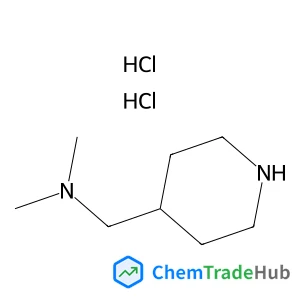
N,N-dimethyl(piperidin-4-yl)methanamine hydrochloride
CAS Number:
172281-72-0
Molecular Formula:
C8H20Cl2N2
Zonglin Gu, Wei Song, Shengtang Liu, Baoyu Li, Leigh D. Plant, Xuan-Yu Meng
Despite significant interest in molybdenum disulfide (MoS2) nanomaterials, particularly in biomedicine, their biological effects have been understudied. Here, we explored the effect of MoS2 nanoflakes on the ubiquitous mitochondrial porin voltage-dependent anion channel (VDAC1), using a combined computational and functional approach. All-atomic molecular dynamics simulations suggest that MoS2 nanoflakes make specific contact interactions with human VDAC1. We show that the initial contacts between hVDAC1 and the nanoflake are hydrophobic but are subsequently enhanced by a complex interplay of van der Waals (vdW), hydrophobic and electrostatic interactions in the equilibrium state. Moreover, the MoS2 nanoflake can insert into the lumen of the hVDAC1 pore. Free-energy calculations computed by the potential of mean force (PMF) verify that the blocked configuration of the MoS2–hVDAC1 complex is more energetically favorable than the non-blocked binding mode. Consistent with these predictions, we showed that MoS2 depolarizes the mitochondrial membrane potential (Ψm) and causes a decrease in the viability of mammalian tissue culture cells. These findings might shed new light on the potential biological effect of MoS2 nanomaterials.
Özlem Kap, Volkan Kılıç, Nesrin Horzum
DOI: 10.1039/D0AN02031A
Xudong Zhao, Yu Wang, Shuang Li, Yingkai Qin, Tie Han, Zhixian Gao, Hui Liu
DOI: 10.1039/D1AN00004G
Lilianna Chęcińska, Wolfgang Morgenroth, Carsten Paulmann, Dylan Jayatilaka, Birger Dittrich
DOI: 10.1039/C2CE26964C
Soumyajit Ghosh, C. Malla Reddy
DOI: 10.1039/C2CE06754D
Navaneetha K. Subbaiyan, Francis D’Souza, Yongshu Xie, Satyajit Sahu, Noelia M. Sanchez-Ballester, Toshiyuki Mori
DOI: 10.1039/C2CC30712J
Xiuli Wang, Jingjing Huang, Lianli Liu, Guocheng Liu, Hongyan Lin, Juwen Zhang, Naili Chen, Yun Qu
DOI: 10.1039/C2CE26892B
Zhujun Li, Feng Xiao
DOI: 10.1039/C7CC09377B
Yingxin Zhan, Huagui Nie, Xiangju Xu, Xiannuo Zheng, Junjie Hou, Huan Duan, Shaoming Huang, Zhi Yang
DOI: 10.1039/C9TA02997D
Yannan Li, Li Yang, Mengqi Du, Guanjun Chang
DOI: 10.1039/C8AN01155A
Zifeng Wang, Zhaoheng Ruan, Zhuoxin Liu, Yukun Wang, Zijie Tang, Hongfei Li, Minshen Zhu, Tak Fuk Hung, Jun Liu, Zicong Shi, Chunyi Zhi
DOI: 10.1039/C8TA01172A
Ethyl 4-chlorothieno[2,3-b]pyridine-5-carboxylate (CAS: 59713-58-5) can be synth...
5-Methyl-1H-indole-3-carbaldehyde (CAS: 52562-50-2) is subject to various regula...
(1,3-Dimethyl-2,4-dioxo-1,2,3,4-tetrahydro-5-pyrimidinyl)boronic acid is a white...
Waste containing Sulfocostunolide A (CAS: 1016983-51-9) should be handled with c...
When handling Murraxocin (CAS: 88478-44-8), ensure proper personal protective eq...
Formvar (CAS: 63148-64-1) is an alkyd resin characterized by a high molecular we...
(S)-4-benzyl-2-((benzyloxy)methyl)morpholine is generally safe when handled with...
Methyl 1-(5-bromo-2-pyrimidinyl)cyclopropanecarboxylate (CAS: 1447607-69-3) is p...
2-Methyl-1-phenyl-1-propanamine hydrochloride (CAS: 24290-47-9) is generally con...
3-(4-Bromophenyl)-2-methylpropanoic acid is synthesized through a multi-step pro...

Physical Chemistry Chemical Physics (PCCP) is an international journal co-owned by 19 physical chemistry and physics societies from around the world. This journal publishes original, cutting-edge research in physical chemistry, chemical physics and biophysical chemistry. To be suitable for publication in PCCP, articles must include significant innovation and/or insight into physical chemistry; this is the most important criterion that reviewers and Editors will judge against when evaluating submissions. The journal has a broad scope and welcomes contributions spanning experiment, theory, computation and data science. Topical coverage includes spectroscopy, dynamics, kinetics, statistical mechanics, thermodynamics, electrochemistry, catalysis, surface science, quantum mechanics, quantum computing and machine learning. Interdisciplinary research areas such as polymers and soft matter, materials, nanoscience, energy, surfaces/interfaces, and biophysical chemistry are welcomed if they demonstrate significant innovation and/or insight into physical chemistry. Joined experimental/theoretical studies are particularly appreciated when complementary and based on up-to-date approaches.
![Sodium 6-amino-3-[(E)-{4-[(E)-(4-aminophenyl)diazenyl]-2-methoxy-5-methylphenyl}diazenyl]-4-hydroxy-2-naphthalenesulfonate structure](https://static.chemtradehub.com/structs/294/2945-96-2-092f.webp "Sodium 6-amino-3-[(E)-{4-[(E)-(4-aminophenyl)diazenyl]-2-methoxy-5-methylphenyl}diazenyl]-4-hydroxy-2-naphthalenesulfonate structure")





