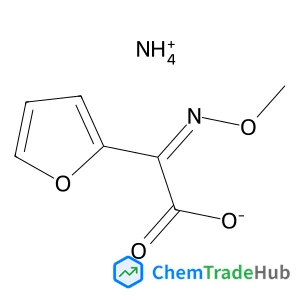
Ammonium (Z)-2-(furan-2-yl)-2-(methoxyimino)acetate
CAS Number:
97148-39-5
Molecular Formula:
C7H10N2O4
Matthew Stanbury, Sylvie Chardon-Noblat, Jean-Marie Mouesca, Vincent Maurel, Jérôme Chauvin
TiO2 nanoparticles are successively functionalized with [Mn(κ2N1,N2-ttpy)(CO)3Br] as catalyst and [Ru(bpy)3]2+ as photosensitizer to yield RuII/TiO2/MnI. Under continuous irradiation at 470 nm and in the presence of a sacrificial electron donor, this triad reduces CO2 to HCOOH (TONmax = 27) with 100% selectivity.
Gary Tresadern, Julie Willis, Ian H. Hillier, C. Ian F. Watt
DOI: 10.1039/B102330F
Alex Brown, Gabriel G. Balint-Kurti, László Füsti-Molnár
DOI: 10.1039/B102542M
Takeshi Matsuda, Fumiko Uchijima, Hirotoshi Sakagami, Nobuo Takahashi
DOI: 10.1039/B105680H
DOI: 10.1039/B004373G
Takane Imaoka, Kimihisa Yamamoto
DOI: 10.1039/B105789H
Max Mühlhäuser, George E. Froudakis, Sigrid D. Peyerimhoff
DOI: 10.1039/B103528M
Xilin Yin, Huanmei Han, Akira Miyamoto
DOI: 10.1039/B003838P
Sílvia M. B. Costa
DOI: 10.1039/B104807B
DOI: 10.1039/B103627K
1H-Indazole-6-carbonitrile finds applications in pharmaceuticals, where it serve...
Waste containing Dioctyl (2E)-2-butenedioate (CAS: 2997-85-5) should be collecte...
Sodium [(1,2-benzoxazol-3-ylmethyl)sulfonyl]azanide is primarily used in pharmac...
Dimethyl 4-(4,4,5,5-tetramethyl-1,3,2-dioxaborolan-2-yl)-2,6-pyridinedicarboxyla...
Waste containing 2-Fluoro-6-hydrazinopyridine (CAS: 80714-39-2) should be manage...
6-Formyl-2-pyridinecarboxylic acid is an organic compound with the molecular for...
Research trends for this compound indicate a focus on its potential applications...
9H-Tribenzo[b,d,f]azepine is typically synthesized via a multi-step process invo...
1-Cyclopropyl-7-ethoxy-6-fluoro-8-methoxy-4-oxo-1,4-dihydro-3-quinolinecarboxyli...
Waste containing Methyl 3-oxo-1,2,3,4-tetrahydro-6-quinoxalinecarboxylate (CAS: ...

ChemComm publishes urgent research which is of outstanding significance and interest to experts in the field, while also appealing to the journal’s broad chemistry readership. Our communication format is ideally suited to short, urgent studies that are of such importance that they require accelerated publication. Our scope covers all topics in chemistry, and research at the interface of chemistry and other disciplines (such as materials science, nanoscience, physics, engineering and biology) where there is a significant novelty in the chemistry aspects. Major topic areas covered include: Analytical Chemistry Catalysis Chemical Biology and medicinal chemistry Computational Chemistry and Machine Learning Energy and sustainable chemistry Environmental Chemistry Green Chemistry Inorganic Chemistry Materials Chemistry Nanoscience Organic Chemistry Physical Chemistry Polymer Chemistry Supramolecular Chemistry