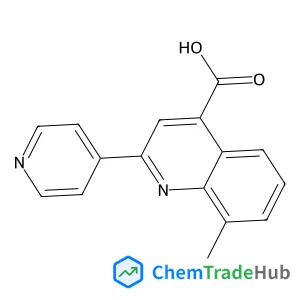
8-Methyl-2-pyridin-4-ylquinoline-4-carboxylic acid
CAS Number:
107027-42-9
Molecular Formula:
C16H12N2O2
Christian M. Wolff, José A. Márquez Prieto, Martin Stolterfoht, Pascal Becker, Thomas Unold, Bernd Rech, Dieter Neher
The incorporation of even small amounts of strontium (Sr) into lead-base hybrid quadruple cation perovskite solar cells results in a systematic increase of the open circuit voltage (Voc) in pin-type perovskite solar cells. We demonstrate via absolute and transient photoluminescence (PL) experiments how the incorporation of Sr significantly reduces the non-radiative recombination losses in the neat perovskite layer. We show that Sr segregates at the perovskite surface, where it induces important changes of morphology and energetics. Notably, the Sr-enriched surface exhibits a wider band gap and a more n-type character, accompanied with significantly stronger surface band bending. As a result, we observe a significant increase of the quasi-Fermi level splitting in the neat perovskite by reduced surface recombination and more importantly, a strong reduction of losses attributed to non-radiative recombination at the interface to the C60 electron-transporting layer. The resulting solar cells exhibited a Voc of 1.18 V, which could be further improved to nearly 1.23 V through addition of a thin polymer interlayer, reducing the non-radiative voltage loss to only 110 meV. Our work shows that simply adding a small amount of Sr to the precursor solutions induces a beneficial surface modification in the perovskite, without requiring any post treatment, resulting in high efficiency solar cells with power conversion efficiency (PCE) up to 20.3%. Our results demonstrate very high Voc values and efficiencies in Sr-containing quadruple cation perovskite pin-type solar cells and highlight the imperative importance of addressing and minimizing the recombination losses at the interface between perovskite and charge transporting layer.
Fulong Zhu, Wei Guo, Yongzhu Fu
DOI: 10.1039/D3CS00703K
Jiafeng Cao, Yuexia Ji, Zongping Shao
DOI: 10.1039/D3CS00303E
Albert Poater
DOI: 10.1039/D3CS00725A
Xiuwen Xu
DOI: 10.1039/D3CS00611E
Chenxi Duan, Chunming Cui
DOI: 10.1039/D3CS00791J
Tyler J. Hannah, Saurabh S. Chitnis
DOI: 10.1039/D3CS00765K
Rémy Rajapaksha, Partha Samanta, Elsje Alessandra Quadrelli, Jérôme Canivet
DOI: 10.1039/D3CS00188A
Siyong Shen, Pengwei Sun, Zhi Gu, Yifei Bai, Xianglin Wang
DOI: 10.1039/D2CS00889K
Waste containing 6-Chloro-5-(2'-hydroxy-3'-methoxy-4-biphenylyl)-3-(3-methoxyphe...
(3alpha,5alpha)-3-Hydroxypregnane-11,20-dione is primarily used in the pharmaceu...
The market for 4-Amino-6-chloro-2-pyridinecarboxylic acid (CAS: 546141-56-4) is ...
Alternatives to (2-Benzoylethyl)trimethylammonium chloride (CAS: 24472-88-6) in ...
N-[4-Nitro-3-(trifluoromethyl)phenyl]acetamide (CAS: 393-12-4) is generally safe...
Alternative reagents such as other phosphates or similar functional groups can b...
There are alternatives to N,N'-Bis(3-aminopropyl)-1,3-propanediamine (CAS: 4605-...
When handling Aluminium trihexadecanoate, it is important to use appropriate per...
(1,1-Dioxido-3-oxo-1,2-benzothiazol-2(3H)-yl)acetic acid is a chemical compound ...
Several alternatives to 5,5-dimethyloxolan-2-one (CAS: 3123-97-5) can be used in...
![2-morpholino-2-[2-(trifluoromethyl)pyrimidin-5-yl]ethanamine structure](https://static.chemtradehub.com/structs/119/1192570-20-9-2810.webp "2-morpholino-2-[2-(trifluoromethyl)pyrimidin-5-yl]ethanamine structure")