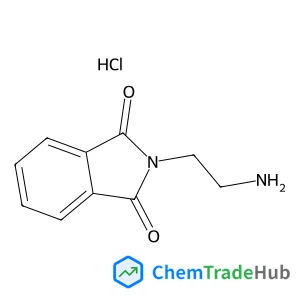
2-(2-Aminoethyl)-1H-isoindole-1,3(2H)-dione hydrochloride (1:1)
CAS Number:
30250-67-0
Molecular Formula:
C10H11ClN2O2
Monika Schechinger, Haley Marks, Samuel Mabbott, Mahua Choudhury
Epigenetic biomarkers are powerful tools for early disease detection and are particularly useful for elusive conditions like preeclampsia. Predicting preeclampsia at an early stage is one of the most important goals of maternal–fetal medicine. To this end, recent studies have identified microRNAs—such as microRNA-17—as early biomarkers for preeclampsia. Yet clinical applications are lagging, owing in part to the sensing challenges presented by the biomarkers’ small size and complex environment. Surface enhanced Raman spectroscopy (SERS) is an emergent optical technique that is recognized for its potential to overcome these challenges. In this study, DNA functionalized nanoparticles were designed as probes to capture and quantify miRNA-17 in solution. SERS was used to determine the presence and concentration of miRNA-17 based on the formation of plasmonic nanoparticle aggregates. The miRNA-17 assay was tested at concentrations of 1 pM to 1 nM in both PBS and a representative complex biological sample. In both situations the assay was unaffected by non-complementary microRNA samples. These results demonstrate SERS's specificity and sensitivity for a new biomarker (miRNA-17) that may ultimately be used in a detection platform for early diagnosis of preeclampsia.

Kinetics and Catalysis

Journal of Physics and Chemistry of Solids

Organic Preparations and Procedures International

Russian Chemical Reviews

Pure and Applied Chemistry

Proceedings of the National Academy of Sciences of the United States of America

Planta Medica

Nature

Journal of Catalysis

Israel Journal of Chemistry
Quan Zhang, Minhua Zhang
DOI: 10.1039/C7CP06456J
Qin Tang, Shufang Zhang, Xinbang Liu, Masato Sumita, Shinsuke Ishihara, Qingmin Ji, Lok Kumar Shrestha
DOI: 10.1039/C7CP04553K
Viraj P. Modak, Andrew J. Amaya
DOI: 10.1039/C7CP05431A
Danillo Valverde, Adalberto Vasconcelos Sanches de Araujo, Antonio Carlos Borin, Sylvio Canuto
DOI: 10.1039/C7CP04885H
Bo Xiong, Yih-Chung Chang, Cheuk-Yiu Ng
DOI: 10.1039/C7CP04886F
Marcos Juanes, Jean Demaison, Iker León, Alberto Lesarri, Heinz Dieter Rudolph
DOI: 10.1039/C7CP06135H
Sonal Kumar, Prasad Rama, Ajay Singh Panwar
DOI: 10.1039/C7CP05005D
Manh-Hiep Vu, Chinh-Chien Nguyen, M. Sakar, Trong-On Do
DOI: 10.1039/C7CP06085H
Moumita Saharay, R. James Kirkpatrick
DOI: 10.1039/C7CP04683A
(1R,3S)-1,3-Cyclopentanediol finds applications in various industries. In the ph...
When handling N'-[4-(Dimethylamino)phenyl]-N,N-dimethyl-1,4-benzenediamine, it i...
There are several alternatives to 5-(2,4-Difluorophenyl)-2-methoxypyrimidine in ...
1-(3-Methoxyphenoxy)propan-2-ol (CAS: 382141-68-6) must comply with the Globally...
Tetrodotoxin Citrate is extremely dangerous and should be handled with extreme c...
2-Methyl-2-propanyl [(1R,3S)-3-hydroxycyclopentyl]carbamate (CAS: 225641-84-9) i...
Waste containing 4-(2-Hydroxyhexafluoroisopropyl)Benzoic Acid (CAS: 16261-80-6) ...
2-Methyl-2-proanyl {(2S)-1-[(benzyloxy)amino]-3-hydroxy-3-methyl-1-oxo-2-butanyl...
Benzeneethanamine, α-ethyl-, hydrochloride (1:1) is an organic compound with the...
In the synthesis of compounds similar to 3-{(E)-[4-(Dimethylamino)phenyl]diazeny...

Analyst publishes analytical and bioanalytical research that reports premier fundamental discoveries and inventions, and the applications of those discoveries, unconfined by traditional discipline barriers.
![N-[(9H-Fluoren-9-ylmethoxy)carbonyl]-beta-phenyl-L-phenylalanine structure](https://static.chemtradehub.com/structs/201/201484-50-6-c2fc.webp "N-[(9H-Fluoren-9-ylmethoxy)carbonyl]-beta-phenyl-L-phenylalanine structure")