












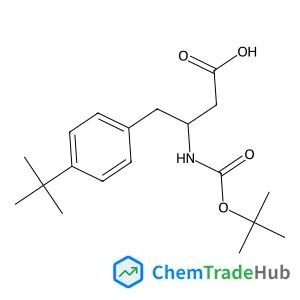
(S)-3-((tert-Butoxycarbonyl)amino)-4-(4-(tert-butyl)phenyl)butanoic acid
CAS Number:
403661-85-8
Molecular Formula:
C19H29NO4
Cuiling Zhang, Dan Li, Dongwei Li, Kai Wen, Xingdong Yang, Ye Zhu
Herein, an ultrasensitive and label-free electrochemical biosensor was developed for microRNA (miRNA) based on rolling circle amplification (RCA)-mediated palladium nanoparticles (PdNPs). The sensor was fabricated by immobilizing dual-functionalized hairpin probes onto an electrode. The specific recognition of target miRNA-21 by the hairpin probes could trigger the RCA reaction, which produced numerous guanine (G)-rich long single-stranded DNAs (ssDNAs). Based on the interaction of the PdII species with the nitrogen atoms of the G bases, these G-rich long ssDNAs served as specific templates in the in situ synthesis of massive PdNPs as electrochemical indicators. The formation of PdNPs was demonstrated to be exactly along the RCA products by high-resolution transmission electron microscopy. Using this cascade signal amplification strategy, the developed biosensor achieved a linear range of 50 aM–100 fM with an ultralow detection limit of 8.6 aM miRNA-21. Furthermore, the developed biosensor exhibited good selectivity, reproducibility, stability and satisfactory feasibility for miRNA-21 detection in human serum samples; this ensured significant potential of this biosensor in disease diagnosis and prognosis applications.
Natasha W. Pettinger, Jennifer M. Empey, Sascha Fröbel, Bern Kohler
DOI: 10.1039/C9CP06579B
Domonkos A. Tasi, Tibor Győri, Gábor Czakó
DOI: 10.1039/C9CP07007A
Yusuke Morino, Hisaya Hara, Ken-ichi Bando, Sakurako Ono, Akihito Imanishi, Yugo Okada, Hiroyuki Matsui, Takafumi Uemura, Jun Takeya
DOI: 10.1039/D0CP00149J
Mhamad Chrayteh, Annunziata Savoia, Thérèse R. Huet, Pascal Dréan
DOI: 10.1039/C9CP06678K
Lei Jin, Xiaoming Zhang, Tingli He, Weizhen Meng, Xuefang Dai, Guodong Liu
DOI: 10.1039/C9CP06033B
Olivier J. J. Ronsin, DongJu Jang, Hans-Joachim Egelhaaf
DOI: 10.1039/D0CP00214C
Jon M. Schwantes, Jacob L. Bair, Edgar C. Buck, Ram Devanathan, Sean H. Kessler, Timothy G. Lach, Jason M. Lonergan, Bruce K. McNamara, Camille J. Palmer, Richard A. Clark
DOI: 10.1039/C9CP05363H
Zhixiang Liu, Mengyuan Xiang, Yao Zhang, Huaiyu Shao, Yunfeng Zhu, Xinli Guo, Liquan Li, Hui Wang, Wanqiang Liu
DOI: 10.1039/C9CP06090A
Liming Wang, Tatiana Zinkevich, Sylvio Indris
DOI: 10.1039/D0CP90046J
N-(4-Methoxybenzyl)-2-pyridinamine (CAS: 52818-63-0) is increasingly being used ...
When handling Ethyl 4-(2-chlorophenyl)-1,3-thiazole-2-carboxylate, appropriate p...
Diethyldiselane (CAS: 628-39-7) is classified under the Globally Harmonized Syst...
The market for oxocopper (CAS: 12053-18-8) is primarily driven by its use in cat...
The market for 5-{[(2-Methyl-2-propanyl)oxy]carbonyl}-5-azaspiro[2.4]heptane-7-c...
2-(1-Pyrrolidinyl)-4-pyridinamine is a chemical compound with the CAS number 359...
2-(3-Pyridinyl)-1-azabicyclo[2.2.2]octane (CAS: 91556-75-1) is a crystalline sol...
(S)-Alpha-allyl-proline hydrochloride is usually synthesized via a Wittig reacti...
3-Methyl-1,2-oxazole-5-carboxylic acid (CAS: 4857-42-5) is an organic compound w...
Lys-SMCC-DM1 is synthesized via a multi-step process involving the coupling of S...

Analyst publishes analytical and bioanalytical research that reports premier fundamental discoveries and inventions, and the applications of those discoveries, unconfined by traditional discipline barriers.

![N-{3-[Benzyl(methyl)amino]propyl}-9-chloro-5,6,7,8-tetrahydro-2-acridinecarboxamide structure](https://static.chemtradehub.com/structs/142/1426944-49-1-1e4c.webp "N-{3-[Benzyl(methyl)amino]propyl}-9-chloro-5,6,7,8-tetrahydro-2-acridinecarboxamide structure")






