











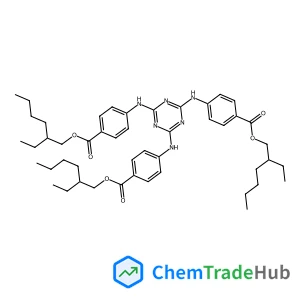
Tris(2-ethylhexyl) 4,4',4''-(1,3,5-triazine-2,4,6-triyltriimino)tribenzoate
CAS Number:
88122-99-0
Molecular Formula:
C48H66N6O6
Qianqian Pei, Xiaolei Song, Su Liu, Jingfeng Wang, Xueqi Leng, Xuejun Cui, Jinghua Yu, Yu Wang
A facile signal-on electrochemical DNA biosensor has been developed for ultrasensitive detection of pathogenic bacteria using an Exo III-assisted autonomous multiple-cycle amplification strategy. The strategy relies on pathogens and aptamer binding-initiated release of a trigger, which combines with the 3′-protruding terminus of the hairpin probe 1, leading to the formation of double-stranded DNA with a blunt 3′ terminus which starts the Exo III-assisted multiple signal amplification reaction. In addition, hairpin probe 2 labeled with an electroactive reporter at the middle of the loop region is ingeniously designed to contain a short hairpin-embedded segment, which can fold into a hairpin structure via an Exo III-assisted cleavage reaction, thus bringing the redox molecule in proximity to the electrode surface for “signal-on” sensing. Under optimal conditions, this biosensor exhibits a very low detection limit as low as 8 cfu mL−1 and a wide linear range from 1.0 × 101 to 1.0 × 10⁷ cfu mL−1 of target pathogenic bacteria. As far as we know, this is the first time that the Exo III-assisted autonomous multiple-cycle amplification strategy has been used for signal-on electrochemical sensing of pathogenic bacteria. In addition, the proposed sensor can also be used for highly sensitive detection of other targets by changing the aptamer sequence, such as nucleic acids, proteins and small molecules. Therefore, the proposed signal-on electrochemical sensing strategy might provide a simple and practical new platform for detection of pathogenic bacteria and related biological analysis, food safety inspection and environmental monitoring.
Piotr Pietrzyk
DOI: 10.1039/B703088F
Antoine Buchard, Audrey Auffrant, Christian Klemps, Laurence Vu-Do, Leïla Boubekeur, Xavier F. Le Goff, Pascal Le Floch
DOI: 10.1039/B618401D
Cotinica Craita, Charles Didier, Pierre Vogel
DOI: 10.1039/B701293D
John E. Moses, Robert M. Adlington
DOI: 10.1039/B512961C
Saumen Hajra, Aswini Kumar Giri, Ananta Karmakar, Snehadrinarayan Khatua
DOI: 10.1039/B618699H
Katja Burgemeister, Giancarlo Franciò, Herbert Hugl
DOI: 10.1039/B512110H
Xiaoguang Li, Benjamin List
DOI: 10.1039/B703977H
When handling lithium chloride hydrate (1:1:1) (CAS: 16712-20-2), it is importan...
4-(4H-1,2,4-Triazol-4-yl)piperidine is generally considered safe for use in phar...
Waste containing 1,3-Thiazole-2-carboxamide (CAS: 16733-85-0) should be collecte...
5-(Difluoromethyl)-2-fluorobenzonitrile (CAS: 934175-58-3) is subject to regulat...
Methyl 3-acetamido-2-thiophenecarboxylate can be synthesized by the reaction of ...
4-Isoquinolinecarbonitrile is a chemical compound with the CAS number 34846-65-6...
Store Methyl 1H-1,2,3-triazole-4-carboxylate (CAS: 877309-59-6) in a cool, dry p...
6-Bromo[1,3]thiazolo[5,4-b]pyridin-2-amine (CAS: 1160791-13-8) is subject to the...
(2S,3S)-2-Ammonio-3-(3,4-dihydroxyphenyl)-3-hydroxypropanoate (CAS: 23651-95-8) ...
7-Bromo-3-methyl-3,4-dihydroquinazolin-4-one is a solid with a crystalline form....

Analyst publishes analytical and bioanalytical research that reports premier fundamental discoveries and inventions, and the applications of those discoveries, unconfined by traditional discipline barriers.
![1-(Hexopyranosyloxy)-4a,5-dihydroxy-7-methyl-1,4a,5,6,7,7a-hexahydrocyclopenta[c]pyran-7-yl 3-phenylacrylate structure](https://static.chemtradehub.com/structs/192/19210-12-9-ecae.webp "1-(Hexopyranosyloxy)-4a,5-dihydroxy-7-methyl-1,4a,5,6,7,7a-hexahydrocyclopenta[c]pyran-7-yl 3-phenylacrylate structure")





