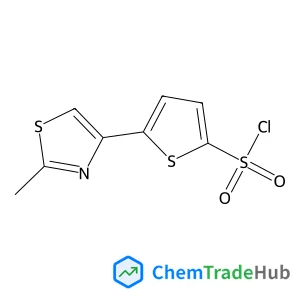
5-(2-Methyl-1,3-thiazol-4-yl)-2-thiophenesulfonyl chloride
CAS Number:
215434-25-6
Molecular Formula:
C8H6ClNO2S3
Shengjie Wang, Dongxiu Zhang, Xiao Zhang, Daoyong Yu, Xiaofeng Jiang, Zhenyang Wang, Meiwen Cao, Yongqing Xia, Heyuan Liu
Photosynthesis in green plants and certain bacteria is an ideal process of solar energy utilization because of its high efficiency and eco-friendliness. Photosynthetic systems usually have sophisticated structures that are constructed through self-assembly of protein, light capturing components and other functional subunits. This inspired researchers to uncover the interaction rules among the photosynthetic subunits and to construct artificial photosynthetic systems via a biomimetic way. Here we selected tetrakis(4-sulfonatophenyl)porphine (TPPS) as a model light-harvesting molecule and short peptide (Ac-I4K2-NH2) self-assembled structures as templates to construct peptide–porphyrin (I4K2/TPPS) co-aggregates via non-covalent interactions. The effects of peptide and porphyrin concentration as well as solution pH on their aggregating behavior and spectroscopic and photoelectric properties were systematically investigated. The results showed that TPPS J-aggregates were obtained under relatively mild conditions in the presence of I4K2 nanostructures and could be easily regulated by the solution pH or molar ratio of TPPS and I4K2. Additionally, great efforts were made to clarify the relationship between the aggregation states of TPPS and their photoelectric properties. The TPPS J-aggregates exhibit a higher photocurrent response compared with other aggregation states as a result of their excellent light capture ability and higher photo-to-electron conversion efficiency. The results provide a promising step towards artificial photosynthetic devices through integrated interaction of organic light capturing components, biomolecules and other functional units.

Russian Journal of Coordination Chemistry

Russian Journal of Organic Chemistry

Current Opinion in Colloid & Interface Science

Saudi Pharmaceutical Journal

Organic Process Research & Development

Crystallography Reports

New Journal of Chemistry

Russian Journal of General Chemistry

Chemistry Education Research and Practice

Journal of Saudi Chemical Society
Cheng-Po Kuo
DOI: 10.1039/C3CP53912A
Katharina Großmann, Susanne Wicker, Udo Weimar, Nicolae Barsan
DOI: 10.1039/C3CP52782D
Ryan Renslow, Jerome Babauta, Andrew Kuprat, Jim Schenk, Cornelius Ivory, Jim Fredrickson, Haluk Beyenal
DOI: 10.1039/C3CP53759E
Carmen López-López, Silvia Colodrero, Hernán Míguez
DOI: 10.1039/C3CP53939C
Deniz Tuna, Andrzej L. Sobolewski, Wolfgang Domcke
DOI: 10.1039/C3CP52359D
Hui-Fang Li, Huai-Qian Wang
DOI: 10.1039/C3CP53292E
Chen Gong, Quanjun Li, Ran Liu, Yuan Hou, Jinxian Wang, Xiangting Dong, Bo Liu, Xue Yang, Zhen Yao, Xiao Tan, Dongmei Li, Jing Liu, Zhiqiang Chen, Bo Zou, Tian Cui, Bingbing Liu
DOI: 10.1039/C3CP53230E
Daniel Stone, Laura Daubney
DOI: 10.1039/C3CP52466C
Rajib Ghosh, Dipak K. Palit
DOI: 10.1039/C3CP53886A
Shengli Chen, Yuwen Liu
DOI: 10.1039/C3CP53773K
Waste containing 6-Chloro-5-(2'-hydroxy-3'-methoxy-4-biphenylyl)-3-(3-methoxyphe...
(3alpha,5alpha)-3-Hydroxypregnane-11,20-dione is primarily used in the pharmaceu...
The market for 4-Amino-6-chloro-2-pyridinecarboxylic acid (CAS: 546141-56-4) is ...
Alternatives to (2-Benzoylethyl)trimethylammonium chloride (CAS: 24472-88-6) in ...
N-[4-Nitro-3-(trifluoromethyl)phenyl]acetamide (CAS: 393-12-4) is generally safe...
Alternative reagents such as other phosphates or similar functional groups can b...
There are alternatives to N,N'-Bis(3-aminopropyl)-1,3-propanediamine (CAS: 4605-...
When handling Aluminium trihexadecanoate, it is important to use appropriate per...
(1,1-Dioxido-3-oxo-1,2-benzothiazol-2(3H)-yl)acetic acid is a chemical compound ...
Several alternatives to 5,5-dimethyloxolan-2-one (CAS: 3123-97-5) can be used in...
![4-{[4-(Trifluoromethoxy)benzyl]oxy}benzonitrile structure](https://static.chemtradehub.com/structs/103/1036629-63-6-2172.webp "4-{[4-(Trifluoromethoxy)benzyl]oxy}benzonitrile structure")
![(3-{[4-(Aminomethyl)-6-(trifluoromethyl)-2-pyridinyl]oxy}phenyl)[(3R,4R)-3-fluoro-4-hydroxy-1-pyrrolidinyl]methanone structure](https://static.chemtradehub.com/structs/200/2007885-39-2-affc.webp "(3-{[4-(Aminomethyl)-6-(trifluoromethyl)-2-pyridinyl]oxy}phenyl)[(3R,4R)-3-fluoro-4-hydroxy-1-pyrrolidinyl]methanone structure")