














Sustainable one step process for making carbon-free TiO2 anodes and sodium-ion battery electrochemistry
Literature Information
Publication Date
2018-05-14
DOI
10.1039/C8SE00082D
Impact Factor
6.367
Authors
Tandeep S. Chadha, Prasit Kumar Dutta, Ramesh Raliya, Sagar Mitra, Pratim Biswas
View Original
Abstract
Electrodes with a carbon-free architecture impart a sustainable solution by eliminating side reactions. Such designs are required for anode systems, especially for sodium-ion batteries where the capacity contribution from carbon is noticed. Herein, carbon-free TiO2 is prepared in the monolithic dendritic form via a facile single-step aerosol vapor deposition technique, grown onto a stainless steel current collector. The single crystalline nature of the anatase dendrites explicitly provides detailed crystallographic analysis. Herein, we have realized an escalation of the rutile phase with the existing anatase phase upon cycling, which is depicted as a moiré pattern, while evaluating the structure through TEM studies. As the anode is carbon and binder-free, the overall material is electrochemically active, and hence appreciably improves the volumetric energy-density. Here, we observe a long cycle life of 1000 cycles from the additive-free anatase dendrites with an adequate capacity retention of 85.1%. Therefore, we believe that our single-step fabrication process to procure additive-free monolithic electrodes is a forthcoming paramount technique to produce sodium-ion batteries on mass.
Related Literature
A silicon-doped carbon dot-based multivariate fluorometric and colorimetric probe for the simultaneous detection of heavy metal ions and dopamine
Yunqi Hao, Tingting Li, Miaomiao Tian, Qijun Dai, Fang Zhang, Fang Chai
2023-12-07
Paper
DOI: 10.1039/D3NJ04627C
Engineered cyclodextrin-based supramolecular hydrogels for biomedical applications
Yuqi Zhao, Zhi Zheng, Cui-Yun Yu, Hua Wei
2023-11-27
Review Article
DOI: 10.1039/D3TB02101G
Red light-triggerable nanohybrids of graphene oxide, gold nanoparticles and thermo-responsive polymers for combined photothermia and drug release effects
Ludovica Maugeri, Giuseppe Forte, Gianpiero Buscarino, Antonino Gulino, Luca Lanzanò, Paolo Bonacci, Nicolò Musso
2023-11-09
Paper
DOI: 10.1039/D3TB01863F
Ingenious microenvironment regulation of a metal–organic framework (MOF) nanoreactor for electrochemical detection of chlorogenic acid
Junfeng Wang, Sihua Pan, Wang Sun, Yang Wang
2024-01-05
Paper
DOI: 10.1039/D3NJ05061K
An NIR-II-photoresponsive CoSnO3 nanozyme for mild photothermally augmented nanocatalytic cancer therapy
Lang Yan, Siyu Shang, Jinyan Hu, Xiaofang Zhang, Jikuai Chen, Bijiang Geng, Yin Zhao, Jiangbo Zhu
2023-12-04
Paper
DOI: 10.1039/D3TB02018E
Sensitive monitoring of NAD(P)H levels within cancer cells using mitochondria-targeted near-infrared cyanine dyes with optimized electron-withdrawing acceptors
Daniel R. Tucker, Micaela Geborkoff, Thomas Werner, Rudy L. Luck, Bhaskar Godugu
2023-12-08
Paper
DOI: 10.1039/D3TB02124F
Discrimination of aniline and benzaldehyde assisted with Fisher's base
Zhiyong Zhang, Zhihao Lu, Xiaocong Zou, Xiunan Xie, Jinmao You, Zan Li
2023-12-01
Communication
DOI: 10.1039/D3NJ04308H
Photothermal synergistic nitric oxide controlled release injectable self-healing adhesive hydrogel for biofilm eradication and wound healing
Weiling Peng, Lixia Li, Yu Zhang, Haibing Su, Xiaohe Jiang, Haimeng Liu, Xiaohua Huang, Li Zhou, Xing-Can Shen, Chanjuan Liu
2023-11-27
Paper
DOI: 10.1039/D3TB02040A
You might also like
Compound Q&A
How should waste containing (6-Bromo-2-naphthyl)oxy](dimethyl)(2-methyl-2-propanyl)silane be handled?
Waste containing (6-Bromo-2-naphthyl)oxy](dimethyl)(2-methyl-2-propanyl)silane (...
100751-65-3[(6-Bromo-2-naphthyl...
Compound Q&A
How is 7-Fluoro-4-isoquinolinecarboxylic acid (CAS: 1841081-40-0) typically synthesized?
7-Fluoro-4-isoquinolinecarboxylic acid can be synthesized via a multi-step proce...
1841081-40-07-Fluoro-4-isoquinol...
Compound Q&A
What are the physical and chemical properties of 2,3,5,6-Tetrabromothieno[3,2-b]thiophene (CAS: 124638-53-5)?
2,3,5,6-Tetrabromothieno[3,2-b]thiophene is a crystalline compound with a high m...
124638-53-52,3,5,6-Tetrabromoth...
Compound Q&A
Is 1-[4-(Benzylamino)-7,8-dihydro-5H-pyrano[4,3-d]pyrimidin-2-yl]-2-methyl-1H-indole-4-carboxamide (CAS: 1542705-92-9) safe?
1-[4-(Benzylamino)-7,8-dihydro-5H-pyrano[4,3-d]pyrimidin-2-yl]-2-methyl-1H-indol...
1542705-92-91-[4-(Benzylamino)-7...
Compound Q&A
What is the market or research trend for imidazo[5,1-d]-1,2,3,5-tetrazine-8-carboxylic acid, 3,4-dihydro-3-methyl-4-oxo- (CAS: 113942-30-6)?
The market for imidazo[5,1-d]-1,2,3,5-tetrazine-8-carboxylic acid, 3,4-dihydro-3...
113942-30-6Imidazo[5,1-d]-1,2,3...
Compound Q&A
What is 3-(Triisopropylsilyl)propiolaldehyde (CAS: 163271-80-5)?
3-(Triisopropylsilyl)propiolaldehyde is a synthetic organic compound with the CA...
163271-80-53-(Triisopropylsilyl...
Compound Q&A
What regulatory guidelines apply to 6-Nitro-2H-1,4-benzoxazin-3(4H)-one (CAS: 81721-87-1)?
6-Nitro-2H-1,4-benzoxazin-3(4H)-one (CAS: 81721-87-1) is subject to various regu...
81721-87-16-Nitro-2H-1,4-benzo...
Compound Q&A
How should waste containing (3-Fluorophenyl)(4-{[(2-methyl-2-propanyl)oxy]carbonyl}-1-piperazinyl)acetic acid (CAS: 885272-91-3) be handled?
Waste containing (3-Fluorophenyl)(4-{[(2-methyl-2-propanyl)oxy]carbonyl}-1-piper...
885272-91-3(3-Fluorophenyl)(4-{...
Compound Q&A
What are the physical and chemical properties of N,N'-4,4'-Biphenyldiyldiisonicotinamide (CAS: 55119-40-9)?
N,N'-4,4'-Biphenyldiyldiisonicotinamide is a white crystalline solid with a mole...
55119-40-9N,N'-4,4'-Biphenyldi...
Compound Q&A
What industries use 6-Bromo-8-fluoro-2-quinazolinol (CAS: 1036756-15-6)?
6-Bromo-8-fluoro-2-quinazolinol is primarily used in the pharmaceutical industry...
1036756-15-66-Bromo-8-fluoro-2-q...
Source Journal
Recommended Compounds

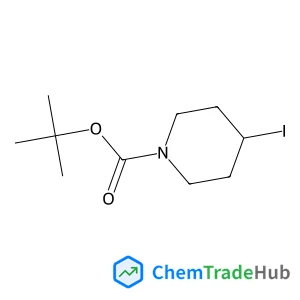
2-Methyl-2-propanyl 4-iodo-1-piperidinecarboxylate
CAS Number:
301673-14-3
Molecular Formula:
C10H18INO2

Recommended Suppliers





Disclaimer
This page provides academic journal information for reference and research purposes only. We are not affiliated with any journal publishers and do not handle publication submissions. For publication-related inquiries, please contact the respective journal publishers directly.
If you notice any inaccuracies in the information displayed, please contact us at support@chemtradehub.com. We will promptly review and address your concerns.