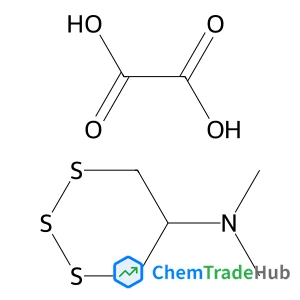
Oxalic acid compound with cyclohexylsulfamothioic O-acid (11)
CAS Number:
31895-22-4
Molecular Formula:
C7H13NO4S3
N. Supantanapong, P. Chuangsoongnern
The development of novel methods for the construction of valuable fluorophores, 3-carbonyl-4-arylbenzo[f]indoles and 3-carbonyl-4-arylnaphthofurans, is described. In this protocol, the important polycarbonyl key intermediate was generated via the ketonization of ortho-alkynylarylketone tethered with a 1,3-dicarbonyl moiety. This intermediate reacted with an amine to selectively form a pyrrole intermediate, followed by cyclization in acetic acid to provide 3-carbonyl-4-arylbenzo[f]indole. Importantly, these conditions did not cause any epimerization of the stereogenic center in chiral amine substrates. Moreover, the polycarbonyl intermediate could also be utilized to prepare 3-carbonyl-4-arylnaphthofuran using In(OTf)3 as a catalyst for double cyclization under thermal conditions. In addition, the fluorescence properties of both fluorophores were also studied.
Alexander Panchenko, Herbert Dilger, Jochen Kerres, Martin Hein, Andreas Ullrich, Till Kaz, Emil Roduner
DOI: 10.1039/B404253K
Tzvetanka Boiadjieva, Giuseppe Cappelletti, Silvia Ardizzone, Sandra Rondinini, Alberto Vertova
DOI: 10.1039/B402370F
C. Crépin, V. Dubois, F. Goldfarb, F. Chaput, J. P. Boilot
DOI: 10.1039/B500578G
D. Mariano A. Vera, Adriana B. Pierini
DOI: 10.1039/B403898C
Isabelle Gener, Alain Moissette, Claude Brémard
DOI: 10.1039/B401816H
DOI: 10.1039/B402156H
Hamilton Varela, Carsten Beta, Antoine Bonnefont
DOI: 10.1039/B502027A
K. Chakarova, E. Ivanova, K. Hadjiivanov, D. Klissurski, H. Knözinger
DOI: 10.1039/B401934B
Eveline Bus, Roel Prins, Jeroen A. van Bokhoven
DOI: 10.1039/B702747H
Zhibo Yang, M. T. Rodgers
DOI: 10.1039/B315089E
Waste containing (6-Bromo-2-naphthyl)oxy](dimethyl)(2-methyl-2-propanyl)silane (...
7-Fluoro-4-isoquinolinecarboxylic acid can be synthesized via a multi-step proce...
2,3,5,6-Tetrabromothieno[3,2-b]thiophene is a crystalline compound with a high m...
1-[4-(Benzylamino)-7,8-dihydro-5H-pyrano[4,3-d]pyrimidin-2-yl]-2-methyl-1H-indol...
The market for imidazo[5,1-d]-1,2,3,5-tetrazine-8-carboxylic acid, 3,4-dihydro-3...
3-(Triisopropylsilyl)propiolaldehyde is a synthetic organic compound with the CA...
6-Nitro-2H-1,4-benzoxazin-3(4H)-one (CAS: 81721-87-1) is subject to various regu...
Waste containing (3-Fluorophenyl)(4-{[(2-methyl-2-propanyl)oxy]carbonyl}-1-piper...
N,N'-4,4'-Biphenyldiyldiisonicotinamide is a white crystalline solid with a mole...
6-Bromo-8-fluoro-2-quinazolinol is primarily used in the pharmaceutical industry...

Organic Chemistry Frontiers publishes high-quality research from across organic chemistry. Emphases are placed on studies that make significant contributions to the field of organic chemistry by reporting either new or significantly improved protocols or methodologies. Topics include, but are not limited to the following: Organic synthesis Development of synthetic methodologies Catalysis Natural products Functional organic materials Supramolecular and macromolecular chemistry Physical and computational organic chemistry
![N-[(E)-Phenylmethylene]benzenesulfonamide structure](https://static.chemtradehub.com/structs/139/13909-34-7-8167.webp "N-[(E)-Phenylmethylene]benzenesulfonamide structure")