












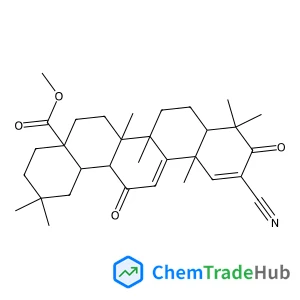
Methyl 2-cyano-3,12-dioxooleana-1,9(11)-dien-28-oate
CAS Number:
218600-53-4
Molecular Formula:
C32H43NO4
Michel Biewend, Steve Neumann, Philipp Michael, Wolfgang H. Binder
Copper(I) bis(N-heterocyclic carbene) (NHC) complexes can be used as catalysts for a wide range of different reactions, like hydrosilylation, CH-activation or copper(I)-catalyzed alkyne/azide cycloaddition (CuAAC) reactions. In this paper a novel synthetic approach towards poly(styrene) (PS)-based copper(I) bis(NHC) complexes with linear and chain extended different architectures and their defined activation for CuAAC by mechanical force is reported. The NHC precursor polymers are synthesized via living RAFT polymerization to ensure defined polymer compositions achieving the N-methylimidazolium functionalization either by modified chain transfer agents (CTA) or via efficient post-polymerization thio-bromo click reactions. Subsequent deprotonation by NaOtBu and coordination to a central copper(I) were used to generate low molecular weight, polymeric linear and chain extended copper(I) bis(NHC) complexes bearing more than one copper(I) center with molecular weights up to 50 000 g mol−1. A mechanochemical activation of these complexes is demonstrated in bulk quantifying the catalytic activity in a fluorogenic CuAAC click reaction with conversions up to 44%, which allows the use of these polymers as stress-sensors.
Jan-Michael Mewes, Andreas Dreuw
DOI: 10.1039/C3CP44338H
Galina S. Matouzenko, Serguei A. Borshch, Volker Schünemann, Juliusz A. Wolny
DOI: 10.1039/C3CP44570D
Giuseppe Graziano
DOI: 10.1039/C3CP50616A
Kees-Jan Weststrate, Ludo Juurlink
DOI: 10.1039/C3CP44503H
Xin Zeng, Stevin S. Pramana, Sudip K. Batabyal, Xiaodong Chen, K. B. Jinesh
DOI: 10.1039/C3CP43470B
Nina O. C. Winter, Nora K. Graf, Samuel Leutwyler, Christof Hättig
DOI: 10.1039/C2CP42694C
Marc-Oliver Winghart, Michael Kühn, Andreas-Neil Unterreiner, Thomas J. A. Wolf, Phuong D. Dau, Hong-Tao Liu, Dao-Ling Huang, Lai-Sheng Wang
DOI: 10.1039/C3CP50497B
Amitaksha Saha, Chellappan Vijila, Rajan Jose, Zhang Jie, Seeram Ramakrishna
DOI: 10.1039/C3CP50994J
Zhuang Liu, Hao Zhang, Jinghong Li, Junhong Chen
DOI: 10.1039/C3CP50647A
When handling 4-(2-Furylmethyl)thiomorpholine 1,1-dioxide (CAS: 79206-94-3), it ...
When handling 4-Chloro-N-[2-(4-morpholinyl)ethyl]benzamide (CAS: 71320-77-9), it...
Waste containing this compound (CAS: 62921-74-8) should be handled according to ...
Waste containing (S)-Methyl 2-amino-3-cyclohexylpropanoate should be collected i...
This compound can be synthesized using a multi-step process involving the conjug...
There are several alternatives to (2E)-3-(3,4-Dichlorophenyl)acrylic acid in syn...
Ethyl 6-(2-nitrophenyl)imidazo[2,1-b][1,3]thiazole-3-carboxylate (CAS: 925437-84...
Waste containing 2-(1,3-Thiazol-2-yl)ethanamine (CAS: 18453-07-1) should be coll...
Methyl 5-iodo-2-methylbenzoate can be synthesized through the iodination of meth...
5-Chloro[1,2,4]triazolo[1,5-a]pyridine is commonly synthesized via the condensat...

Polymer Chemistry welcomes submissions in all areas of polymer science that have a strong focus on macromolecular chemistry. Manuscripts may cover a broad range of fields, yet no direct application focus is required.
![N-[(Benzyloxy)carbonyl]serine structure](https://static.chemtradehub.com/structs/276/2768-56-1-77f7.webp "N-[(Benzyloxy)carbonyl]serine structure")






