












Enzymatic assembly of adhesive molecular networks with sequence-dependent mechanical properties inspired by mussel foot proteins
Literature Information
Publication Date
2019-01-14
DOI
10.1039/C8PY01581C
Impact Factor
5.582
Authors
Byung Min Park, Jiren Luo
View Original
Abstract
By inserting short peptide motifs derived from Mfp-3 and Mfp-5 into elastin-like polypeptides (ELPs), we created several recombinant protein polymers that can form adhesive hydrogels upon enzymatic oxidation. The resulting materials exhibited sequence-dependent bulk mechanical properties and strong adhesiveness. The materials also showed excellent cytocompatibility toward encapsulated human alveolar epithelial cells. This study illustrates a new strategy for designing adhesive materials for biomedical and research purposes.
Related Literature
Moderate band-gap-broadening induced high separation of electron–hole pairs in Br substituted BiOI: a combined experimental and theoretical investigation
Hongwei Huang, Xiaowei Li, Xu Han, Na Tian, Yihe Zhang, Tierui Zhang
2014-12-15
Paper
DOI: 10.1039/C4CP04842C
Synergistic effects of nonmetal co-doping with sulfur in anatase TiO2: a DFT + U study
Zong-Yan Zhao, Qing-Ju Liu
2014-12-04
Paper
DOI: 10.1039/C4CP05065G
Reducing optical losses in organic solar cells using microlens arrays: theoretical and experimental investigation of microlens dimensions
Yuqing Chen, Stephen Bergeson, Max Noack, Joong-Mok Park, Andrew C. Hillier
2014-12-18
Paper
DOI: 10.1039/C4CP05221H
Co(iii) protoporphyrin IX chloride in solution: spin-state and metal coordination revealed from resonant inelastic X-ray scattering and electronic structure calculations
Jie Xiao, Bernd Winter
2014-12-12
Paper
DOI: 10.1039/C4CP04703F
Microsecond pulsed hydrogen/deuterium exchange of electrosprayed ubiquitin ions stored in a linear ion trap
2014-12-16
Paper
DOI: 10.1039/C4CP04716H
A quantitative prediction of the viscosity of ionic liquids using Sσ-profile molecular descriptors
Xiangping Zhang, Suojiang Zhang
2014-12-17
Paper
DOI: 10.1039/C4CP04712E
Effect of the borax mass and pre-spray medium temperature on droplet size and velocity vector distributions of intermittently sprayed starchy solutions
Muhammad Yasin Naz, Shaharin Anwar Sulaiman, Bambang Ariwahjoedi
2014-12-18
Paper
DOI: 10.1039/C4CP04378B
Photoelectron spectroscopy and theoretical studies of anion–π interactions: binding strength and anion specificity
Bin Zhou, Zhen-Rong Sun, Xue-Bin Wang
2014-12-16
Paper
DOI: 10.1039/C4CP04687K
An equation to calculate internuclear distances of covalent, ionic and metallic lattices
Peter F. Lang, Barry C. Smith
2014-12-16
Paper
DOI: 10.1039/C4CP05135A
You might also like
Compound Q&A
What precautions should be taken when handling 4-(2-Furylmethyl)thiomorpholine 1,1-dioxide (CAS: 79206-94-3)?
When handling 4-(2-Furylmethyl)thiomorpholine 1,1-dioxide (CAS: 79206-94-3), it ...
79206-94-34-(2-Furylmethyl)thi...
Compound Q&A
What precautions should be taken when handling 4-Chloro-N-[2-(4-morpholinyl)ethyl]benzamide (CAS: 71320-77-9)?
When handling 4-Chloro-N-[2-(4-morpholinyl)ethyl]benzamide (CAS: 71320-77-9), it...
71320-77-94-Chloro-N-[2-(4-mor...
Compound Q&A
How should waste containing 2-[2-(2-Methoxyethoxy)ethoxy]ethyl 4-methylbenzenesulfonate (CAS: 62921-74-8) be handled?
Waste containing this compound (CAS: 62921-74-8) should be handled according to ...
62921-74-82-[2-(2-Methoxyethox...
Compound Q&A
How should waste containing (S)-Methyl 2-amino-3-cyclohexylpropanoate be handled?
Waste containing (S)-Methyl 2-amino-3-cyclohexylpropanoate should be collected i...
40056-18-6(S)-Methyl 2-amino-3...
Compound Q&A
How is 5-({4-[(2S,4R)-4-Hydroxy-2-methyltetrahydro-2H-pyran-4-yl]-2-thienyl}sulfanyl)-1-methyl-1,3-dihydro-2H-indol-2-one (CAS: 166882-70-8) typically synthesized?
This compound can be synthesized using a multi-step process involving the conjug...
166882-70-85-({4-[(2S,4R)-4-Hyd...
Compound Q&A
Are there alternatives to (2E)-3-(3,4-Dichlorophenyl)acrylic acid (CAS: 7312-27-8) in synthesis?
There are several alternatives to (2E)-3-(3,4-Dichlorophenyl)acrylic acid in syn...
7312-27-8(2E)-3-(3,4-Dichloro...
Compound Q&A
How should Ethyl 6-(2-nitrophenyl)imidazo[2,1-b][1,3]thiazole-3-carboxylate (CAS: 925437-84-9) be stored?
Ethyl 6-(2-nitrophenyl)imidazo[2,1-b][1,3]thiazole-3-carboxylate (CAS: 925437-84...
925437-84-9Ethyl 6-(2-nitrophen...
Compound Q&A
How should waste containing 2-(1,3-Thiazol-2-yl)ethanamine (CAS: 18453-07-1) be handled?
Waste containing 2-(1,3-Thiazol-2-yl)ethanamine (CAS: 18453-07-1) should be coll...
18453-07-12-(1,3-Thiazol-2-yl)...
Compound Q&A
How is Methyl 5-iodo-2-methylbenzoate (CAS: 103440-54-6) typically synthesized?
Methyl 5-iodo-2-methylbenzoate can be synthesized through the iodination of meth...
103440-54-6Methyl 5-iodo-2-meth...
Compound Q&A
How is 5-Chloro[1,2,4]triazolo[1,5-a]pyridine (CAS: 1427399-34-5) typically synthesized?
5-Chloro[1,2,4]triazolo[1,5-a]pyridine is commonly synthesized via the condensat...
1427399-34-55-Chloro[1,2,4]triaz...
Source Journal
Polymer Chemistry

CiteScore:
8.6
Self-citation Rate:
7.3%
Articles per Year:
457
Polymer Chemistry welcomes submissions in all areas of polymer science that have a strong focus on macromolecular chemistry. Manuscripts may cover a broad range of fields, yet no direct application focus is required.
Recommended Compounds

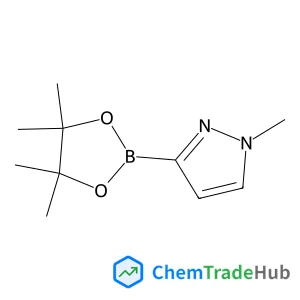
1-Methyl-3-(4,4,5,5-tetramethyl-1,3,2-dioxaborolan-2-yl)-1H-pyrazole
CAS Number:
1020174-04-2
Molecular Formula:
C10H17BN2O2
![[4-(Heptyloxy)phenyl]boronic acid structure](https://static.chemtradehub.com/structs/136/136370-19-9-ad33.webp "[4-(Heptyloxy)phenyl]boronic acid structure")
Recommended Suppliers





Disclaimer
This page provides academic journal information for reference and research purposes only. We are not affiliated with any journal publishers and do not handle publication submissions. For publication-related inquiries, please contact the respective journal publishers directly.
If you notice any inaccuracies in the information displayed, please contact us at support@chemtradehub.com. We will promptly review and address your concerns.