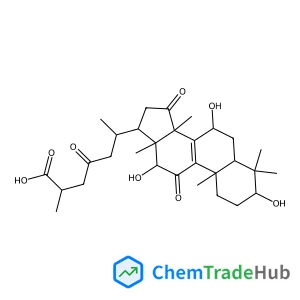
(3beta,7beta,12beta)-3,7,12-Trihydroxy-11,15,23-trioxolanost-8-en-26-oic acid
CAS Number:
98665-22-6
Molecular Formula:
C30H44O8
Zong-Yan Zhao, Qing-Ju Liu
Using DFT + U calculations, the crystal structure and electronic properties of nonmetal co-doping with sulfur in anatase TiO2 are systematically investigated. The initial purpose of this work is to improve the photocatalytic performance of S mono-doped TiO2, in which S occupies the lattice Ti site and acts as a recombination center. Among eight nonmetal impurities that occupy the interstitial site of a TiO6 octahedron, the synergistic effects of B, C, and O with S could achieve this purpose: suppressing the recombination of photogenerated electron–hole pairs by inducing a local inner built-in electric field and eliminating the deep impurity energy bands of S mono-doped TiO2. Furthermore, the photon absorption could be extended to the visible-light region, owing to the overlap of impurity energy bands with the top of the valence band or the bottom of the conduction band. Thus, Ti1−xO2SxBy, Ti1−xO2SxCy and Ti1−xO2SxOy could be considered as promising efficient photocatalysts. Furthermore, the underlying mechanism and tendency of these synergistic effects have been discussed, according to the relationship between the photocatalytic performance and the crystal or electronic structure.
E. Voss, B. Vigolo, G. Medjahdi, C. Hérold, J.-F. Marêché, J. Ghanbaja, F. Le Normand, V. Mamane
DOI: 10.1039/C6CP08568G
Carlie M. Novak, Ryan C. Fortenberry
DOI: 10.1039/C6CP08140A
Ryansu Sai, Kazuhide Ueno, Kenta Fujii, Yohei Nakano, Naho Shigaki, Hiromori Tsutsumi
DOI: 10.1039/C6CP08386B
L. A. Ferreira, V. N. Uversky, B. Y. Zaslavsky
DOI: 10.1039/C6CP08214A
R. Sasai, Y. Kato, W. Soontornchaiyakul, H. Usami, A. Masumori, W. Norimatsu
DOI: 10.1039/C6CP07250J
Marnik Bercx, Nasrin Sarmadian, Rolando Saniz, Bart Partoens, Dirk Lamoen
DOI: 10.1039/C7CP90033C
Hao Jin, Jianwei Li, Ying Dai, Yadong Wei
DOI: 10.1039/C6CP08158D
Hua-Bin Sun, Ying-Xian Zhou, Lu-Lu Zhang, Xue-Lin Yang, Xing-Zhong Cao, Hanu Arave, Hui Fang, Gan Liang
DOI: 10.1039/C6CP07760A
DOI: 10.1039/C6CP07597E
When handling 4-(2-Furylmethyl)thiomorpholine 1,1-dioxide (CAS: 79206-94-3), it ...
When handling 4-Chloro-N-[2-(4-morpholinyl)ethyl]benzamide (CAS: 71320-77-9), it...
Waste containing this compound (CAS: 62921-74-8) should be handled according to ...
Waste containing (S)-Methyl 2-amino-3-cyclohexylpropanoate should be collected i...
This compound can be synthesized using a multi-step process involving the conjug...
There are several alternatives to (2E)-3-(3,4-Dichlorophenyl)acrylic acid in syn...
Ethyl 6-(2-nitrophenyl)imidazo[2,1-b][1,3]thiazole-3-carboxylate (CAS: 925437-84...
Waste containing 2-(1,3-Thiazol-2-yl)ethanamine (CAS: 18453-07-1) should be coll...
Methyl 5-iodo-2-methylbenzoate can be synthesized through the iodination of meth...
5-Chloro[1,2,4]triazolo[1,5-a]pyridine is commonly synthesized via the condensat...

Physical Chemistry Chemical Physics (PCCP) is an international journal co-owned by 19 physical chemistry and physics societies from around the world. This journal publishes original, cutting-edge research in physical chemistry, chemical physics and biophysical chemistry. To be suitable for publication in PCCP, articles must include significant innovation and/or insight into physical chemistry; this is the most important criterion that reviewers and Editors will judge against when evaluating submissions. The journal has a broad scope and welcomes contributions spanning experiment, theory, computation and data science. Topical coverage includes spectroscopy, dynamics, kinetics, statistical mechanics, thermodynamics, electrochemistry, catalysis, surface science, quantum mechanics, quantum computing and machine learning. Interdisciplinary research areas such as polymers and soft matter, materials, nanoscience, energy, surfaces/interfaces, and biophysical chemistry are welcomed if they demonstrate significant innovation and/or insight into physical chemistry. Joined experimental/theoretical studies are particularly appreciated when complementary and based on up-to-date approaches.
![1,2-Diphenyl-4-[2-(phenylsulfinyl)ethyl]-3,5-pyrazolidinedione structure](https://static.chemtradehub.com/structs/57-/57-96-5-efcc.webp "1,2-Diphenyl-4-[2-(phenylsulfinyl)ethyl]-3,5-pyrazolidinedione structure")