












Regioisomeric wide-band-gap polymers with different fluorine topologies for non-fullerene organic solar cells
Literature Information
Publication Date
2018-12-04
DOI
10.1039/C8PY01458B
Impact Factor
5.582
Authors
Yuxiang Li, Jin-Woo Lee, Minseok Kim, Changyeon Lee, Young Woong Lee, Bumjoon J. Kim, Han Young Woo
View Original
Abstract
Two regioisomeric wide-band-gap donor polymers with different fluorine topologies are designed and synthesized for use in nonfullerene organic solar cells (NFOSCs). Two fluorine atoms are substituted on the phenylene moiety in an anti (PTBDD2F-a) or a syn (PTBDD2F-s) fashion. The two isomeric polymers show nearly identical optical, thermal, and electrochemical properties, but exhibit different interchain packing and film morphologies in both pristine and blend films with an n-type acceptor (ITIC). These different morphological properties are related to differences in the molecular dipole, symmetry, and backbone curvatures of PTBDD2F-a and PTBDD2F-s, which influence the interchain packing and resulting electrical properties. From grazing incidence X-ray scattering measurements, PTBDD2F-a:ITIC shows more pronounced and two separate out-of-plane (010) peaks compared to PTBDD2F-s:ITIC, suggesting a stronger face-on cofacial packing of ITIC molecules in the PTBDD2F-a:ITIC blend. A higher domain purity (1.00 vs. 0.71) is also observed for PTBDD2F-a:ITIC compared to PTBDD2F-s:ITIC in the resonant soft X-ray scattering measurements. These different morphological features induce ∼2.5 times higher hole mobility and ∼6 times higher electron mobility with higher power conversion efficiency (6.60 vs. 5.47%) for PTBDD2F-a:ITIC than for PTBDD2F-s:ITIC. This comparative study highlights the effects of different fluorine topologies along the polymer backbone, which should be carefully considered to optimize the blend morphology and optoelectronic properties of NFOSCs.
Related Literature
Role of polar side chains in Li+ coordination and transport properties of polyoxetane-based polymer electrolytes
Ryansu Sai, Kazuhide Ueno, Kenta Fujii, Yohei Nakano, Naho Shigaki, Hiromori Tsutsumi
2017-01-23
Paper
DOI: 10.1039/C6CP08386B
Covalent functionalization of polyhedral graphitic particles synthesized by arc discharge from graphite
E. Voss, B. Vigolo, G. Medjahdi, C. Hérold, J.-F. Marêché, J. Ghanbaja, F. Le Normand, V. Mamane
2017-01-26
Paper
DOI: 10.1039/C6CP08568G
Layered structure of the near-surface region of oxidized chalcopyrite (CuFeS2): hard X-ray photoelectron spectroscopy, X-ray absorption spectroscopy and DFT+U studies
Yuri Mikhlin, Vladimir Nasluzov, Alexander Romanchenko, Yevgeny Tomashevich, Alexey Shor, Roberto Félix
2017-01-09
Paper
DOI: 10.1039/C6CP07598C
A new approach to distance measurements between two spin labels in the >10 nm range
2017-01-27
Paper
DOI: 10.1039/C6CP07597E
Hydration of the simplest α-keto acid: a rotational spectroscopic and ab initio study of the pyruvic acid–water complex
Elijah G. Schnitzler, Nathan A. Seifert, Supriya Ghosh, Javix Thomas, Yunjie Xu, Wolfgang Jäger
2017-01-17
Paper
DOI: 10.1039/C6CP08741H
Charge transport mechanisms in sol–gel grown La0.7Pb0.3MnO3/LaAlO3 manganite films
Eesh Vaghela, M. J. Keshvani, Keval Gadani, Zalak Joshi, Hetal Boricha, K. Asokan, D. Venkateshwarlu, V. Ganesan, N. A. Shah, P. S. Solanki
2017-01-31
Paper
DOI: 10.1039/C6CP07730G
Nonadiabatic Renner–Teller quantum dynamics of OH(X2Π) + H+ reactive collisions
Pablo Gamallo, Sinan Akpinar, Paolo Defazio, Carlo Petrongolo
2017-01-09
Paper
DOI: 10.1039/C6CP07756K
The water association band as a marker of hydrogen bonds in trehalose amorphous matrices
Sergio Giuffrida, Lorenzo Cordone
2017-01-04
Paper
DOI: 10.1039/C6CP06848K
Molecular aggregation of naphthalimide organic semiconductors assisted by amphiphilic and lipophilic interactions: a joint theoretical and experimental study
I. Arrechea-Marcos, M. J. Mancheño, M. C. Ruiz Delgado, M. M. Ramos, J. A. Quintana, J. M. Villalvilla, M. A. Díaz-García, J. T. López Navarrete, R. Ponce Ortiz, J. L. Segura
2017-02-03
Paper
DOI: 10.1039/C6CP06819G
Photoassist-phosphorylated TiO2 as a catalyst for direct formation of 5-(hydroxymethyl)furfural from glucose
Masashi Hattori, Keigo Kamata
2016-12-23
Paper
DOI: 10.1039/C6CP06864B
You might also like
Compound Q&A
What precautions should be taken when handling 4-(2-Furylmethyl)thiomorpholine 1,1-dioxide (CAS: 79206-94-3)?
When handling 4-(2-Furylmethyl)thiomorpholine 1,1-dioxide (CAS: 79206-94-3), it ...
79206-94-34-(2-Furylmethyl)thi...
Compound Q&A
What precautions should be taken when handling 4-Chloro-N-[2-(4-morpholinyl)ethyl]benzamide (CAS: 71320-77-9)?
When handling 4-Chloro-N-[2-(4-morpholinyl)ethyl]benzamide (CAS: 71320-77-9), it...
71320-77-94-Chloro-N-[2-(4-mor...
Compound Q&A
How should waste containing 2-[2-(2-Methoxyethoxy)ethoxy]ethyl 4-methylbenzenesulfonate (CAS: 62921-74-8) be handled?
Waste containing this compound (CAS: 62921-74-8) should be handled according to ...
62921-74-82-[2-(2-Methoxyethox...
Compound Q&A
How should waste containing (S)-Methyl 2-amino-3-cyclohexylpropanoate be handled?
Waste containing (S)-Methyl 2-amino-3-cyclohexylpropanoate should be collected i...
40056-18-6(S)-Methyl 2-amino-3...
Compound Q&A
How is 5-({4-[(2S,4R)-4-Hydroxy-2-methyltetrahydro-2H-pyran-4-yl]-2-thienyl}sulfanyl)-1-methyl-1,3-dihydro-2H-indol-2-one (CAS: 166882-70-8) typically synthesized?
This compound can be synthesized using a multi-step process involving the conjug...
166882-70-85-({4-[(2S,4R)-4-Hyd...
Compound Q&A
Are there alternatives to (2E)-3-(3,4-Dichlorophenyl)acrylic acid (CAS: 7312-27-8) in synthesis?
There are several alternatives to (2E)-3-(3,4-Dichlorophenyl)acrylic acid in syn...
7312-27-8(2E)-3-(3,4-Dichloro...
Compound Q&A
How should Ethyl 6-(2-nitrophenyl)imidazo[2,1-b][1,3]thiazole-3-carboxylate (CAS: 925437-84-9) be stored?
Ethyl 6-(2-nitrophenyl)imidazo[2,1-b][1,3]thiazole-3-carboxylate (CAS: 925437-84...
925437-84-9Ethyl 6-(2-nitrophen...
Compound Q&A
How should waste containing 2-(1,3-Thiazol-2-yl)ethanamine (CAS: 18453-07-1) be handled?
Waste containing 2-(1,3-Thiazol-2-yl)ethanamine (CAS: 18453-07-1) should be coll...
18453-07-12-(1,3-Thiazol-2-yl)...
Compound Q&A
How is Methyl 5-iodo-2-methylbenzoate (CAS: 103440-54-6) typically synthesized?
Methyl 5-iodo-2-methylbenzoate can be synthesized through the iodination of meth...
103440-54-6Methyl 5-iodo-2-meth...
Compound Q&A
How is 5-Chloro[1,2,4]triazolo[1,5-a]pyridine (CAS: 1427399-34-5) typically synthesized?
5-Chloro[1,2,4]triazolo[1,5-a]pyridine is commonly synthesized via the condensat...
1427399-34-55-Chloro[1,2,4]triaz...
Source Journal
Polymer Chemistry

CiteScore:
8.6
Self-citation Rate:
7.3%
Articles per Year:
457
Polymer Chemistry welcomes submissions in all areas of polymer science that have a strong focus on macromolecular chemistry. Manuscripts may cover a broad range of fields, yet no direct application focus is required.
Recommended Compounds
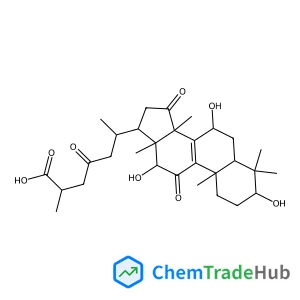
(3beta,7beta,12beta)-3,7,12-Trihydroxy-11,15,23-trioxolanost-8-en-26-oic acid
CAS Number:
98665-22-6
Molecular Formula:
C30H44O8
Recommended Suppliers






Disclaimer
This page provides academic journal information for reference and research purposes only. We are not affiliated with any journal publishers and do not handle publication submissions. For publication-related inquiries, please contact the respective journal publishers directly.
If you notice any inaccuracies in the information displayed, please contact us at support@chemtradehub.com. We will promptly review and address your concerns.