












Nickel and palladium complexes with fluorinated alkyl substituted α-diimine ligands for living/controlled olefin polymerization
Literature Information
Publication Date
2018-02-16
DOI
10.1039/C8PY00201K
Impact Factor
5.582
Authors
Robert Mundil, Anatolij Sokolohorskyj, Jan Hošek, Josef Cvačka, Ivana Císařová, Jaroslav Kvíčala, Jan Merna
View Original
Abstract
A series of six nickel and two palladium novel complexes bearing α-diimine ligands with fluorinated alkyl substituents in para-aryl positions was prepared. Two nickel complexes were structurally characterized by X-ray diffraction. Upon activation by methylaluminoxane or borate, the complexes were tested in ethene, propene, and hex-1-ene polymerization using toluene and chlorobenzene. Propene and hex-1-ene polymerization initiated by nickel complexes and ethene polymerization initiated by palladium complexes showed living/controlled character and yielded high molar mass polyolefins with narrow molar mass dispersity (Đ < 1.2). The effect of fluoroalkyl substituents on catalyst activity, thermal stability and chain-walking is only minor. The branching density of polyolefins can be regulated more efficiently by the variation of ortho-aryl and backbone substituents of α-diimine ligands. The topology of polyethylenes prepared by palladium complexes at low ethene pressure is dendritic as shown by Mark–Houwink plots and g′ values obtained from SEC with viscometric detection. The solubility of most of the complexes in fluorinated solvents is limited with the exception of palladium methyl chloride derivatives which suggest the promising method for further design of catalysts suitable for interphase polymerization.
Related Literature
Domino ‘Staudinger–aza-Wittig–1,5-phosphonium-rearrangement–fragmentation’ reactions of 1-azido-2-hydroxy-4,6-dioxohexanes
Peter Langer, Heydar Shojaei
2003-10-31
Communication
DOI: 10.1039/B310701A
The key intermediates that interact with the fluorophores in the peroxyoxalate chemiluminescence reaction of 2,4,6-trichlorophenyl N-aryl-N-tosyloxamates
Ryu Koike, Jiro Motoyoshiya, Yutaka Takaguchi, Hiromu Aoyama
2003-02-25
Communication
DOI: 10.1039/B300079F
A novel AlEt3-promoted tandem reductive rearrangement of 1-benzyloxy-2,3-epoxides: new route to 2-quaternary 1,3-diol units
De Run Li, Wu Jiong Xia, Yong Qiang Tu, Fu Min Zhang, Lei Shi
2003-02-25
Communication
DOI: 10.1039/B209948A
Preparation, structure, and some coordination properties of 2-chloro-3,3-diphenyl-3-thioxo-1-(2,4,6-tri-t-butylphenyl)-1,3-diphosphapropene
Shigekazu Ito, Hongze Liang, Masaaki Yoshifuji
2003-01-13
Communication
DOI: 10.1039/B211230B
Isolation and structural characterization of the first thermally robust and air stable Cr(4+) bent-metallocene complex
Piet-Jan Sinnema, Justin Nairn, Ralph Zehnder, Pamela J. Shapiro, Brendan Twamley, Alex Blumenfeld
2003-11-24
Communication
DOI: 10.1039/B311352C
Novel synthesis of highly active Pt/C cathode electrocatalyst for direct methanolfuel cell
Zhenhua Zhou, Suli Wang, Weijiang Zhou, Guoxiong Wang, Luhua Jiang, Wenzhen Li, Shuqin Song, Jianguo Liu, Gongquan Sun
2003-01-13
Communication
DOI: 10.1039/B211075J
Designed layer assembly: a three-dimensional framework with 74% extra-framework volume by connection of infinite two-dimensional sheets
T. J. Prior, D. Bradshaw, S. J. Teat, M. J. Rosseinsky
2003-01-28
Communication
DOI: 10.1039/B211124C
Concise asymmetric syntheses of (−)-lentiginosine and of its pyrrolizidinic analogue
Tahar Ayad, Yves Génisson, Michel Baltas, Liliane Gorrichon
2003-01-29
Communication
DOI: 10.1039/B212217K
Diastereoselective titanium-mediated construction of cis-2,3-ring annelated 1-(2′-chloroethyl)cyclopropanols
Frédéric Lecornué, Jean Ollivier
2003-01-29
Communication
DOI: 10.1039/B211642A
You might also like
Compound Q&A
What precautions should be taken when handling lithium chloride hydrate (1:1:1) (CAS: 16712-20-2)?
When handling lithium chloride hydrate (1:1:1) (CAS: 16712-20-2), it is importan...
16712-20-2Lithium chloride hyd...
Compound Q&A
Is 4-(4H-1,2,4-Triazol-4-yl)piperidine (CAS: 690261-92-8) safe?
4-(4H-1,2,4-Triazol-4-yl)piperidine is generally considered safe for use in phar...
690261-92-84-(4H-1,2,4-Triazol-...
Compound Q&A
How should waste containing 1,3-Thiazole-2-carboxamide (CAS: 16733-85-0) be handled?
Waste containing 1,3-Thiazole-2-carboxamide (CAS: 16733-85-0) should be collecte...
16733-85-01,3-Thiazole-2-carbo...
Compound Q&A
What regulatory guidelines apply to 5-(Difluoromethyl)-2-fluorobenzonitrile (CAS: 934175-58-3)?
5-(Difluoromethyl)-2-fluorobenzonitrile (CAS: 934175-58-3) is subject to regulat...
934175-58-35-(Difluoromethyl)-2...
Compound Q&A
How is Methyl 3-acetamido-2-thiophenecarboxylate (CAS: 22288-79-5) typically synthesized?
Methyl 3-acetamido-2-thiophenecarboxylate can be synthesized by the reaction of ...
22288-79-5Methyl 3-acetamido-2...
Compound Q&A
What is 4-Isoquinolinecarbonitrile (CAS: 34846-65-6)?
4-Isoquinolinecarbonitrile is a chemical compound with the CAS number 34846-65-6...
34846-65-64-Isoquinolinecarbon...
Compound Q&A
How should Methyl 1H-1,2,3-triazole-4-carboxylate (CAS: 877309-59-6) be stored?
Store Methyl 1H-1,2,3-triazole-4-carboxylate (CAS: 877309-59-6) in a cool, dry p...
877309-59-6Methyl 1H-1,2,3-tria...
Compound Q&A
What regulatory guidelines apply to 6-Bromo[1,3]thiazolo[5,4-b]pyridin-2-amine (CAS: 1160791-13-8)?
6-Bromo[1,3]thiazolo[5,4-b]pyridin-2-amine (CAS: 1160791-13-8) is subject to the...
1160791-13-86-Bromo[1,3]thiazolo...
Compound Q&A
Is (2S,3S)-2-Ammonio-3-(3,4-dihydroxyphenyl)-3-hydroxypropanoate (CAS: 23651-95-8) safe?
(2S,3S)-2-Ammonio-3-(3,4-dihydroxyphenyl)-3-hydroxypropanoate (CAS: 23651-95-8) ...
23651-95-8(2S,3S)-2-Ammonio-3-...
Compound Q&A
What are the physical and chemical properties of 7-bromo-3-methyl-3,4-dihydroquinazolin-4-one (CAS: 1293987-84-4)?
7-Bromo-3-methyl-3,4-dihydroquinazolin-4-one is a solid with a crystalline form....
1293987-84-47-bromo-3-methyl-3,4...
Source Journal
Polymer Chemistry

CiteScore:
8.6
Self-citation Rate:
7.3%
Articles per Year:
457
Polymer Chemistry welcomes submissions in all areas of polymer science that have a strong focus on macromolecular chemistry. Manuscripts may cover a broad range of fields, yet no direct application focus is required.
Recommended Compounds
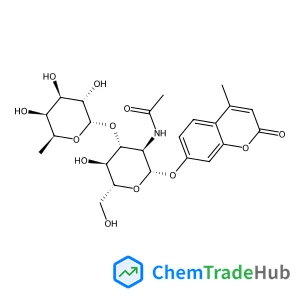
4-Methyl-2-oxo-2H-chromen-7-yl 2-acetamido-2-deoxy-3-O-(6-deoxy-alpha-L-galactopyranosyl)-beta-D-glucopyranoside
CAS Number:
383160-12-1
Molecular Formula:
C24H31NO12
![Ethyl 4-[8-chloro(5,5,6,6,7-~2~H_5_)-5,6-dihydro-11H-benzo[5,6]cyclohepta[1,2-b]pyridin-11-ylidene]-1-piperidinecarboxylate structure](https://static.chemtradehub.com/structs/102/1020719-57-6-37e2.webp "Ethyl 4-[8-chloro(5,5,6,6,7-~2~H_5_)-5,6-dihydro-11H-benzo[5,6]cyclohepta[1,2-b]pyridin-11-ylidene]-1-piperidinecarboxylate structure")
Ethyl 4-[8-chloro(5,5,6,6,7-~2~H_5_)-5,6-dihydro-11H-benzo[5,6]cyclohepta[1,2-b]pyridin-11-ylidene]-1-piperidinecarboxylate
CAS Number:
1020719-57-6
Molecular Formula:
C22H18D5ClN2O2
Recommended Suppliers





Disclaimer
This page provides academic journal information for reference and research purposes only. We are not affiliated with any journal publishers and do not handle publication submissions. For publication-related inquiries, please contact the respective journal publishers directly.
If you notice any inaccuracies in the information displayed, please contact us at support@chemtradehub.com. We will promptly review and address your concerns.