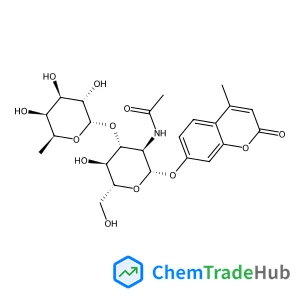
4-Methyl-2-oxo-2H-chromen-7-yl 2-acetamido-2-deoxy-3-O-(6-deoxy-alpha-L-galactopyranosyl)-beta-D-glucopyranoside
CAS Number:
383160-12-1
Molecular Formula:
C24H31NO12
De Run Li, Wu Jiong Xia, Yong Qiang Tu, Fu Min Zhang, Lei Shi
A novel and highly stereoselective tandem rearrangement–reduction reaction of 1-benzyloxy-2,3-epoxide, under the promotion of triethylaluminum (AlEt3), has been developed to construct a quaternary stereocenter and the hydroxymethyl attached to the carbon center in one-step.
Remi Beucher, Vasile Hulea, Claudia Cammarano
DOI: 10.1039/D1RE00258A
Dominique M. Roberge, Paul Hanselmann, Petteri Elsner
DOI: 10.1039/D1RE00264C
Vivek Kumar, Ravinder Kumar Wanchoo, Amrit Pal Toor
DOI: 10.1039/D1RE00149C
Lijuan Jiang, Benyu Sun, Shuangshuang Liu, Mengmeng Du, Qianqian Hu, Honghui Gong, Baozhong Liu
DOI: 10.1039/D1RE00352F
Ning Qi, Michael K. Wismer, Donald V. Conway, Shane W. Krska, Spencer D. Dreher, Shishi Lin
DOI: 10.1039/D1RE00317H
Jing Song, Yongjin Cui, Guangsheng Luo, Jian Deng, Yujun Wang
DOI: 10.1039/D1RE00362C
Jiaqi Yan, Wenjin Ni, Ting Duan, Zhenpan Chen, Fangfang Zhao
DOI: 10.1039/D1RE00269D
When handling lithium chloride hydrate (1:1:1) (CAS: 16712-20-2), it is importan...
4-(4H-1,2,4-Triazol-4-yl)piperidine is generally considered safe for use in phar...
Waste containing 1,3-Thiazole-2-carboxamide (CAS: 16733-85-0) should be collecte...
5-(Difluoromethyl)-2-fluorobenzonitrile (CAS: 934175-58-3) is subject to regulat...
Methyl 3-acetamido-2-thiophenecarboxylate can be synthesized by the reaction of ...
4-Isoquinolinecarbonitrile is a chemical compound with the CAS number 34846-65-6...
Store Methyl 1H-1,2,3-triazole-4-carboxylate (CAS: 877309-59-6) in a cool, dry p...
6-Bromo[1,3]thiazolo[5,4-b]pyridin-2-amine (CAS: 1160791-13-8) is subject to the...
(2S,3S)-2-Ammonio-3-(3,4-dihydroxyphenyl)-3-hydroxypropanoate (CAS: 23651-95-8) ...
7-Bromo-3-methyl-3,4-dihydroquinazolin-4-one is a solid with a crystalline form....

ChemComm publishes urgent research which is of outstanding significance and interest to experts in the field, while also appealing to the journal’s broad chemistry readership. Our communication format is ideally suited to short, urgent studies that are of such importance that they require accelerated publication. Our scope covers all topics in chemistry, and research at the interface of chemistry and other disciplines (such as materials science, nanoscience, physics, engineering and biology) where there is a significant novelty in the chemistry aspects. Major topic areas covered include: Analytical Chemistry Catalysis Chemical Biology and medicinal chemistry Computational Chemistry and Machine Learning Energy and sustainable chemistry Environmental Chemistry Green Chemistry Inorganic Chemistry Materials Chemistry Nanoscience Organic Chemistry Physical Chemistry Polymer Chemistry Supramolecular Chemistry
![(1R,5R)-3-{[(2-Methyl-2-propanyl)oxy]carbonyl}-3-azabicyclo[3.1.0]hexane-1-carboxylic acid structure](https://static.chemtradehub.com/structs/116/1165450-63-4-bfe1.webp "(1R,5R)-3-{[(2-Methyl-2-propanyl)oxy]carbonyl}-3-azabicyclo[3.1.0]hexane-1-carboxylic acid structure")