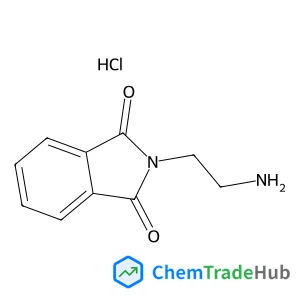
2-(2-Aminoethyl)-1H-isoindole-1,3(2H)-dione hydrochloride (1:1)
CAS Number:
30250-67-0
Molecular Formula:
C10H11ClN2O2
Masaaki Suzuki, Ryuichiro Taniguchi
Doubly N-fused hexaphyrins were synthesized from meso-aryl substituted hexaphyrins and X-ray crystallography revealed that syn- or anti-double N-fusion occurred, depending on the positions of meso-substituents.

Colloid Journal

Topics in Catalysis

Atomization and Sprays

Journal of Asian Natural Products Research

Herald of the Russian Academy of Sciences

Bioorganic & Medicinal Chemistry Letters

Medicinal Chemistry Research

Heteroatom Chemistry

Journal of the Indian Institute of Science

Biocatalysis and Biotransformation
Janice B. Rabor, Koki Kawamura, Junichi Kurawaki, Yasuro Niidome
DOI: 10.1039/C9AN00247B
Ryan M. Bock, Bryan J. McEntire, Tetsuya Adachi, Wenliang Zhu, Osam Mazda
DOI: 10.1039/C8AN00233A
Yuqing Hou, Wen Zhang, Shengtao Li, Zhen Wang, Huiqing Zhong, Zhiming Liu, Zhouyi Guo
DOI: 10.1039/C8AN00405F
Hongfang Gao, Hetong Qi, Yijin Peng, Honglan Qi, Chengxiao Zhang
DOI: 10.1039/C8AN00640G
(1R,3S)-1,3-Cyclopentanediol finds applications in various industries. In the ph...
When handling N'-[4-(Dimethylamino)phenyl]-N,N-dimethyl-1,4-benzenediamine, it i...
There are several alternatives to 5-(2,4-Difluorophenyl)-2-methoxypyrimidine in ...
1-(3-Methoxyphenoxy)propan-2-ol (CAS: 382141-68-6) must comply with the Globally...
Tetrodotoxin Citrate is extremely dangerous and should be handled with extreme c...
2-Methyl-2-propanyl [(1R,3S)-3-hydroxycyclopentyl]carbamate (CAS: 225641-84-9) i...
Waste containing 4-(2-Hydroxyhexafluoroisopropyl)Benzoic Acid (CAS: 16261-80-6) ...
2-Methyl-2-proanyl {(2S)-1-[(benzyloxy)amino]-3-hydroxy-3-methyl-1-oxo-2-butanyl...
Benzeneethanamine, α-ethyl-, hydrochloride (1:1) is an organic compound with the...
In the synthesis of compounds similar to 3-{(E)-[4-(Dimethylamino)phenyl]diazeny...

ChemComm publishes urgent research which is of outstanding significance and interest to experts in the field, while also appealing to the journal’s broad chemistry readership. Our communication format is ideally suited to short, urgent studies that are of such importance that they require accelerated publication. Our scope covers all topics in chemistry, and research at the interface of chemistry and other disciplines (such as materials science, nanoscience, physics, engineering and biology) where there is a significant novelty in the chemistry aspects. Major topic areas covered include: Analytical Chemistry Catalysis Chemical Biology and medicinal chemistry Computational Chemistry and Machine Learning Energy and sustainable chemistry Environmental Chemistry Green Chemistry Inorganic Chemistry Materials Chemistry Nanoscience Organic Chemistry Physical Chemistry Polymer Chemistry Supramolecular Chemistry
![N,N'-1,2-Ethanediylbis[2-(vinylsulfonyl)acetamide] structure](https://static.chemtradehub.com/structs/667/66710-66-5-b556.webp "N,N'-1,2-Ethanediylbis[2-(vinylsulfonyl)acetamide] structure")