












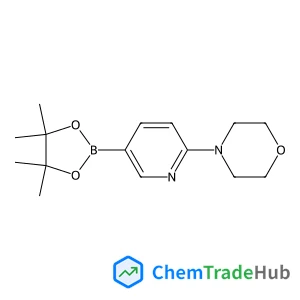
4-(5-(4,4,5,5-tetramethyl-1,3,2-dioxaborolan-2-yl)pyridin-2-yl)morpholine
CAS Number:
485799-04-0
Molecular Formula:
C15H23BN2O3
Yujie Wu, Runze Wu, Dhanaraju Mandalapu, Xinjian Ji, Tuo Chen, Wei Ding, Qi Zhang
The radical S-adenosylmethionine (SAM) superfamily is currently the largest known enzyme family. These enzymes reductively cleave SAM to produce a highly reactive 5′-deoxyadenosyl (dAdo) radical, which abstracts a hydrogen from the substrate and initiates diverse reactions. The canonic dAdo radical-mediated hydrogen abstraction can be changed to radical addition reactions by using olefin-containing substrate analogues, which result in adenosylation reactions. Here we report investigation of the adenosylation reactions catalyzed by four radical SAM L-Tyr lyases (RSTLs), including HydG, FbiC, and two ThiH enzymes from different organisms. We show RSTLs have diverse substrate specificity, and ThiH from E. coli exhibits the highest substrate tolerance toward the tested substrates. We also show ThiH from Clostridium berjerinckii does not act on 4-amino-L-phenylalanine, but catalyzes adenosylation of the corresponding olefin-containing analogue, suggesting adenosylation may occur more easily than the canonic radical SAM reactions. Our study highlights the remarkable catalytic promiscuity of radical SAM enzyme and the potential in using these enzymes for the synthesis of nucleotide-containing compounds.
Patrick Taylor, Paul M. Lahti
DOI: 10.1039/B411574K
Atsushi Shimojima
DOI: 10.1039/B411794H
Donald H. McCullough, III, Steven L. Regen
DOI: 10.1039/B410027C
Yahong Zhang, Xijuan Yu, Xiaoyan Wang, Wei Shan, Pengyuan Yang, Yi Tang
DOI: 10.1039/B411336E
DOI: 10.1039/B300963G
Bas G. G. Lohmeijer, Daan Wouters, Zhihui Yin, Ulrich S. Schubert
DOI: 10.1039/B411777H
Stefano Sforza, Tullia Tedeschi, Roberto Corradini, Arnaldo Dossena, Rosangela Marchelli
DOI: 10.1039/B212718K
Richard T. Baker, Leila Naji, Karen Lochhead, John A. Chudek
DOI: 10.1039/B301039B
Toshiaki Mori, Yoshimi Sekine, Kenji Yamamoto, Yoshio Okahata
DOI: 10.1039/B411082J
Hao Chen, Xubin Zheng, Pengxiang Yang, R. Graham Cooks
DOI: 10.1039/B314713D
(1R,3S)-1,3-Cyclopentanediol finds applications in various industries. In the ph...
When handling N'-[4-(Dimethylamino)phenyl]-N,N-dimethyl-1,4-benzenediamine, it i...
There are several alternatives to 5-(2,4-Difluorophenyl)-2-methoxypyrimidine in ...
1-(3-Methoxyphenoxy)propan-2-ol (CAS: 382141-68-6) must comply with the Globally...
Tetrodotoxin Citrate is extremely dangerous and should be handled with extreme c...
2-Methyl-2-propanyl [(1R,3S)-3-hydroxycyclopentyl]carbamate (CAS: 225641-84-9) i...
Waste containing 4-(2-Hydroxyhexafluoroisopropyl)Benzoic Acid (CAS: 16261-80-6) ...
2-Methyl-2-proanyl {(2S)-1-[(benzyloxy)amino]-3-hydroxy-3-methyl-1-oxo-2-butanyl...
Benzeneethanamine, α-ethyl-, hydrochloride (1:1) is an organic compound with the...
In the synthesis of compounds similar to 3-{(E)-[4-(Dimethylamino)phenyl]diazeny...

Organic & Biomolecular Chemistry (OBC) publishes original and high impact research and reviews in organic chemistry. We welcome research that shows new or significantly improved protocols or methodologies in total synthesis, synthetic methodology or physical and theoretical organic chemistry as well as research that shows a significant advance in the organic chemistry or molecular design aspects of chemical biology, catalysis, supramolecular and macromolecular chemistry, theoretical chemistry, mechanism-oriented physical organic chemistry, medicinal chemistry or natural products. Articles published in the journal should report new work which makes a highly-significant impact in the field. Routine and incremental work is generally not suitable for publication in the journal. More details about key areas of our scope are below. In all cases authors should include in their article clear rationale for why their research has been carried out.
![Ethyl 3-((6-(4,5-dihydro-1H-benzo[d]azepin-3(2H)-yl)-2-(pyridin-2-yl)pyrimidin-4-yl)amino)propanoate structure](https://static.chemtradehub.com/structs/137/1373423-53-0-496a.webp "Ethyl 3-((6-(4,5-dihydro-1H-benzo[d]azepin-3(2H)-yl)-2-(pyridin-2-yl)pyrimidin-4-yl)amino)propanoate structure")
![N-[(5,6-Dichloro-1H-benzimidazol-2-yl)methyl]-9-(1-methyl-1H-pyrazol-4-yl)-2-(4-morpholinyl)-9H-purin-6-amine structure](https://static.chemtradehub.com/structs/238/2387704-62-1-25f4.webp "N-[(5,6-Dichloro-1H-benzimidazol-2-yl)methyl]-9-(1-methyl-1H-pyrazol-4-yl)-2-(4-morpholinyl)-9H-purin-6-amine structure")






