











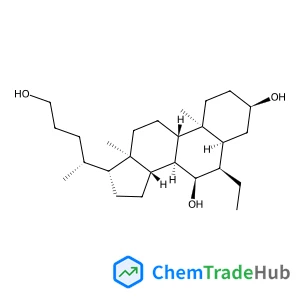
(3alpha,5beta,6alpha,7alpha)-6-Ethylcholane-3,7,24-triol
CAS Number:
1537866-49-1
Molecular Formula:
C26H46O3
Attoor Chandrasekhar, Venkatachalam Ramkumar, Sethuraman Sankararaman
Pd(II) catalyzed direct C–H carbonylative annulation of N,1-diaryl-1H-tetrazol-5-amines and N,4-diaryl-4H-1,2,4-triazol-3-amines gave the corresponding triazole and tetrazole fused quinazolinones in good yields. This methodology offers a convenient method for the synthesis of these important heterocyclic scaffolds in a highly atom economical process. On the mechanistic aspect weakly nucleophilic triazole and tetrazole moieties function as both directing as well as intramolecular nucleophiles. The catalytically active C–H activated intermediate dimeric Pd complex was isolated and characterized which on exposure to CO gas gave the corresponding tetrazole fused quinazolinone derivative. On the basis of isolation of the intermediate and observed kinetic isotope effects, a mechanism has been proposed for the C–H activated direct carbonylative annulation reaction.
Jingwen Xiong, Zongzhi Li, Jihua Tan, Shaomin Ji, Jianwei Sun, Xianwei Li, Yanping Huo
DOI: 10.1039/C8AN00940F
Chen Zeng, Fanghao Hu, Rong Long, Wei Min
DOI: 10.1039/C8AN00910D
Stephan Vogt, Marco Kelkenberg, Tanja Nöll, Benedikt Steinhoff, Holger Schönherr, Hans Merzendorfer, Gilbert Nöll
DOI: 10.1039/C8AN01453A
Borja Cantero-Tubilla, Larry P. Walker
DOI: 10.1039/C8AN01137K
Arthur Schönhals, Hans Tholl, Mathias Glasmacher, Niels Kröger-Lui, Annemarie Pucci, Wolfgang Petrich
DOI: 10.1039/C6AN01757F
Gerardo Gutiérrez-Juárez, David Cywiak, Rafael Pérez-Solano, Gary A. Baker
DOI: 10.1039/C6AN02662A
Aamar F. Khan, Dale A. C. Brownson, Christopher W. Foster, Graham C. Smith, Craig E. Banks
DOI: 10.1039/C7AN00323D
Rosa A. S. Couto, Lifu Chen, Sabine Kuss, Richard G. Compton
DOI: 10.1039/C8AN01675E
N. E. Dina, H. Zhou, A. Colniţă, N. Leopold, C. Coman, C. Haisch
DOI: 10.1039/C7AN00106A
N-(4-Methoxybenzyl)-2-pyridinamine (CAS: 52818-63-0) is increasingly being used ...
When handling Ethyl 4-(2-chlorophenyl)-1,3-thiazole-2-carboxylate, appropriate p...
Diethyldiselane (CAS: 628-39-7) is classified under the Globally Harmonized Syst...
The market for oxocopper (CAS: 12053-18-8) is primarily driven by its use in cat...
The market for 5-{[(2-Methyl-2-propanyl)oxy]carbonyl}-5-azaspiro[2.4]heptane-7-c...
2-(1-Pyrrolidinyl)-4-pyridinamine is a chemical compound with the CAS number 359...
2-(3-Pyridinyl)-1-azabicyclo[2.2.2]octane (CAS: 91556-75-1) is a crystalline sol...
(S)-Alpha-allyl-proline hydrochloride is usually synthesized via a Wittig reacti...
3-Methyl-1,2-oxazole-5-carboxylic acid (CAS: 4857-42-5) is an organic compound w...
Lys-SMCC-DM1 is synthesized via a multi-step process involving the coupling of S...

Organic & Biomolecular Chemistry (OBC) publishes original and high impact research and reviews in organic chemistry. We welcome research that shows new or significantly improved protocols or methodologies in total synthesis, synthetic methodology or physical and theoretical organic chemistry as well as research that shows a significant advance in the organic chemistry or molecular design aspects of chemical biology, catalysis, supramolecular and macromolecular chemistry, theoretical chemistry, mechanism-oriented physical organic chemistry, medicinal chemistry or natural products. Articles published in the journal should report new work which makes a highly-significant impact in the field. Routine and incremental work is generally not suitable for publication in the journal. More details about key areas of our scope are below. In all cases authors should include in their article clear rationale for why their research has been carried out.
![N-{[(2-Methyl-2-propanyl)oxy]carbonyl}-L-methionylglycine structure](https://static.chemtradehub.com/structs/234/23446-03-9-e1e5.webp "N-{[(2-Methyl-2-propanyl)oxy]carbonyl}-L-methionylglycine structure")




