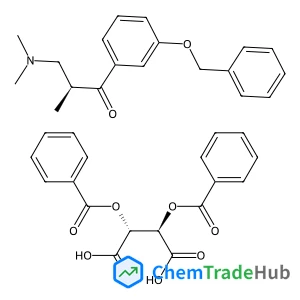
(S)-1-(3-(Benzyloxy)phenyl)-3-(dimethylamino)-2-methylpropan-1-one (2r,3r)-2,3-bis(benzoyloxy)succinate
CAS Number:
1004315-81-4
Molecular Formula:
C37H37NO10
Bruno Drouillat, Cristina Peggion, Barbara Biondi, Karen Wright, François Couty, Marco Crisma
Unlike the extensively investigated relationship between the peptide β-bend ribbon and its prototypical 310-helix conformation, the corresponding relationship between the narrower γ-bend ribbon and its regular γ-helix counterpart still remains to be studied, as the latter 3D-structures have not yet been experimentally authenticated. In this paper, we describe the results of the first characterization, both in the crystal state and in solution, of the γ-bend ribbon conformation using X-ray diffraction and FT-IR absorption, electronic CD and 2D-NMR spectroscopies applied to an appropriate set of synthetic, homo-chiral, sequential dipeptide oligomers based on (S)-Ala and the known γ-bend inducer, Cα-tetrasubstituted, N-alkylated α-amino acid residue (S)-Cα-methyl-azetidine-carboxylic acid.
Sadu Nageswara Rao, Darapaneni Chandra Mohan, Subbarayappa Adimurthy
DOI: 10.1039/C4GC01402B
David J. Chadderdon, Le Xin, Ji Qi, Yang Qiu, Phani Krishna, Karren L. More, Wenzhen Li
DOI: 10.1039/C4GC00401A
Yong Yang, Robert M. Rioux
DOI: 10.1039/C4GC00642A
Paula M. Uberman, Natalia J. S. Costa, Rafaela C. Carmona, Alcindo A. Dos Santos, Liane M. Rossi
DOI: 10.1039/C4GC00669K
Valeria Bugatti, Bluma Guenther Soares
DOI: 10.1039/C4GC00969J
Rongchang Luo, Xiantai Zhou, Wuying Zhang, Zhongxiu Liang, Jun Jiang, Hongbing Ji
DOI: 10.1039/C4GC00671B
Yajun Zhang, Guohua Zhao, Yanan Zhang, Xiaofeng Huang
DOI: 10.1039/C4GC00454J
Samuel E. Evans, John Z. Staniforth, Richard J. Darton, R. Mark Ormerod
DOI: 10.1039/C4GC00782D
Zhicheng Jiang, Ting He, Jianmei Li, Changwei Hu
DOI: 10.1039/C4GC00620H
B. S. Rajput, S. R. Gaikwad, S. K. Menon, S. H. Chikkali
DOI: 10.1039/C4GC00543K
2-Methylbenzene-1,4-diamine dihydrochloride (CAS: 615-45-2) should be stored in ...
(1S,4S)-2,5-Diazabicyclo[2.2.1]heptane dihydrobromide is generally considered sa...
(6-Chloropyridazin-3-YL)methanamine finds applications in the pharmaceutical ind...
2-Fluoro-3-methylphenol is primarily used in the synthesis of pharmaceuticals, p...
When handling 3-Methoxy-4-nitrobenzonitrile, it is important to wear appropriate...
When handling 1,3-Oxazolo[4,5-b]pyridine-2(3H)-thione (CAS: 211949-57-4), it is ...
4-Ethynylbenzamide (CAS: 90347-86-7) falls under various regulatory guidelines i...
3-(2-Ethylphenyl)-2-thioxo-4-imidazolidinone is primarily used as an intermediat...
(2-Fluoro-6-methoxyphenyl)acetic acid, also known as 4-fluoro-3-methoxybenzoic a...
Market trends for 2-[4-(Hydroxymethyl)phenoxy]ethanol (CAS: 102196-18-9) indicat...

Organic & Biomolecular Chemistry (OBC) publishes original and high impact research and reviews in organic chemistry. We welcome research that shows new or significantly improved protocols or methodologies in total synthesis, synthetic methodology or physical and theoretical organic chemistry as well as research that shows a significant advance in the organic chemistry or molecular design aspects of chemical biology, catalysis, supramolecular and macromolecular chemistry, theoretical chemistry, mechanism-oriented physical organic chemistry, medicinal chemistry or natural products. Articles published in the journal should report new work which makes a highly-significant impact in the field. Routine and incremental work is generally not suitable for publication in the journal. More details about key areas of our scope are below. In all cases authors should include in their article clear rationale for why their research has been carried out.
![[1-(5-Methyl-2-pyridinyl)-1H-pyrazol-4-yl]methanol structure](https://static.chemtradehub.com/structs/143/1439822-99-7-6cc9.webp "[1-(5-Methyl-2-pyridinyl)-1H-pyrazol-4-yl]methanol structure")
![1H-Imidazo[4,5-c]pyridine-7-carboxylic acid structure](https://static.chemtradehub.com/structs/123/1234616-39-7-1344.webp "1H-Imidazo[4,5-c]pyridine-7-carboxylic acid structure")