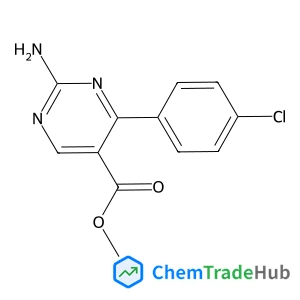
Methyl 2-amino-4-(4-chlorophenyl)-5-pyrimidinecarboxylate
CAS Number:
1133115-56-6
Molecular Formula:
C12H10ClN3O2
Changchun Yuan, Shangyong Zhong, Xingyi Li, Yanhong Wang, Miao-Miao Xun, Yunli Bai, Kongkai Zhu
Total synthesis and absolute configuration confirmation of γ-elemene-type sesquiterpenes, which possess vast potential for biological activities, was investigated based on a convergent synthetic strategy. A key intermediate with all functional groups of this family of natural products was accessed by an intermolecular aldol reaction and then an acetylation of a known ketone (12) derived from commercially available verbenone. The versatile intermediate can be easily transformed into structurally different γ-elemene-type sesquiterpenes based on control of base-promoted cyclization manipulation in different solvents. The utility of this robust approach is illustrated by the first syntheses of elema-1,3,7(11),8-tetraen-8,12-lactam (4′) and 8β-methoxy-isogermafurenolide (6a), as well as the syntheses of elem-1,3,7,8-tetraen-8,12-olide (3) and hydroxyisogermafurenolide (5) in only 6 or 7 steps. In addition, the structure of the reported 5βH-elem-1,3,7,8-tetraen-8,12-olide (1) was revised as elem-1,3,7,8-tetraen-8,12-olide (3) by comparison of their identified datum, and the absolute configuration of elema-1,3,7(11),8-tetraen-8,12-lactam was confirmed as 4′. Furthermore, the inhibitory effect of all synthesized natural compounds and their natural analogues on cancer cell proliferation was evaluated. Among them compounds 3, 4 and 4′ were found to possess potent inhibitory activity against Kasumi-1 and Pfeiffer. Meanwhile, preliminary structure–activity relationships for these compounds are discussed.
Fei liu, Maïté Audemar, Karine De Oliveira Vigier, Jean-Marc Clacens, Floryan De Campo, François Jérôme
DOI: 10.1039/C4GC01158A
Yuchao Lu, Peng Wei, Yuxin Pei, Hengfu Xu, Xiaoting Xin
DOI: 10.1039/C4GC00770K
Yong Yang, Robert M. Rioux
DOI: 10.1039/C4GC00642A
Yves Schellekens, Bert Van Trimpont, Pieter-Jan Goelen, Koen Binnemans, Mario Smet, Marie-Anne Persoons, Dirk De Vos
DOI: 10.1039/C4GC00873A
Alexander Gutmann, Linda Bungaruang, Hansjoerg Weber, Mario Leypold, Rolf Breinbauer
DOI: 10.1039/C4GC00960F
Sarah Kirchhecker, Markus Antonietti, Davide Esposito
DOI: 10.1039/C4GC00564C
A. Figoli, T. Marino, S. Simone, E. Di Nicolò, X.-M. Li, T. He, S. Tornaghi, E. Drioli
DOI: 10.1039/C4GC00613E
Shota Kanno, Kenichi Kon
DOI: 10.1039/C4GC00735B
Kanagasabai Balamurugan, Noppadon Sathitsuksanoh, Sonny Zhang, Venkatesan Subramanian
DOI: 10.1039/C4GC00373J
Wei Luo, Bien Tan
DOI: 10.1039/C4GC00822G
2-Methylbenzene-1,4-diamine dihydrochloride (CAS: 615-45-2) should be stored in ...
(1S,4S)-2,5-Diazabicyclo[2.2.1]heptane dihydrobromide is generally considered sa...
(6-Chloropyridazin-3-YL)methanamine finds applications in the pharmaceutical ind...
2-Fluoro-3-methylphenol is primarily used in the synthesis of pharmaceuticals, p...
When handling 3-Methoxy-4-nitrobenzonitrile, it is important to wear appropriate...
When handling 1,3-Oxazolo[4,5-b]pyridine-2(3H)-thione (CAS: 211949-57-4), it is ...
4-Ethynylbenzamide (CAS: 90347-86-7) falls under various regulatory guidelines i...
3-(2-Ethylphenyl)-2-thioxo-4-imidazolidinone is primarily used as an intermediat...
(2-Fluoro-6-methoxyphenyl)acetic acid, also known as 4-fluoro-3-methoxybenzoic a...
Market trends for 2-[4-(Hydroxymethyl)phenoxy]ethanol (CAS: 102196-18-9) indicat...

Organic & Biomolecular Chemistry (OBC) publishes original and high impact research and reviews in organic chemistry. We welcome research that shows new or significantly improved protocols or methodologies in total synthesis, synthetic methodology or physical and theoretical organic chemistry as well as research that shows a significant advance in the organic chemistry or molecular design aspects of chemical biology, catalysis, supramolecular and macromolecular chemistry, theoretical chemistry, mechanism-oriented physical organic chemistry, medicinal chemistry or natural products. Articles published in the journal should report new work which makes a highly-significant impact in the field. Routine and incremental work is generally not suitable for publication in the journal. More details about key areas of our scope are below. In all cases authors should include in their article clear rationale for why their research has been carried out.
![(1R,6R)-6-({[(2-Methyl-2-propanyl)oxy]carbonyl}amino)-3-cyclohexene-1-carboxylic acid structure](https://static.chemtradehub.com/structs/865/865689-24-3-5fef.webp "(1R,6R)-6-({[(2-Methyl-2-propanyl)oxy]carbonyl}amino)-3-cyclohexene-1-carboxylic acid structure")

![1-Benzyl-1,7-diazaspiro[4.4]nonane dihydrochloride structure](https://static.chemtradehub.com/structs/115/1159822-71-5-0320.webp "1-Benzyl-1,7-diazaspiro[4.4]nonane dihydrochloride structure")