


Comparison of riboflavin-derived flavinium salts applied to catalytic H2O2 oxidations
Literature Information
Publication Date
2018-05-09
DOI
10.1039/C8OB00856F
Impact Factor
3.876
Authors
Takuya Sakai, Takuma Kumoi, Tatsuro Ishikawa, Takahiro Nitta, Hiroki Iida
View Original
Abstract
A series of flavinium salts, 5-ethylisoalloxazinium, 5-ethylalloxazinium, and 1,10-ethylene-bridged alloxazinium triflates, were prepared from commercially available riboflavin. This study presents a comparison between their optical and redox properties, and their catalytic activity in H2O2 oxidations of sulfide, tertiary amine, and cyclobutanone. Reflecting the difference between the π-conjugated ring structures, the flavinium salts displayed very different redox properties, with reduction potentials in the order of: 5-ethylisoalloxazinium > 5-ethylalloxazinium > 1,10-ethylene-bridged alloxazinium. A comparison of their catalytic activity revealed that 5-ethylisoalloxazinium triflate specifically oxidises sulfide and cyclobutanone, and 5-ethylalloxazinium triflate smoothly oxidises tertiary amine. 1,10-Bridged alloxazinium triflate, which can be readily obtained from riboflavin in large quantities, showed moderate catalytic activity for the H2O2 oxidation of sulfide and cyclobutanone.
Recommended Journals

Journal of Chemical Sciences

Bioorganic & Medicinal Chemistry Letters

Chinese Journal of Chemistry

Bioorganic & Medicinal Chemistry

Cellulose

Critical Reviews in Solid State and Materials Sciences

Journal of Asian Natural Products Research

Journal of the Indian Institute of Science

Colloid Journal

Herald of the Russian Academy of Sciences
Related Literature
A fluorogenic C4N4 probe for azide-based labelling
Hidetoshi Noda, Yasuko Asada, Masakatsu Shibasaki, Naoya Kumagai
2018-12-11
Communication
DOI: 10.1039/C8OB02695E
Tandem synthesis of 4-aminoxanthones is controlled by a water-assisted tautomerization: a general straightforward reaction
Ana Bornadiego, Jesús Díaz, Carlos F. Marcos
2019-01-17
Paper
DOI: 10.1039/C8OB02527D
Scalable electrochemical oxidant-and metal-free dehydrogenative coupling of S–H/N–H
Shanyu Tang, Yan Liu, Longjia Li, Xuanhe Ren, Jiao Li, Guanyu Yang, Heng Li, Bingxin Yuan
2019-01-10
Communication
DOI: 10.1039/C8OB03211D
Asymmetric organocatalytic double 1,6-addition: rapid access to chiral chromans with molecular complexity
Sourav Roy, Suman Pradhan, Krishan Kumar, Indranil Chatterjee
2020-04-28
Research Article
DOI: 10.1039/D0QO00354A
Synthesis and biological evaluation of fluorinated analogues of ripostatin A
Vladyslav Shenderman
2018-12-10
Communication
DOI: 10.1039/C8OB02890G
Posttranscriptional spin labeling of RNA by tetrazine-based cycloaddition
Christof Domnick, Gregor Hagelueken, Frank Eggert, Olav Schiemann, Stephanie Kath-Schorr
2018-11-28
Communication
DOI: 10.1039/C8OB02597E
Access to SCN-containing thiazolines via electrochemical regioselective thiocyanothiocyclization of N-allylthioamides
Yan-An Zhang, Zhong Ding, Peng Liu, Wei-Si Guo, Li-Rong Wen, Ming Li
2020-04-09
Research Article
DOI: 10.1039/D0QO00300J
Iron-catalyzed asymmetric intramolecular cyclopropanation reactions using chiral tetramethyl-1,1′-spirobiindane-based bisoxazoline (TMSI-BOX) ligands
Haorui Gu, Shaoying Huang, Xufeng Lin
2019-01-09
Paper
DOI: 10.1039/C8OB03065K
Chemiluminescence molecular probe with a linear chain reaction amplification mechanism
Samer Gnaim, Doron Shabat
2019-01-21
Communication
DOI: 10.1039/C8OB03042A
Mechanism and origins of stereo- and enantioselectivities of palladium-catalyzed hydroamination of racemic internal allenes via dynamic kinetic resolution: a computational study
Zhenzhen Wu, Mei Zhang, Yu Shi, Genping Huang
2020-05-08
Research Article
DOI: 10.1039/D0QO00174K
You might also like
Compound Q&A
What industries use (1R,3S)-1,3-Cyclopentanediol (CAS: 16326-97-9)?
(1R,3S)-1,3-Cyclopentanediol finds applications in various industries. In the ph...
16326-97-9(1R,3S)-1,3-Cyclopen...
Compound Q&A
What precautions should be taken when handling N'-[4-(Dimethylamino)phenyl]-N,N-dimethyl-1,4-benzenediamine (CAS: 637-31-0)?
When handling N'-[4-(Dimethylamino)phenyl]-N,N-dimethyl-1,4-benzenediamine, it i...
637-31-0N'-[4-(Dimethylamino...
Compound Q&A
Are there alternatives to 5-(2,4-Difluorophenyl)-2-methoxypyrimidine (CAS: 1352318-16-1) in synthesis?
There are several alternatives to 5-(2,4-Difluorophenyl)-2-methoxypyrimidine in ...
1352318-16-15-(2,4-Difluoropheny...
Compound Q&A
What regulatory guidelines apply to 1-(3-Methoxyphenoxy)propan-2-ol (CAS: 382141-68-6)?
1-(3-Methoxyphenoxy)propan-2-ol (CAS: 382141-68-6) must comply with the Globally...
382141-68-61-(3-Methoxyphenoxy)...
Compound Q&A
Is Tetrodotoxin Citrate (CAS: 18660-81-6) safe?
Tetrodotoxin Citrate is extremely dangerous and should be handled with extreme c...
18660-81-6Tetrodotoxin Citrate
Compound Q&A
What are the main uses of 2-Methyl-2-propanyl [(1R,3S)-3-hydroxycyclopentyl]carbamate (CAS: 225641-84-9)?
2-Methyl-2-propanyl [(1R,3S)-3-hydroxycyclopentyl]carbamate (CAS: 225641-84-9) i...
225641-84-92-Methyl-2-propanyl ...
Compound Q&A
How should waste containing 4-(2-Hydroxyhexafluoroisopropyl)Benzoic Acid (CAS: 16261-80-6) be handled?
Waste containing 4-(2-Hydroxyhexafluoroisopropyl)Benzoic Acid (CAS: 16261-80-6) ...
16261-80-64-(2-Hydroxyhexafluo...
Compound Q&A
How is 2-Methyl-2-proanyl {(2S)-1-[(benzyloxy)amino]-3-hydroxy-3-methyl-1-oxo-2-butanyl}carbamate (CAS: 102507-19-7) typically synthesized?
2-Methyl-2-proanyl {(2S)-1-[(benzyloxy)amino]-3-hydroxy-3-methyl-1-oxo-2-butanyl...
102507-19-72-Methyl-2-propanyl ...
Compound Q&A
What is Benzeneethanamine, α-ethyl-, hydrochloride (1:1) (CAS: 20735-15-3)?
Benzeneethanamine, α-ethyl-, hydrochloride (1:1) is an organic compound with the...
20735-15-3Benzeneethanamine, α...
Compound Q&A
Are there alternatives to 3-{(E)-[4-(Dimethylamino)phenyl]diazenyl}benzoic acid (CAS: 20691-84-3) in synthesis?
In the synthesis of compounds similar to 3-{(E)-[4-(Dimethylamino)phenyl]diazeny...
20691-84-33-{(E)-[4-(Dimethyla...
Source Journal
Organic & Biomolecular Chemistry

CiteScore:
3.4
Self-citation Rate:
10.3%
Articles per Year:
1041
Organic & Biomolecular Chemistry (OBC) publishes original and high impact research and reviews in organic chemistry. We welcome research that shows new or significantly improved protocols or methodologies in total synthesis, synthetic methodology or physical and theoretical organic chemistry as well as research that shows a significant advance in the organic chemistry or molecular design aspects of chemical biology, catalysis, supramolecular and macromolecular chemistry, theoretical chemistry, mechanism-oriented physical organic chemistry, medicinal chemistry or natural products. Articles published in the journal should report new work which makes a highly-significant impact in the field. Routine and incremental work is generally not suitable for publication in the journal. More details about key areas of our scope are below. In all cases authors should include in their article clear rationale for why their research has been carried out.
Recommended Compounds
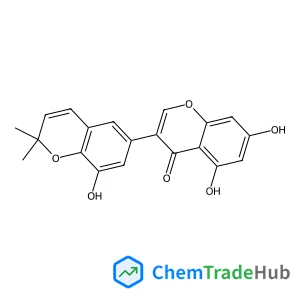
5,7,8'-Trihydroxy-2',2'-dimethyl-2'H,4H-3,6'-bichromen-4-one
CAS Number:
129280-33-7
Molecular Formula:
C20H16O6
Recommended Suppliers







Disclaimer
This page provides academic journal information for reference and research purposes only. We are not affiliated with any journal publishers and do not handle publication submissions. For publication-related inquiries, please contact the respective journal publishers directly.
If you notice any inaccuracies in the information displayed, please contact us at support@chemtradehub.com. We will promptly review and address your concerns.