












Probing the mechanism of thermally driven thiol-Michael dynamic covalent chemistry
Literature Information
Publication Date
2018-03-15
DOI
10.1039/C8OB00397A
Impact Factor
3.876
Authors
Borui Zhang, Progyateg Chakma, Max P. Shulman, Jun Ke, Zachary A. Digby, Dominik Konkolewicz
View Original
Abstract
The kinetics and mechanism of the thermally activated dynamic covalent exchange of thiol-Michael adducts is investigated. A model system of thiol-Michael adducts between thiophenol and phenylvinylketone derivatives and adducts between 2-mercaptoethanol phenylvinylketone derivatives in N,N-dimethylformamide (DMF) at elevated temperatures is used to probe the underlying exchange mechanism. The kinetic data show negligible free Michael acceptor, which is consistent with the highly efficient thiol-Michael reaction being a “click”-like reaction that significantly favors the adduct form. At elevated temperatures of 90 °C in DMF the thiol-Michael adducts reach equilibrium after 24 h, although equilibration did not occur within 24 h at 60 °C or 75 °C, and negligible exchange occurs under ambient conditions. A kinetic model was developed to describe the dynamic covalent exchange and equilibration. The experimental and simulation kinetic data of dynamic covalent exchange are consistent with the thiol-Michael adducts undergoing a retro-Michael reaction, followed by subsequent addition of a free thiol to the liberated Michael acceptor. Kinetic analysis is consistent with the fragmentation, or retro-Michael reaction, being the rate-determining step in the dynamic covalent exchange. This suggests that the key step in dynamic covalent exchange is not enhanced by addition of free thiol or free Michael acceptor, since the addition reaction is much faster than the retro-Michael reaction. This fundamental study will guide the design of organic compounds, materials, and bioconjugates that utilize the thermally activated dynamic covalent thiol-Michael linkages.
Related Literature
Anion clusters of naphthalene and solvents: structure, ion core, and intermolecular interactions
Sang Hak Lee, Jeong Hyun Kim, Inho Chu, Jae Kyu Song
2009-08-25
Paper
DOI: 10.1039/B903626A
Vibrational spectroscopy and DFT calculations of the di-amino acid peptidel-aspartyl-l-glutamic acid in the zwitterionic state
Nighat Kausar, Trevor J. Dines, Babur Z. Chowdhry, Bruce D. Alexander
2009-06-11
Paper
DOI: 10.1039/B903131F
Cyanide leaching of Au/CeO2: highly active gold clusters for 1,3-butadiene hydrogenation
Y. Guan, E. J. M. Hensen
2009-08-19
Paper
DOI: 10.1039/B909487C
Surface and interstitial Ti diffusion at the rutile TiO2(110) surface
P. A. Mulheran, M. Nolan, C. S. Browne, M. Basham, E. Sanville, R. A. Bennett
2010-06-17
Paper
DOI: 10.1039/C002698K
Understanding underlying processes in formic acidfuelcells
Sunghyun Uhm, Hye Jin Lee
2009-08-04
Perspective
DOI: 10.1039/B909525J
Self-promotion mechanism for CO electrooxidation on gold
Paramaconi Rodriguez, Marc T. M. Koper
2010-06-24
Paper
DOI: 10.1039/B926365A
The state of absorbed hydrogen in the structure of reduced copper chromite from the vibration spectra
Galina N. Kustova, Hervé Jobic, Tamara M. Yurieva, Georgii A. Filonenko, Lyudmila M. Plyasova
2009-05-13
Paper
DOI: 10.1039/B821381J
Temperature dependence on the charge transport behaviour of 3-D superlattice crystals of mercaptosuccinic acid-protected gold nanoparticles
A. Sreekumaran Nair, Keisaku Kimura
2009-09-14
Communication
DOI: 10.1039/B913391G
Interactions and dynamics in electrolyte solutions by dielectric spectroscopy
Richard Buchner, Glenn Hefter
2009-07-02
Perspective
DOI: 10.1039/B906555P
Threshold behavior and analytical fitting of partial wave capture probabilities for attractive R−n potentials
2009-08-21
Paper
DOI: 10.1039/B912679A
You might also like
Compound Q&A
How should waste containing N-Methoxy-N-methyl-1,3-thiazole-5-carboxamide (CAS: 898825-89-3) be handled?
Waste containing N-Methoxy-N-methyl-1,3-thiazole-5-carboxamide (CAS: 898825-89-3...
898825-89-3N-Methoxy-N-methyl-1...
Compound Q&A
How should N-(4-Biphenylyl)dibenzo[b,d]furan-4-amine (CAS: 1318338-47-4) be stored?
N-(4-Biphenylyl)dibenzo[b,d]furan-4-amine should be stored in a tightly sealed c...
1318338-47-4N-(4-Biphenylyl)dibe...
Compound Q&A
What is the market or research trend for 3-Acetamido-5-amino-2,4,6-triiodobenzoic acid (CAS: 1713-07-1)?
The market for 3-Acetamido-5-amino-2,4,6-triiodobenzoic acid (CAS: 1713-07-1) is...
1713-07-13-Acetamido-5-amino-...
Compound Q&A
How should Benzyl 2-O-acetyl-3,4,6-tri-O-benzyl-beta-D-galactopyranoside (CAS: 61820-03-9) be stored?
Benzyl 2-O-acetyl-3,4,6-tri-O-benzyl-beta-D-galactopyranoside (CAS: 61820-03-9) ...
61820-03-9Benzyl 2-O-acetyl-3,...
Compound Q&A
What regulatory guidelines apply to 2-Ethylpiperazine dihydrochloride (CAS: 438050-52-3)?
2-Ethylpiperazine dihydrochloride (CAS: 438050-52-3) is regulated under the Glob...
438050-52-32-Ethylpiperazine di...
Compound Q&A
What regulatory guidelines apply to 1,1'-[1,3-Phenylenebis(methylene)]bis(3-methyl-1H-pyrrole-2,5-dione) (CAS: 119462-56-5)?
1,1'-[1,3-Phenylenebis(methylene)]bis(3-methyl-1H-pyrrole-2,5-dione) (CAS: 11946...
119462-56-51,1'-[1,3-Phenyleneb...
Compound Q&A
Are there alternatives to 5-Fluoro-2-(1-pyrrolidinyl)pyridine (CAS: 1287217-79-1) in synthesis?
Several alternatives can be used in the synthesis of 5-Fluoro-2-(1-pyrrolidinyl)...
1287217-79-15-Fluoro-2-(1-pyrrol...
Compound Q&A
What precautions should be taken when handling 1-((2R,3R,4R,5R)-5-((bis(4-methoxyphenyl)(phenyl)methoxy)methyl)-4-hydroxy-3-methoxytetrahydrofuran-2-yl)-5-methylpyrimidine-2,4(1H,3H)-dione (CAS: 153631-19-7)?
Proper personal protective equipment (PPE) must be worn when handling this compo...
153631-19-71-((2R,3R,4R,5R)-5-(...
Compound Q&A
What precautions should be taken when handling 6-Bromoimidazo[1,2-a]pyridin-8-amine (CAS: 676371-00-9)?
When handling 6-Bromoimidazo[1,2-a]pyridin-8-amine, it is important to wear appr...
676371-00-96-Bromoimidazo[1,2-a...
Compound Q&A
Are there alternatives to (2S,4R)-4-(4-Nitrobenzyl)pyrrolidine-2-carboxylic acid hydrochloride (CAS: 1049740-22-8) in synthesis?
Alternatives to (2S,4R)-4-(4-Nitrobenzyl)pyrrolidine-2-carboxylic acid hydrochlo...
1049740-22-8(2S,4R)-4-(4-Nitrobe...
Source Journal
Organic & Biomolecular Chemistry

CiteScore:
3.4
Self-citation Rate:
10.3%
Articles per Year:
1041
Organic & Biomolecular Chemistry (OBC) publishes original and high impact research and reviews in organic chemistry. We welcome research that shows new or significantly improved protocols or methodologies in total synthesis, synthetic methodology or physical and theoretical organic chemistry as well as research that shows a significant advance in the organic chemistry or molecular design aspects of chemical biology, catalysis, supramolecular and macromolecular chemistry, theoretical chemistry, mechanism-oriented physical organic chemistry, medicinal chemistry or natural products. Articles published in the journal should report new work which makes a highly-significant impact in the field. Routine and incremental work is generally not suitable for publication in the journal. More details about key areas of our scope are below. In all cases authors should include in their article clear rationale for why their research has been carried out.
Recommended Compounds
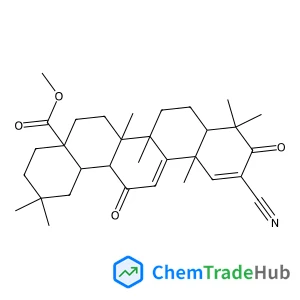
Methyl 2-cyano-3,12-dioxooleana-1,9(11)-dien-28-oate
CAS Number:
218600-53-4
Molecular Formula:
C32H43NO4


1-Methyl-3-(4,4,5,5-tetramethyl-1,3,2-dioxaborolan-2-yl)-1H-pyrazole
CAS Number:
1020174-04-2
Molecular Formula:
C10H17BN2O2
Recommended Suppliers




Disclaimer
This page provides academic journal information for reference and research purposes only. We are not affiliated with any journal publishers and do not handle publication submissions. For publication-related inquiries, please contact the respective journal publishers directly.
If you notice any inaccuracies in the information displayed, please contact us at support@chemtradehub.com. We will promptly review and address your concerns.