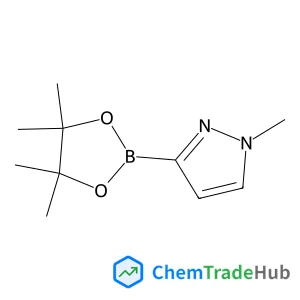
1-Methyl-3-(4,4,5,5-tetramethyl-1,3,2-dioxaborolan-2-yl)-1H-pyrazole
CAS Number:
1020174-04-2
Molecular Formula:
C10H17BN2O2
An efficient strategy for the synthesis of C-2 and C-3 branched sugar dienes via cross dehydrogenative coupling of sugar enol ethers with terminal alkenes was developed. Both pyran and furan based enol ethers coupled smoothly with electron rich as well as deficient alkene sources yielding sugar dienes with complete E-stereoselectivity. This coupling reaction was applied successfully for the synthesis of orthogonally protected pseudo-C-saccharides as an alternative to olefin metathesis. Substrate scope was further enhanced by reacting exoglycals with methyl acrylate to generate C-5 branched sugars with moderate diastereoselectivity. These diene subunits were reacted with maleic anhydride under [4 + 2] cycloaddition conditions to generate highly functionalised chiral oxadecalin cores. Finally, utilizing this C–C bond formation, a sugar based conjugated triene was synthesized in excellent yield and selectivity.

Israel Journal of Chemistry

Pharmacological Reviews

Journal of Medicinal Chemistry

Helvetica Chimica Acta

European Journal of Wood and Wood Products

Nature

Journal of Physics and Chemistry of Solids

Molecular Pharmacology

Proceedings of the National Academy of Sciences of the United States of America

Organic Preparations and Procedures International
Anik Sen
DOI: 10.1039/C7CP00472A
Tianhui Liu, Bina Fu, Dong H. Zhang
DOI: 10.1039/C7CP01770G
Jorge A. Carrazana-García, Enrique M. Cabaleiro-Lago, Jesús Rodríguez-Otero
DOI: 10.1039/C7CP01491K
Hyun Joon Chang, Myeongsang Lee, Jae In Kim, Sungsoo Na
DOI: 10.1039/C7CP01418J
DOI: 10.1039/C7CP01263B
Jorge Royes, Víctor Polo, Santiago Uriel, Luis Oriol, Milagros Piñol, Rosa M. Tejedor
DOI: 10.1039/C7CP01739A
Amedeo Capobianco, Alessandro Landi, Andrea Peluso
DOI: 10.1039/C7CP02029E
M. del Cueto, A. S. Muzas, M. F. Somers, G. J. Kroes
DOI: 10.1039/C7CP02904G
Yujie Bai, Qinfang Zhang, Gaixia Luo, Yali Bu, Lei Zhu, Lele Fan, Baolin Wang
DOI: 10.1039/C7CP01627A
Waste containing N-Methoxy-N-methyl-1,3-thiazole-5-carboxamide (CAS: 898825-89-3...
N-(4-Biphenylyl)dibenzo[b,d]furan-4-amine should be stored in a tightly sealed c...
The market for 3-Acetamido-5-amino-2,4,6-triiodobenzoic acid (CAS: 1713-07-1) is...
Benzyl 2-O-acetyl-3,4,6-tri-O-benzyl-beta-D-galactopyranoside (CAS: 61820-03-9) ...
2-Ethylpiperazine dihydrochloride (CAS: 438050-52-3) is regulated under the Glob...
1,1'-[1,3-Phenylenebis(methylene)]bis(3-methyl-1H-pyrrole-2,5-dione) (CAS: 11946...
Several alternatives can be used in the synthesis of 5-Fluoro-2-(1-pyrrolidinyl)...
Proper personal protective equipment (PPE) must be worn when handling this compo...
When handling 6-Bromoimidazo[1,2-a]pyridin-8-amine, it is important to wear appr...
Alternatives to (2S,4R)-4-(4-Nitrobenzyl)pyrrolidine-2-carboxylic acid hydrochlo...

Organic & Biomolecular Chemistry (OBC) publishes original and high impact research and reviews in organic chemistry. We welcome research that shows new or significantly improved protocols or methodologies in total synthesis, synthetic methodology or physical and theoretical organic chemistry as well as research that shows a significant advance in the organic chemistry or molecular design aspects of chemical biology, catalysis, supramolecular and macromolecular chemistry, theoretical chemistry, mechanism-oriented physical organic chemistry, medicinal chemistry or natural products. Articles published in the journal should report new work which makes a highly-significant impact in the field. Routine and incremental work is generally not suitable for publication in the journal. More details about key areas of our scope are below. In all cases authors should include in their article clear rationale for why their research has been carried out.