












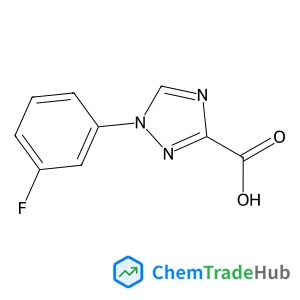
1-(3-Fluorophenyl)-1H-1,2,4-triazole-3-carboxylic acid
CAS Number:
1292369-51-7
Molecular Formula:
C9H6FN3O2
Xiangkun Wu, Tongpo Yu, Yan Chen, Xiaoguo Zhou, Shilin Liu, Xinhua Dai, Fuyi Liu, Liusi Sheng
The dissociative photoionization of CF3Cl was investigated using threshold photoelectron photoion coincidence (TPEPICO) imaging in the energy range of 12.30–18.50 eV. The coincident time-of-flight mass spectra and three-dimensional time-sliced images of the CF2Cl+ fragment were recorded at a few specific photon energies. Two fragmentation pathways were observed that led to the breakage of the C–Cl and C–F bonds, while the branching ratio elicited an energy-dependent relationship. The CF3+ fragment was dominant in the dissociation of the X2E, A2A′ and B2A′′ states, while CF2Cl+ became the predominant fragment and its branching ratio remained constant in the energy range associated with the C2E and D2E states. Based on the inflection point in the energy-dependent curve of the fragment branching ratios, the adiabatic ionization energy (IEa) of C2E is suggested to be 15.46 eV. Although the excess energy increased considerably from C2E to D2E, the kinetic energy release distributions (KERDs) of CF2Cl+ were similar. Moreover, the anisotropy parameters β for the F-loss channel were positive and larger than those for the Cl-loss channel. The calculated F-loss potential energy curves of CF3Cl+ suggested that for the C2E and D2E states, the C–F bond rupture occurred via the internal conversion to the A2A′ state followed by the dissociation attributed to the crossing of the barrier along the C–F coordinate. Based on the experimental and theoretical conclusions, the internal conversion is the rate-determining step in the dissociative photoionization of CF3Cl via the C2E and D2E ionic states, irrespective of whether the C–F and C–Cl bonds rupture.
Tim Phillips, Chatna Rajput, Lance Twyman, Ihtshamul Haq, Jim A. Thomas
DOI: 10.1039/B506946G
Jeane Bordini, Peter C. Ford, Elia Tfouni
DOI: 10.1039/B507407J
Raja Kaliappan, Lakshmi S. Kaanumalle, V. Ramamurthy
DOI: 10.1039/B507517C
Naoto Hashimoto, Keiko Ninomiya, Takamasa Endo, Masahiko Sisido
DOI: 10.1039/B508194G
Neil T. Kemp, Nagindar K. Singh
DOI: 10.1039/B506195D
Ramsey Ida, Gang Wu
DOI: 10.1039/B505674H
Kazunori Nakashima, Tatsuo Maruyama, Noriho Kamiya, Masahiro Goto
DOI: 10.1039/B505479F
Hui Hong, Tim Stinear, Paul Skelton, Jonathan B. Spencer, Peter F. Leadlay
DOI: 10.1039/B506835E
Jinxing Ye, Darren J. Dixon, Peter S. Hynes
DOI: 10.1039/B508833J
Waste containing N-Methoxy-N-methyl-1,3-thiazole-5-carboxamide (CAS: 898825-89-3...
N-(4-Biphenylyl)dibenzo[b,d]furan-4-amine should be stored in a tightly sealed c...
The market for 3-Acetamido-5-amino-2,4,6-triiodobenzoic acid (CAS: 1713-07-1) is...
Benzyl 2-O-acetyl-3,4,6-tri-O-benzyl-beta-D-galactopyranoside (CAS: 61820-03-9) ...
2-Ethylpiperazine dihydrochloride (CAS: 438050-52-3) is regulated under the Glob...
1,1'-[1,3-Phenylenebis(methylene)]bis(3-methyl-1H-pyrrole-2,5-dione) (CAS: 11946...
Several alternatives can be used in the synthesis of 5-Fluoro-2-(1-pyrrolidinyl)...
Proper personal protective equipment (PPE) must be worn when handling this compo...
When handling 6-Bromoimidazo[1,2-a]pyridin-8-amine, it is important to wear appr...
Alternatives to (2S,4R)-4-(4-Nitrobenzyl)pyrrolidine-2-carboxylic acid hydrochlo...

Physical Chemistry Chemical Physics (PCCP) is an international journal co-owned by 19 physical chemistry and physics societies from around the world. This journal publishes original, cutting-edge research in physical chemistry, chemical physics and biophysical chemistry. To be suitable for publication in PCCP, articles must include significant innovation and/or insight into physical chemistry; this is the most important criterion that reviewers and Editors will judge against when evaluating submissions. The journal has a broad scope and welcomes contributions spanning experiment, theory, computation and data science. Topical coverage includes spectroscopy, dynamics, kinetics, statistical mechanics, thermodynamics, electrochemistry, catalysis, surface science, quantum mechanics, quantum computing and machine learning. Interdisciplinary research areas such as polymers and soft matter, materials, nanoscience, energy, surfaces/interfaces, and biophysical chemistry are welcomed if they demonstrate significant innovation and/or insight into physical chemistry. Joined experimental/theoretical studies are particularly appreciated when complementary and based on up-to-date approaches.
![2-Methyl-2-propanyl {3-[4-(4,4,5,5-tetramethyl-1,3,2-dioxaborolan-2-yl)phenyl]-3-oxetanyl}carbamate structure](https://static.chemtradehub.com/structs/127/1279090-25-3-1b84.webp "2-Methyl-2-propanyl {3-[4-(4,4,5,5-tetramethyl-1,3,2-dioxaborolan-2-yl)phenyl]-3-oxetanyl}carbamate structure")



