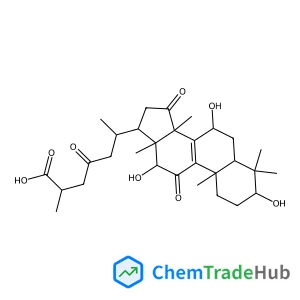
(3beta,7beta,12beta)-3,7,12-Trihydroxy-11,15,23-trioxolanost-8-en-26-oic acid
CAS Number:
98665-22-6
Molecular Formula:
C30H44O8
Kumar R. Bhushan, Fangbing Liu, Preeti Misra, John V. Frangioni
Microwave-assisted synthesis of near-infrared fluorescent sphingosine derivatives is described, and the utility of the probes demonstrated by co-localization studies with visible wavelength fluorescent sphingosine derivatives.
Glen R. Jenness, Jennifer Seiter, Manoj K. Shukla
DOI: 10.1039/C8CP02590H
Swapan K. Ghosh
DOI: 10.1039/C8CP00844B
Sebastian Schwalbe, Jana Schaber, Simon Krause, Irena Senkovska, Stefan Kaskel, Eike Brunner, Jens Kortus, Gotthard Seifert
DOI: 10.1039/C8CP04025G
Onkar Nath Verma, Vandna Tomar, Manish Kumar, Kamal K. Srivastav, Vasant Sathe, Priyanka A. Jha, Prabhakar Singh
DOI: 10.1039/C8CP01971A
Weiwei Yang, Kimberley N. Poland, Steven R. Davis
DOI: 10.1039/C8CP05091K
Pilar Herrasti
DOI: 10.1039/C8CP02513D
H. Fabio Busnengo
DOI: 10.1039/C8CP03515F
Bas van Dijk, Jan P. Hofmann, Dennis G. H. Hetterscheid
DOI: 10.1039/C8CP03419B
Yalan Yan, Hao Liu, Yonghao Han, Fangfei Li, Chunxiao Gao
DOI: 10.1039/C8CP03701A
When handling 4-(2-Furylmethyl)thiomorpholine 1,1-dioxide (CAS: 79206-94-3), it ...
When handling 4-Chloro-N-[2-(4-morpholinyl)ethyl]benzamide (CAS: 71320-77-9), it...
Waste containing this compound (CAS: 62921-74-8) should be handled according to ...
Waste containing (S)-Methyl 2-amino-3-cyclohexylpropanoate should be collected i...
This compound can be synthesized using a multi-step process involving the conjug...
There are several alternatives to (2E)-3-(3,4-Dichlorophenyl)acrylic acid in syn...
Ethyl 6-(2-nitrophenyl)imidazo[2,1-b][1,3]thiazole-3-carboxylate (CAS: 925437-84...
Waste containing 2-(1,3-Thiazol-2-yl)ethanamine (CAS: 18453-07-1) should be coll...
Methyl 5-iodo-2-methylbenzoate can be synthesized through the iodination of meth...
5-Chloro[1,2,4]triazolo[1,5-a]pyridine is commonly synthesized via the condensat...

ChemComm publishes urgent research which is of outstanding significance and interest to experts in the field, while also appealing to the journal’s broad chemistry readership. Our communication format is ideally suited to short, urgent studies that are of such importance that they require accelerated publication. Our scope covers all topics in chemistry, and research at the interface of chemistry and other disciplines (such as materials science, nanoscience, physics, engineering and biology) where there is a significant novelty in the chemistry aspects. Major topic areas covered include: Analytical Chemistry Catalysis Chemical Biology and medicinal chemistry Computational Chemistry and Machine Learning Energy and sustainable chemistry Environmental Chemistry Green Chemistry Inorganic Chemistry Materials Chemistry Nanoscience Organic Chemistry Physical Chemistry Polymer Chemistry Supramolecular Chemistry