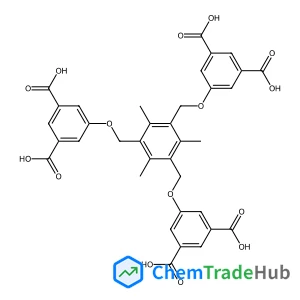
5,5',5''-(((2,4,6-Trimethylbenzene-1,3,5-triyl)tris(methylene))tris(oxy))triisophthalic acid
CAS Number:
1159974-70-5
Molecular Formula:
C36H30O15
Junwei Lucas Bao, Donald G. Truhlar
The FE integral for the normalized Boltzmann-weighted number of unimolecular states above the threshold energy is the key quantity for computing the collision efficiency in the pressure-dependent unimolecular rate theory developed by Troe, who calls this the energy dependence factor of the density of states. By using the Whitten–Rabinovitch approximation and assuming that the Whitten–Rabinovitch a(E) function is independent of energy, FE can be approximated by an analytical formula; this approximate formula is widely used because of its convenience and computational efficiency. Here we test its validity by comparing the rate constants computed by using the approximate FE to the ones determined by using the numerically integrated FE. For small-sized molecules and for reactions with high threshold energies E0, the differences are negligible at all temperatures, but in other cases, the approximate formula tends to underestimate FE and thus overestimates the collision efficiency, and this leads to smaller pressure falloff. When a(E) at high energies differs appreciably from a(E0), we find that the underestimation of pressure-dependent rate constants by using the approximate formula can be greater than a factor of 5 at high temperatures. The physical insight we draw from this study is that, for reactions with threshold energies below about 30 kcal mol−1, the rate of collisional energy transfer can be appreciably slowed down by the increase in the density of states at higher energies, and this increases the falloff effect by which finite-pressure rate constants become lower than the high-pressure limit, especially at higher temperatures.
Yvonne Chiang, A. Jerry Kresge, Ikenna Onyido, John P. Richard, Peter Wan, Musheng Xu
DOI: 10.1039/B506706E
Jyongsik Jang, Byungkwon Lim, Moonjung Choi
DOI: 10.1039/B506265A
A. J. (Ton) Dirks, Sander S. van Berkel, Nikos S. Hatzakis, Joost A. Opsteen, Floris L. van Delft, Jeroen J. L. M. Cornelissen, Alan E. Rowan, Jan C. M. van Hest, Floris P. J. T. Rutjes, Roeland J. M. Nolte
DOI: 10.1039/B508428H
Young Sin You, Jung Hee Yoon, Hyoung Chan Kim, Chang Seop Hong
DOI: 10.1039/B507051A
Steven Dickson, Darrell Dean, Robert. D. Singer
DOI: 10.1039/B508400H
Makeba B. Murphy-Jolly, Lesley C. Lewis, Andrew J. M. Caffyn
DOI: 10.1039/B507752D
Patrik Västilä, Jenny Wettergren, Hans Adolfsson
DOI: 10.1039/B505516D
D. Krishna Kumar, D. Amilan Jose, Amitava Das, Parthasarathi Dastidar
DOI: 10.1039/B506941F
Motoichi Kurisawa, Joo Eun Chung, Yi Yan Yang, Shu Jun Gao, Hiroshi Uyama
DOI: 10.1039/B506989K
Waste containing N-Methoxy-N-methyl-1,3-thiazole-5-carboxamide (CAS: 898825-89-3...
N-(4-Biphenylyl)dibenzo[b,d]furan-4-amine should be stored in a tightly sealed c...
The market for 3-Acetamido-5-amino-2,4,6-triiodobenzoic acid (CAS: 1713-07-1) is...
Benzyl 2-O-acetyl-3,4,6-tri-O-benzyl-beta-D-galactopyranoside (CAS: 61820-03-9) ...
2-Ethylpiperazine dihydrochloride (CAS: 438050-52-3) is regulated under the Glob...
1,1'-[1,3-Phenylenebis(methylene)]bis(3-methyl-1H-pyrrole-2,5-dione) (CAS: 11946...
Several alternatives can be used in the synthesis of 5-Fluoro-2-(1-pyrrolidinyl)...
Proper personal protective equipment (PPE) must be worn when handling this compo...
When handling 6-Bromoimidazo[1,2-a]pyridin-8-amine, it is important to wear appr...
Alternatives to (2S,4R)-4-(4-Nitrobenzyl)pyrrolidine-2-carboxylic acid hydrochlo...

Physical Chemistry Chemical Physics (PCCP) is an international journal co-owned by 19 physical chemistry and physics societies from around the world. This journal publishes original, cutting-edge research in physical chemistry, chemical physics and biophysical chemistry. To be suitable for publication in PCCP, articles must include significant innovation and/or insight into physical chemistry; this is the most important criterion that reviewers and Editors will judge against when evaluating submissions. The journal has a broad scope and welcomes contributions spanning experiment, theory, computation and data science. Topical coverage includes spectroscopy, dynamics, kinetics, statistical mechanics, thermodynamics, electrochemistry, catalysis, surface science, quantum mechanics, quantum computing and machine learning. Interdisciplinary research areas such as polymers and soft matter, materials, nanoscience, energy, surfaces/interfaces, and biophysical chemistry are welcomed if they demonstrate significant innovation and/or insight into physical chemistry. Joined experimental/theoretical studies are particularly appreciated when complementary and based on up-to-date approaches.
![2-(7,7-Difluorobicyclo[4.1.0]hept-1-yl)ethanamine structure](https://static.chemtradehub.com/structs/209/2098065-08-6-ff24.webp "2-(7,7-Difluorobicyclo[4.1.0]hept-1-yl)ethanamine structure")