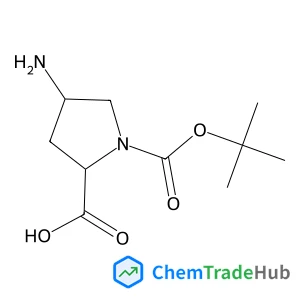
(2R,4R)-1-Boc-4-Aminopyrrolidine-2-carboxylic acid
CAS Number:
132622-98-1
Molecular Formula:
C10H18N2O4
M. Koroleva, D. Bidanov, E. Yurtov
The stabilization of oil-in-water emulsions with SiO2 and Fe3O4 nanoparticles was investigated. The mechanism of emulsion stabilization was altered by changing the mass ratio of negatively charged Ludox HS-30 to positively charged Ludox CL nanoparticles in emulsions. At a mass ratio of nanoparticles between 0.3 : 1.0 and 1 : 1, small nanoparticle heteroaggregates adsorbed on the surface of the oil droplets, giving them resistance to coalescence. The interface film rigidity was enough to prevent droplet deformation. After creaming, the oil-phase fraction in the residual emulsion increased up to dense packing, but did not exceed 0.74–0.78 for a long time. At the mass ratio of (1.5–2.5) : 1.0, the emulsions were kinetically stable to creaming and coalescence due to the formation of a three-dimensional network of nanoparticle heteroaggregates in the aqueous phase. At a mass ratio of Ludox HS-30 to Ludox CL nanoparticles above 3 : 1, large heteroaggregates were formed in the aqueous phase and the rapid separation of the oil and water phases from the emulsions occurred. Such a change in the stability of emulsions was due to a significant alteration of the value of the net ζ-potential of the heteroaggregates. In the case of stabilization with Ludox CL and Fe3O4 nanoparticles, emulsions with nanoparticle networks in the aqueous phase were obtained at pH 8, and these emulsions were stable against creaming and coalescence. Emulsions resistant to coalescence were produced in the systems with Ludox CL and Fe3O4 nanoparticles at pH 4–6 and in systems with Ludox HS-30 and Fe3O4 nanoparticles at pH 2–6.
Wenbin Guo, Yi Cao, Songbin Li
DOI: 10.1039/D3CP04846B
Kuldeep Singh Negi, Nilimesh Das, Tanmoy Khan, Pratik Sen
DOI: 10.1039/D3CP03357K
Christina Kjær, Emil Vogt, Jeppe Langeland, Nanna Falk Christensen, Thomas Toft Lindkvist, Henrik G. Kjaergaard, Steen Brøndsted Nielsen
DOI: 10.1039/D3CP04615J
You Li, Yi Wan, Jiamin Yao, Hongqian Zheng, Xi Wang, Xuan Liu, Bo Ouyang, Chengxi Huang, Kaiming Deng, Erjun Kan
DOI: 10.1039/D3CP04951E
Thomas Nevolianis, Raja A. Ahmed, Arnim Hellweg, Michael Diedenhofen, Kai Leonhard
DOI: 10.1039/D3CP04077A
Heng Sun, Yichen Tian, Yuna Fu, Yongrong Lei, Yani Wang, Xinrui Yan, Jianhua Wang
DOI: 10.1039/D3CP04351G
When considering alternatives to 1-(4-Chlorophenyl)-N-hydroxymethanimine (CAS: 3...
This compound should be stored in a cool, dry place away from direct sunlight. I...
3-(4-Bromophenyl)-5-(2-fluorophenyl)-1,2,4-oxadiazole is synthesized through a m...
5-Chloro-2-(4-chlorophenyl)-4-methyl-6-[3-(1-piperidinyl)propoxy]pyrimidine (CAS...
2-Chloro-4-(difluoromethoxy)pyridine is used in the pharmaceutical industry for ...
3-Chloro-6-methylpyridazine (CAS: 1121-79-5) is classified under the Globally Ha...
Several alternatives can be used in the synthesis of Methyl 4,5-dimethyl-2-nitro...
Alternatives to (2E,2'E)-3,3'-(1,4-Phenylene)bisacrylaldehyde include other acry...
3-Amino-5-chloropyridin-2-ol hydrochloride is an organic compound with the CAS n...
When handling 6,7-Difluoro-2,3-dihydro-4H-chromen-4-one, it is essential to wear...

Physical Chemistry Chemical Physics (PCCP) is an international journal co-owned by 19 physical chemistry and physics societies from around the world. This journal publishes original, cutting-edge research in physical chemistry, chemical physics and biophysical chemistry. To be suitable for publication in PCCP, articles must include significant innovation and/or insight into physical chemistry; this is the most important criterion that reviewers and Editors will judge against when evaluating submissions. The journal has a broad scope and welcomes contributions spanning experiment, theory, computation and data science. Topical coverage includes spectroscopy, dynamics, kinetics, statistical mechanics, thermodynamics, electrochemistry, catalysis, surface science, quantum mechanics, quantum computing and machine learning. Interdisciplinary research areas such as polymers and soft matter, materials, nanoscience, energy, surfaces/interfaces, and biophysical chemistry are welcomed if they demonstrate significant innovation and/or insight into physical chemistry. Joined experimental/theoretical studies are particularly appreciated when complementary and based on up-to-date approaches.