












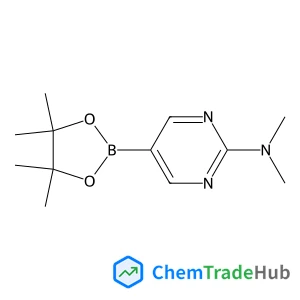
N,N-Dimethyl-5-(4,4,5,5-tetramethyl-1,3,2-dioxaborolan-2-yl)-2-pyrimidinamine
CAS Number:
1032759-30-0
Molecular Formula:
C12H20BN3O2
Thomas Nevolianis, Raja A. Ahmed, Arnim Hellweg, Michael Diedenhofen, Kai Leonhard
Accurately predicting partition coefficients log P is crucial for reducing costs and accelerating drug design as it provides valuable information about the bioavailability, pharmacokinetics, and toxicity of different drug candidates. However, the performance of the existing methods is ambiguous, making it unclear whether these methods can be effectively utilized in drug discovery. To assess the performance of these methods, a series of SAMPL challenges have been conducted over the past few years, aiming to enable the development and validation of predictive models. In this study, we present two independent contributions to the SAMPL9 challenge for predicting the toluene/water partition coefficients for 16 molecules. Both submissions, A and B, use the COSMO-RS approach, albeit in slightly different procedures, to compute the transfer free energies from water to toluene of the molecules presented in the challenge, and consequently, their corresponding log P values. Based on the results, COSMO-RS submission A achieves the top position with an R2 value of 0.93 while it ranks second in terms of root-mean-square error (RMSE) with a value of 1.23 log P units. COSMO-RS submission B achieves an R2 value of 0.83 and an RMSE value of 1.48 log P units. Following the challenge, we predict the log P values using a neural network model, which was pre-trained on COSMO-RS data achieving an R2 of 0.92 and RMSE of 1.04 log P units. Compared to previous SAMPL challenges, all contributions displayed large deviations in predicting the toluene/water partition coefficient. These large deviations emphasize that further research is needed to develop accurate and reliable methods for modeling solvent effects on small molecule transfer-free energies.
Behnaz Bagheri, Björn Baumeier, Mikko Karttunen
DOI: 10.1039/C6CP02944B
Asaya Fujita, Yoshiaki Kinemuchi, Wataru Yamaguchi
DOI: 10.1039/C6CP06200H
Maciej Ptak, Mirosław Mączka, Anna Gągor, Adam Sieradzki, Bartosz Bondzior, Przemysław Dereń, S. Pawlus
DOI: 10.1039/C6CP05151K
Weifu Sun, Zihan Chen, Qin Zhang, Junli Zhou, Feng Li, Xiao Jin, Dongyu Li, Qinghua Li
DOI: 10.1039/C6CP04963J
Fu Kit Sheong
DOI: 10.1039/C6CP02545E
Andrew G. Stack, Jose M. Borreguero, Timothy R. Prisk, Eugene Mamontov, Hsiu-Wen Wang, Lukas Vlcek, David J. Wesolowski
DOI: 10.1039/C6CP05836A
Peter Psarras, Jiajun He, Jennifer Wilcox
DOI: 10.1039/C6CP05865E
Chao Wang, Panlai Li, Zhijun Wang, Yuansheng Sun, Jinge Cheng, Zhenling Li, Miaomiao Tian, Zhiping Yang
DOI: 10.1039/C6CP05490K
Feng Zhou, Rajesh Kodiyath, Hideki Abe, Youquan Deng
DOI: 10.1039/C6CP05289D
When considering alternatives to 1-(4-Chlorophenyl)-N-hydroxymethanimine (CAS: 3...
This compound should be stored in a cool, dry place away from direct sunlight. I...
3-(4-Bromophenyl)-5-(2-fluorophenyl)-1,2,4-oxadiazole is synthesized through a m...
5-Chloro-2-(4-chlorophenyl)-4-methyl-6-[3-(1-piperidinyl)propoxy]pyrimidine (CAS...
2-Chloro-4-(difluoromethoxy)pyridine is used in the pharmaceutical industry for ...
3-Chloro-6-methylpyridazine (CAS: 1121-79-5) is classified under the Globally Ha...
Several alternatives can be used in the synthesis of Methyl 4,5-dimethyl-2-nitro...
Alternatives to (2E,2'E)-3,3'-(1,4-Phenylene)bisacrylaldehyde include other acry...
3-Amino-5-chloropyridin-2-ol hydrochloride is an organic compound with the CAS n...
When handling 6,7-Difluoro-2,3-dihydro-4H-chromen-4-one, it is essential to wear...

Physical Chemistry Chemical Physics (PCCP) is an international journal co-owned by 19 physical chemistry and physics societies from around the world. This journal publishes original, cutting-edge research in physical chemistry, chemical physics and biophysical chemistry. To be suitable for publication in PCCP, articles must include significant innovation and/or insight into physical chemistry; this is the most important criterion that reviewers and Editors will judge against when evaluating submissions. The journal has a broad scope and welcomes contributions spanning experiment, theory, computation and data science. Topical coverage includes spectroscopy, dynamics, kinetics, statistical mechanics, thermodynamics, electrochemistry, catalysis, surface science, quantum mechanics, quantum computing and machine learning. Interdisciplinary research areas such as polymers and soft matter, materials, nanoscience, energy, surfaces/interfaces, and biophysical chemistry are welcomed if they demonstrate significant innovation and/or insight into physical chemistry. Joined experimental/theoretical studies are particularly appreciated when complementary and based on up-to-date approaches.
![4-[(3-Chloro-2-fluorophenyl)amino]-7-methoxy-6-quinazolinyl acetate structure](https://static.chemtradehub.com/structs/740/740081-22-5-f58f.webp "4-[(3-Chloro-2-fluorophenyl)amino]-7-methoxy-6-quinazolinyl acetate structure")
![[4-(Isobutyrylamino)phenyl]boronic acid structure](https://static.chemtradehub.com/structs/874/874219-50-8-6ab5.webp "[4-(Isobutyrylamino)phenyl]boronic acid structure")



