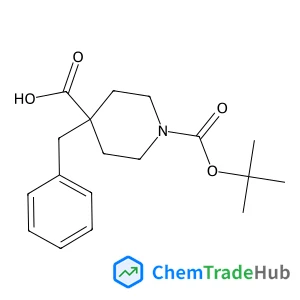
4-Benzyl-1-(tert-butoxycarbonyl)piperidine-4-carboxylic acid
CAS Number:
170838-87-6
Molecular Formula:
C18H25NO4
Jianna Bao, Huabo Fan, Xiaojia Xue, Qing Xie, Pengju Pan
Because of the different crystallization behaviors of semicrystalline supramolecular polymers (SMPs) from conventional polymers, investigation on the unique crystallization kinetics and crystalline structures of SMPs is of fundamental importance to tune their physical properties and functions in processing. Herein, we chose the multiple hydrogen-bonding 2-ureido-4[1H]-pyrimidinone (UPy) group as the supramolecular unit and poly(butylene adipate) (PBA) as the polymorphic polymer block, and synthesized UPy-functionalized PBAs (i.e., UPy-bonded supramolecular PBAs). The crystallization kinetics, polymorphic crystalline structure, phase transition, and lamellar morphology of the UPy-functionalized PBAs were investigated and compared with those of the pristine PBA. UPy end functionalization suppressed the crystallization rate and crystallinity of the linked PBA chains. Compared to the pristine PBA, the UPy-functionalized PBAs preferred to form the thermally-stable α crystals at the same temperature; this was more obvious for the samples with a high content of the UPy end group. The facilitated formation of α crystals in the UPy-functionalized PBAs was attributed to the decreased equilibrium melting temperature. UPy end functionalization also decreased the critical temperature and broadened the temperature range for the β-to-α phase transition of PBA during heating. Due to the segregation of the UPy unit in the amorphous phase, the UPy-functionalized PBAs exhibited larger long periods than the pristine PBA, even though they had a lower degree of crystallinity.
Fei Yan, Yan Zhang, Hsiang-kuo Yuan, Molly K. Gregas, Tuan Vo-Dinh
DOI: 10.1039/B810949D
Kumar R. Bhushan, Fangbing Liu, Preeti Misra, John V. Frangioni
DOI: 10.1039/B807930G
Cheng-Lan Lin, Hui-Chun Yang, Nai-Ti Lin, I-Jui Hsu, Yu Wang, Tien-Yau Luh
DOI: 10.1039/B808958B
Maria J. Petersson, Wendy A. Loughlin, Ian D. Jenkins
DOI: 10.1039/B807695B
Shun Kubota, Kanako Unoike, Takashi Karatsu, Akihide Kitamura
DOI: 10.1039/B808684B
Wei Chen, Han Huang, Andrew Thye, Shen Wee
DOI: 10.1039/B805788E
Craig P. Montgomery, Elizabeth J. New, David Parker, Robert D. Peacock
DOI: 10.1039/B810978H
Xueguang Wang, Hajime Kawanami, Nazrul M. Islam, Maya Chattergee, Toshirou Yokoyama, Yutaka Ikushima
DOI: 10.1039/B808201D
Thibaut Forestier, Stéphane Mornet, Nathalie Daro, Taishi Nishihara, Shin-ichiro Mouri, Koichiro Tanaka, Olivier Fouché, Eric Freysz, Jean-François Létard
DOI: 10.1039/B806347H
Chun Ghee Tan, Robert N. Grass
DOI: 10.1039/B807741J
When handling 4-(2-Furylmethyl)thiomorpholine 1,1-dioxide (CAS: 79206-94-3), it ...
When handling 4-Chloro-N-[2-(4-morpholinyl)ethyl]benzamide (CAS: 71320-77-9), it...
Waste containing this compound (CAS: 62921-74-8) should be handled according to ...
Waste containing (S)-Methyl 2-amino-3-cyclohexylpropanoate should be collected i...
This compound can be synthesized using a multi-step process involving the conjug...
There are several alternatives to (2E)-3-(3,4-Dichlorophenyl)acrylic acid in syn...
Ethyl 6-(2-nitrophenyl)imidazo[2,1-b][1,3]thiazole-3-carboxylate (CAS: 925437-84...
Waste containing 2-(1,3-Thiazol-2-yl)ethanamine (CAS: 18453-07-1) should be coll...
Methyl 5-iodo-2-methylbenzoate can be synthesized through the iodination of meth...
5-Chloro[1,2,4]triazolo[1,5-a]pyridine is commonly synthesized via the condensat...

Physical Chemistry Chemical Physics (PCCP) is an international journal co-owned by 19 physical chemistry and physics societies from around the world. This journal publishes original, cutting-edge research in physical chemistry, chemical physics and biophysical chemistry. To be suitable for publication in PCCP, articles must include significant innovation and/or insight into physical chemistry; this is the most important criterion that reviewers and Editors will judge against when evaluating submissions. The journal has a broad scope and welcomes contributions spanning experiment, theory, computation and data science. Topical coverage includes spectroscopy, dynamics, kinetics, statistical mechanics, thermodynamics, electrochemistry, catalysis, surface science, quantum mechanics, quantum computing and machine learning. Interdisciplinary research areas such as polymers and soft matter, materials, nanoscience, energy, surfaces/interfaces, and biophysical chemistry are welcomed if they demonstrate significant innovation and/or insight into physical chemistry. Joined experimental/theoretical studies are particularly appreciated when complementary and based on up-to-date approaches.
![2,6-Di(thiophen-2-yl)dithieno[3,2-b:2',3'-d]thiophene structure](https://static.chemtradehub.com/structs/910/910788-24-8-5b70.webp "2,6-Di(thiophen-2-yl)dithieno[3,2-b:2',3'-d]thiophene structure")