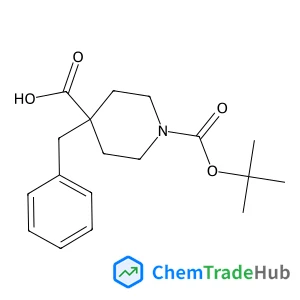
4-Benzyl-1-(tert-butoxycarbonyl)piperidine-4-carboxylic acid
CAS Number:
170838-87-6
Molecular Formula:
C18H25NO4
Christophe Gourlaouen, Sergi Vela, Sylvie Choua, Mathilde Berville, Jennifer A. Wytko, Jean Weiss, Vincent Robert
The microscopic origin of van der Waals- and magnetic-interactions in 4,4′ methyl viologen cation-based units (MV+˙ and MV2+) was inspected using wave function (variational DDCI and perturbative MP2, CASPT2) and density functional theory (DFT) calculations. The analysis deepens the comprehension of the magnetic behavior of experimental bis-viologen cyclophanes ([CYC]2(+˙)), in which the MV+˙ units are connected through alkyl linkers of different lengths. The formation of the so-called long-multicenter bonds in such radical dimers, responsible for the quenching of the magnetic response, was analyzed in [MV2]2(+˙). Dynamical correlation effects, accessible from second-order perturbation corrections, were decisive in observing a bonding regime characterized by an equilibrium distance of 3.3 Å and a 45 kJ mol−1 dissociation energy. At larger intermolecular distances, our calculations on [MV2]2(+˙) indicate that the singlet and triplet states are energetically competing (i.e. weak exchange interactions, JAB). Despite the absence of any clear bonding regime at the MP2 level, the puzzling association of two di-cations into [MV2]4+ is anticipated at 3.3 Å using weakly screened point charges (ε = 1.5) to account for the Coulomb interactions between the solvated subunits. The main conclusion is that both dispersion interactions and environment effects are required to overcome the Coulomb repulsion associated with doubly-charged species. All these data provide some complementary insights into the nature and amplitude of interactions between cation and dication units, and their relevance in various experimental manifestations.
Daniël J. Bakker, Raimund Feifel, Anouk M. Rijs, Vitali Zhaunerchyk
DOI: 10.1039/C5CP07426F
Christophe Garagnon, Valerie Serradeil
DOI: 10.1039/C6CP00972G
Rania S. Seoudi, Annette Dowd, Brian J. Smith, Adam Mechler
DOI: 10.1039/C6CP01355D
Anatolii N. Rykov, Olga E. Grikina, Leonid S. Khaikin
DOI: 10.1039/C5CP07719B
DOI: 10.1039/C5CP02190A
Arturo Moncho-Jordá
DOI: 10.1039/C5CP07794J
Zonghu Han, Meng Wang, Xiangyan Chen, Shaohua Shen
DOI: 10.1039/C6CP00692B
Jyun-Yi Wu, Li-Jen Chen, Yan-Ping Chen, Shiang-Tai Lin
DOI: 10.1039/C5CP06419H
Rui Li, Miao Zhang, Yingru Li, Ji Chen, Bowen Yao, Mingpeng Yu, Gaoquan Shi
DOI: 10.1039/C6CP00512H
Lars H. Andersen, Jørgen Houmøller, Hjalte V. Kiefer, Elie Lattouf, Mark H. Stockett
DOI: 10.1039/C6CP00433D
This compound is mainly used as an intermediate in the synthesis of antipsychoti...
Waste containing 1-(D-Ribofuranosyl)-1,4-dihydro-3-pyridinecarboxamide (CAS: 191...
2-Methyl-2-propanyl 3-bromo-3-(hydroxymethyl)-1-azetidinecarboxylate (CAS: 20079...
N-(4-Chloro-2-pyridinyl)acetamide (CAS: 245056-66-0) is a chemical compound with...
5-Chloro-2-hydroxybenzoic acid, also known as 5-chlorosalicylic acid, is an arom...
When handling 1,1-Dichloro-1-fluoroethane (CAS: 1717-00-6), it is important to u...
Fmoc-(2S,3R)-3-phenylpyrrolidine-2-carboxylic acid is a white crystalline solid ...
4-Amino-5-bromo-2-pyridinecarboxylic acid is primarily used as a precursor in th...
Handling this compound should be done with personal protective equipment (PPE) i...
When handling 8-bromo-2,2-dimethyl-3,4-dihydro-2H-1,4-benzoxazin-3-one, use prop...

Physical Chemistry Chemical Physics (PCCP) is an international journal co-owned by 19 physical chemistry and physics societies from around the world. This journal publishes original, cutting-edge research in physical chemistry, chemical physics and biophysical chemistry. To be suitable for publication in PCCP, articles must include significant innovation and/or insight into physical chemistry; this is the most important criterion that reviewers and Editors will judge against when evaluating submissions. The journal has a broad scope and welcomes contributions spanning experiment, theory, computation and data science. Topical coverage includes spectroscopy, dynamics, kinetics, statistical mechanics, thermodynamics, electrochemistry, catalysis, surface science, quantum mechanics, quantum computing and machine learning. Interdisciplinary research areas such as polymers and soft matter, materials, nanoscience, energy, surfaces/interfaces, and biophysical chemistry are welcomed if they demonstrate significant innovation and/or insight into physical chemistry. Joined experimental/theoretical studies are particularly appreciated when complementary and based on up-to-date approaches.
![tert-Butyl N-[(2-chloropyridin-4-yl)methyl]carbamate structure](https://static.chemtradehub.com/structs/916/916210-27-0-9f95.webp "tert-Butyl N-[(2-chloropyridin-4-yl)methyl]carbamate structure")