












Machine learning for predicting product distributions in catalytic regioselective reactions
Literature Information
Publication Date
2018-06-22
DOI
10.1039/C8CP03141J
Impact Factor
3.676
Authors
Sayan Banerjee, A. Sreenithya, Raghavan B. Sunoj
View Original
Abstract
Gaining predictable control over various forms of selectivities, such as enantio- and/or regio-selectivities, has been a long-standing goal in chemical catalysis. Although a number of factors such as the molecular features of the reactants and catalysts, as well as the reaction conditions, can influence the outcome of a reaction, it is not quite conspicuous as to what combinations of these parameters would offer a desired form of selectivity. We use machine learning tools, such as the neural network (NN), decision tree (DT), logistic regression (LR) and Random forest algorithms, to (a) analyze the outcome of an important catalytic regio-selective difluorination reaction of alkenes, and (b) decipher the complex interplay of various molecular parameters and their non-linear dependencies. The connection between what features of alkenes will yield 1,1-difluorination and how subtle changes would steer the reaction to 1,2-difluorination under identical conditions is enunciated. The NN was able to accurately predict whether a given alkene would yield a 1,1- or 1,2-difluorinated product. A combination of DT and the random forest classifier offered important chemical insights, which could be used in making a more rational choice of the reactant alkene for the desired regioisomeric product. The results could have far reaching implications in predicting which regioisomer is likely to be formed under a given set of conditions, and thus this technique is capable of expediting the development of catalytic transformations.
Related Literature
Novel photoacid generators for cationic photopolymerization
Nicolas Klikovits, Patrick Knaack, Daniel Bomze, Ingo Krossing, Robert Liska
2017-06-29
Paper
DOI: 10.1039/C7PY00855D
Facile synthesis of ROS-responsive biodegradable main chain poly(carbonate-thioether) copolymers
Bingkun Yan, Yan Zhang, Chao Wei, Yue Xu
2018-01-17
Paper
DOI: 10.1039/C7PY01908D
New fluorescent through-space conjugated polymers: synthesis, optical properties and explosive detection
Yingying Zhang, Pingchuan Shen, Bairong He, Wenwen Luo, Zujin Zhao
2017-12-04
Paper
DOI: 10.1039/C7PY01700F
SET-LRP mediated by TREN in biphasic water–organic solvent mixtures provides the most economical and efficient process
Adrian Moreno, Silvia Grama, Tong Liu, Marina Galià, Virgil Percec
2017-11-24
Paper
DOI: 10.1039/C7PY01841J
Synthesis, stereocomplex crystallization and homo-crystallization of enantiomeric poly(lactic acid-co-alanine)s with ester and amide linkages
Hideto Tsuji, Shotaro Sato, Noriaki Masaki, Yuki Arakawa
2017-12-28
Paper
DOI: 10.1039/C7PY02024D
The Hantzsch reaction in polymer chemistry: synthesis and tentative application
Haibo Wu, Zhiming Wang, Lei Tao
2017-11-07
Minireview
DOI: 10.1039/C7PY01718A
Studies on the hard confinement effect on the RAFT polymerization of a monomeric ionic liquid. Unexpected triggering of RAFT polymerization at 30 °C
Karol Erfurt, Anna Chrobok, Andrzej Zięba, Rafał Bielas
2017-11-29
Paper
DOI: 10.1039/C7PY01726J
Cell-penetrating poly(disulfide)-based star polymers for simultaneous intracellular delivery of miRNAs and small molecule drugs
Wenhua Yang, Changmin Yu, Chunxian Wu, Shao Q. Yao, Shuizhu Wu
2017-06-19
Paper
DOI: 10.1039/C7PY00666G
Polymerization of alkyl diazoacetates initiated by the amidinate/Pd system: efficient synthesis of high molecular weight poly(alkoxycarbonylmethylene)s with moderate stereoregularity
Hiroaki Shimomoto, Junya Kawamata, Hirokazu Murakami, Kazuki Yamashita, Tomomichi Itoh, Eiji Ihara
2017-06-19
Paper
DOI: 10.1039/C7PY00816C
You might also like
Compound Q&A
What precautions should be taken when handling 4-(2-Furylmethyl)thiomorpholine 1,1-dioxide (CAS: 79206-94-3)?
When handling 4-(2-Furylmethyl)thiomorpholine 1,1-dioxide (CAS: 79206-94-3), it ...
79206-94-34-(2-Furylmethyl)thi...
Compound Q&A
What precautions should be taken when handling 4-Chloro-N-[2-(4-morpholinyl)ethyl]benzamide (CAS: 71320-77-9)?
When handling 4-Chloro-N-[2-(4-morpholinyl)ethyl]benzamide (CAS: 71320-77-9), it...
71320-77-94-Chloro-N-[2-(4-mor...
Compound Q&A
How should waste containing 2-[2-(2-Methoxyethoxy)ethoxy]ethyl 4-methylbenzenesulfonate (CAS: 62921-74-8) be handled?
Waste containing this compound (CAS: 62921-74-8) should be handled according to ...
62921-74-82-[2-(2-Methoxyethox...
Compound Q&A
How should waste containing (S)-Methyl 2-amino-3-cyclohexylpropanoate be handled?
Waste containing (S)-Methyl 2-amino-3-cyclohexylpropanoate should be collected i...
40056-18-6(S)-Methyl 2-amino-3...
Compound Q&A
How is 5-({4-[(2S,4R)-4-Hydroxy-2-methyltetrahydro-2H-pyran-4-yl]-2-thienyl}sulfanyl)-1-methyl-1,3-dihydro-2H-indol-2-one (CAS: 166882-70-8) typically synthesized?
This compound can be synthesized using a multi-step process involving the conjug...
166882-70-85-({4-[(2S,4R)-4-Hyd...
Compound Q&A
Are there alternatives to (2E)-3-(3,4-Dichlorophenyl)acrylic acid (CAS: 7312-27-8) in synthesis?
There are several alternatives to (2E)-3-(3,4-Dichlorophenyl)acrylic acid in syn...
7312-27-8(2E)-3-(3,4-Dichloro...
Compound Q&A
How should Ethyl 6-(2-nitrophenyl)imidazo[2,1-b][1,3]thiazole-3-carboxylate (CAS: 925437-84-9) be stored?
Ethyl 6-(2-nitrophenyl)imidazo[2,1-b][1,3]thiazole-3-carboxylate (CAS: 925437-84...
925437-84-9Ethyl 6-(2-nitrophen...
Compound Q&A
How should waste containing 2-(1,3-Thiazol-2-yl)ethanamine (CAS: 18453-07-1) be handled?
Waste containing 2-(1,3-Thiazol-2-yl)ethanamine (CAS: 18453-07-1) should be coll...
18453-07-12-(1,3-Thiazol-2-yl)...
Compound Q&A
How is Methyl 5-iodo-2-methylbenzoate (CAS: 103440-54-6) typically synthesized?
Methyl 5-iodo-2-methylbenzoate can be synthesized through the iodination of meth...
103440-54-6Methyl 5-iodo-2-meth...
Compound Q&A
How is 5-Chloro[1,2,4]triazolo[1,5-a]pyridine (CAS: 1427399-34-5) typically synthesized?
5-Chloro[1,2,4]triazolo[1,5-a]pyridine is commonly synthesized via the condensat...
1427399-34-55-Chloro[1,2,4]triaz...
Source Journal
Physical Chemistry Chemical Physics

CiteScore:
5.5
Self-citation Rate:
10.3%
Articles per Year:
3036
Physical Chemistry Chemical Physics (PCCP) is an international journal co-owned by 19 physical chemistry and physics societies from around the world. This journal publishes original, cutting-edge research in physical chemistry, chemical physics and biophysical chemistry. To be suitable for publication in PCCP, articles must include significant innovation and/or insight into physical chemistry; this is the most important criterion that reviewers and Editors will judge against when evaluating submissions. The journal has a broad scope and welcomes contributions spanning experiment, theory, computation and data science. Topical coverage includes spectroscopy, dynamics, kinetics, statistical mechanics, thermodynamics, electrochemistry, catalysis, surface science, quantum mechanics, quantum computing and machine learning. Interdisciplinary research areas such as polymers and soft matter, materials, nanoscience, energy, surfaces/interfaces, and biophysical chemistry are welcomed if they demonstrate significant innovation and/or insight into physical chemistry. Joined experimental/theoretical studies are particularly appreciated when complementary and based on up-to-date approaches.
Recommended Compounds


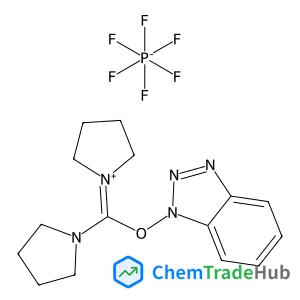
(1H-Benzotriazol-1-yloxy)(di-1-pyrrolidinyl)methylium hexafluorophosphate
CAS Number:
105379-24-6
Molecular Formula:
C15H21F6N5OP
Recommended Suppliers





Disclaimer
This page provides academic journal information for reference and research purposes only. We are not affiliated with any journal publishers and do not handle publication submissions. For publication-related inquiries, please contact the respective journal publishers directly.
If you notice any inaccuracies in the information displayed, please contact us at support@chemtradehub.com. We will promptly review and address your concerns.