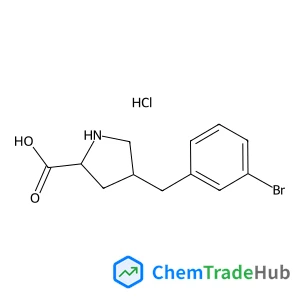
(2S,4R)-4-(3-Bromobenzyl)pyrrolidine-2-carboxylic acid hydrochloride
CAS Number:
1049734-10-2
Molecular Formula:
C12H15BrClNO2
Chao Xu, Le Yu, Feng Long Gu
Global nonadiabatic switching on-the-fly trajectory surface hopping simulations at the 5SA-CASSCF(6,6)/6-31G quantum level have been employed to probe the photoisomerization mechanism of trans-azobenzene upon ππ* excitation within four coupled singlet low-lying electronic states (S0, S1, S2, and S3). We have performed 586 sampling trajectories (331 starting from S2 and 255 from S3), and we found about half of the sampling trajectories staying on S1 or S2 states as resonances and the other half of them ending on the ground S0 state as active trajectories. The present simulation has demonstrated that there are six distinct photoisomerization pathways which can be summarized as three categories; one is the newly opened inversion–inversion nonreactive isomerization pathway accounting for 40% (34%) of active trajectories at a time constant of 80 fs (320 fs), the other is the inversion–torsion reactive and nonreactive isomerization pathways accounting for 40% (20%) of active trajectories at a time constant of 880 fs (1700 fs), and the third is the torsion–torsion reactive and nonreactive isomerization pathways accounting for 20% (46%) of active trajectories at a time constant of 780 fs (1000 fs) upon S2 (S3) ππ* excitation. The simulated total reactive quantum yield for trans-azobenzene photoisomerization upon S2 (S3) ππ* excitation is about 0.11 (0.13) which is in good agreement with recent experimental results of 0.09–0.20. Furthermore, the newly opened inversion–inversion nonreactive isomerization pathway from the present simulation agrees well with cascade experimental measurements of the Sn → S1 → S0 relaxation mechanism in both branching ratio and time constant.
Giada Arena, Elena Cini, Elena Petricci, Rosario Randino, Maurizio Taddei
DOI: 10.1039/C5QO00025D
Resul Ozdemir, Sangyun Park, İbrahim Deneme, Yonghan Park, Yunus Zorlu, Kevser Harmandar, Choongik Kim, Hakan Usta
DOI: 10.1039/C8QO00856F
Yunpeng Chen, Yunfan Yang, Yu Zhao, Shixing Liu, Yongqing Li
DOI: 10.1039/C8QO01111G
Xin-Xing Wu, Hui Tian, Yu Wang, Anjia Liu, Hengfan Chen, Zhixiang Fan, Xuefeng Li, Shufeng Chen
DOI: 10.1039/C8QO00964C
Chunhui Shan, Kangbao Zhong, Xiaotian Qi, Dongdong Xu, Ling-Bo Qu, Ruopeng Bai
DOI: 10.1039/C8QO00699G
Jia-hao Zhang, Yin Wei
DOI: 10.1039/C8QO00907D
Pedro Almendros, Hikaru Yanai, Shoki Hoshikawa, Cristina Aragoncillo, Carlos Lázaro-Milla, Mireia Toledano-Pinedo, Takashi Matsumoto, Benito Alcaide
DOI: 10.1039/C8QO00955D
Matthias Leiendecker, Adisak Chatupheeraphat, Magnus Rueping
DOI: 10.1039/C5QO00001G
2-(2-Chloroacetamido)-3-phenylpropanoic acid (CAS: 7765-11-9) is generally consi...
2-(Benzyloxy)-5-bromobenzoic acid can be handled safely if appropriate precautio...
(4-Methyl-1,2,5-oxadiazol-3-yl)methanamine hydrochloride is a chemical compound ...
2-(5-Hexylthiophen-2-yl)-4,4,5,5-tetramethyl-1,3,2-dioxaborolane (CAS: 917985-54...
While 4-(8-Methyl-9H-1,3-dioxolo[4,5-h][2,3]benzodiazepin-5-yl)benzenamine (CAS:...
The market for tert-butyl 3-hydroxy-4,5,7,8-tetrahydro-2H-pyrazolo[3,4-d]azepine...
Waste containing 3,5-Diamino-1H-pyrazole-4-carbonitrile (CAS: 6844-58-2) should ...
(6-Fluoro-3-pyridinyl)boronic acid can be synthesized through the reaction of 6-...
Dibenzyl carbonimidoylbiscarbamate (CAS: 10065-79-9) finds applications in vario...
The market for (beta,beta,2,3,4,5,6-~2~H_7_)Phenylalanine (CAS: 74228-83-4) is g...

Physical Chemistry Chemical Physics (PCCP) is an international journal co-owned by 19 physical chemistry and physics societies from around the world. This journal publishes original, cutting-edge research in physical chemistry, chemical physics and biophysical chemistry. To be suitable for publication in PCCP, articles must include significant innovation and/or insight into physical chemistry; this is the most important criterion that reviewers and Editors will judge against when evaluating submissions. The journal has a broad scope and welcomes contributions spanning experiment, theory, computation and data science. Topical coverage includes spectroscopy, dynamics, kinetics, statistical mechanics, thermodynamics, electrochemistry, catalysis, surface science, quantum mechanics, quantum computing and machine learning. Interdisciplinary research areas such as polymers and soft matter, materials, nanoscience, energy, surfaces/interfaces, and biophysical chemistry are welcomed if they demonstrate significant innovation and/or insight into physical chemistry. Joined experimental/theoretical studies are particularly appreciated when complementary and based on up-to-date approaches.