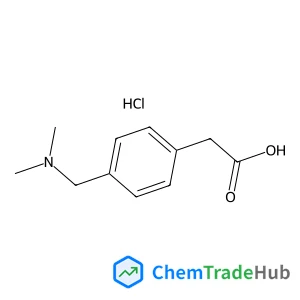
4-(Dimethylaminomethyl)phenylacetic acid hydrochloride
CAS Number:
99985-52-1
Molecular Formula:
C11H16ClNO2
Niladri Sekhar Mondal, Subhadip Nath, Debnarayan Jana, Nanda Kumar Ghosh
We report the optical and thermoelectric properties of the two-dimensional Dirac material T-silicene (TS) sheet and nanoribbons (NRs) by first-principles calculations. Both the optical and thermoelectric properties of TS can be modified by tailoring the sheet into nanoribbons of different widths and edge geometries. The optical response of the structures is highly anisotropic. A π interband transition occurs in the visible range of incident light with parallel polarization. The optical response for asymmetric arm-chair TS nanoribbons (ATSNRs) is larger than for symmetric ATSNRs. The absorptions of asymmetric ATSNR are redshifted due to a decrease in the bandgap with the width of the NRs. Plasma frequencies of the sheet and the NRs are identified from the imaginary part of the dielectric function and electron energy loss spectra curves. Thermoelectric properties like electrical conductivity, Seebeck coefficient, power factor, and electronic figure of merit are also studied. Compared with graphene, the TS sheet possesses a higher electrical conductivity and a better figure of merit. Among the NRs, asymmetric ATSNRs exhibit a better thermoelectric performance. All these intriguing features of TS may shed light on fabricating smart opto-electronic and thermoelectric devices.
Shogo Amemori, Nobuo Kimizuka
DOI: 10.1039/C5CP02733K
Chandan Sahu, Deepanwita Ghosh, Kaushik Sen, Abhijit K. Das
DOI: 10.1039/C5CP02442K
Sundaram Arulmozhiraja, Naoki Nakatani, Akira Nakayama
DOI: 10.1039/C5CP03089G
Qingguo Bai, Conghui Si, Jie Zhang, Zhonghua Zhang
DOI: 10.1039/C6CP02535H
Sara Laporte, Fabio Finocchi, Lorenzo Paulatto, Marc Blanchard, Etienne Balan, François Guyot, Antonino Marco Saitta
DOI: 10.1039/C5CP02097B
Wilk Bartłomiej, Walerian Arabczyk
DOI: 10.1039/C5CP02376A
Mark T. Sims, Laurence C. Abbott, Stephen J. Cowling, John W. Goodby, John N. Moore
DOI: 10.1039/C6CP03823A
Florian Thöle, Liwen F. Wan, David Prendergast
DOI: 10.1039/C5CP03046C
Waste containing N-Methoxy-N-methyl-1,3-thiazole-5-carboxamide (CAS: 898825-89-3...
N-(4-Biphenylyl)dibenzo[b,d]furan-4-amine should be stored in a tightly sealed c...
The market for 3-Acetamido-5-amino-2,4,6-triiodobenzoic acid (CAS: 1713-07-1) is...
Benzyl 2-O-acetyl-3,4,6-tri-O-benzyl-beta-D-galactopyranoside (CAS: 61820-03-9) ...
2-Ethylpiperazine dihydrochloride (CAS: 438050-52-3) is regulated under the Glob...
1,1'-[1,3-Phenylenebis(methylene)]bis(3-methyl-1H-pyrrole-2,5-dione) (CAS: 11946...
Several alternatives can be used in the synthesis of 5-Fluoro-2-(1-pyrrolidinyl)...
Proper personal protective equipment (PPE) must be worn when handling this compo...
When handling 6-Bromoimidazo[1,2-a]pyridin-8-amine, it is important to wear appr...
Alternatives to (2S,4R)-4-(4-Nitrobenzyl)pyrrolidine-2-carboxylic acid hydrochlo...

Physical Chemistry Chemical Physics (PCCP) is an international journal co-owned by 19 physical chemistry and physics societies from around the world. This journal publishes original, cutting-edge research in physical chemistry, chemical physics and biophysical chemistry. To be suitable for publication in PCCP, articles must include significant innovation and/or insight into physical chemistry; this is the most important criterion that reviewers and Editors will judge against when evaluating submissions. The journal has a broad scope and welcomes contributions spanning experiment, theory, computation and data science. Topical coverage includes spectroscopy, dynamics, kinetics, statistical mechanics, thermodynamics, electrochemistry, catalysis, surface science, quantum mechanics, quantum computing and machine learning. Interdisciplinary research areas such as polymers and soft matter, materials, nanoscience, energy, surfaces/interfaces, and biophysical chemistry are welcomed if they demonstrate significant innovation and/or insight into physical chemistry. Joined experimental/theoretical studies are particularly appreciated when complementary and based on up-to-date approaches.

![4-[(2-{2-[2-(2-Aminoethoxy)ethoxy]ethoxy}ethyl)amino]-2-(2,6-dioxo-3-piperidinyl)-1H-isoindole-1,3(2H)-dione structure](https://static.chemtradehub.com/structs/209/2093416-31-8-3162.webp "4-[(2-{2-[2-(2-Aminoethoxy)ethoxy]ethoxy}ethyl)amino]-2-(2,6-dioxo-3-piperidinyl)-1H-isoindole-1,3(2H)-dione structure")