












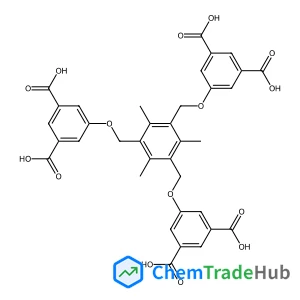
5,5',5''-(((2,4,6-Trimethylbenzene-1,3,5-triyl)tris(methylene))tris(oxy))triisophthalic acid
CAS Number:
1159974-70-5
Molecular Formula:
C36H30O15
Michael Busch, Elisabet Ahlberg, Kari Laasonen
We describe a simple and efficient procedure to compute a conversion factor for the absolute potential of the standard hydrogen electrode in water to any other solvent. In contrast to earlier methods our procedure only requires the pKa of an arbitrary acid in water and few simple quantum chemical calculations as input. Thus, it is not affected adversely by experimental shortcomings related to measurements in non-aqueous solvents. By combining this conversion factor with the absolute potential in water, the absolute potential in the solvent of interest is obtained. Based on this procedure a new generalized computational standard hydrogen electrode for the computation of electron transfer and proton-coupled electron transfer potentials in non-aqueous solvents and ionic liquids is developed. This enables for the first time the reliable prediction of redox potentials in any solvent. The method is tested through calculation of absolute potentials in 36 solvents. Using the Kamlet–Taft linear solvation energy model we find that the relative absolute potentials consistently increase with decreasing polarisability and decreasing hydrogen bonding ability. For protic solvents good agreement with literature is observed while significant deviations are found for aprotic solvents. The obtained conversion factors are independent of the quantum chemical method, while minor differences are observed between solvation models. This does, however, not affect the global trends.
Eva Zarkadoula, Haizhou Xue, Yanwen Zhang
DOI: 10.1039/C5CP02382C
Richard J. Zamora, Arthur F. Voter, Danny Perez, Romain Perriot, Blas P. Uberuaga
DOI: 10.1039/C6CP03931F
Roberto Carlos Salvarezza, Pilar Carro
DOI: 10.1039/C5CP04180E
DOI: 10.1039/C6CP00624H
Christoph J. Sahle, Christian Sternemann, Carlotta Giacobbe, Yigang Yan, Christopher Weis, Yury Forov, Metin Tolan, Michael Krisch
DOI: 10.1039/C6CP02495E
Qingguo Bai, Conghui Si, Jie Zhang, Zhonghua Zhang
DOI: 10.1039/C6CP02535H
Mengmeng Ren, Changshuai Dong, Baoyin Li, Yang Liu, Teng Chen, Peng Wu, Zheng Cheng, Xiangyang Liu
DOI: 10.1039/C5CP03473F
W. Liu, M. Nachtegaal, A. I. Frenkel, B. Rutkowski, M. Werheid, A.-K. Herrmann, C. Laugier-Bonnaud, H.-C. Yilmaz, N. Gaponik, A. Czyrska-Filemonowicz, A. Eychmüller
DOI: 10.1039/C6CP03527B
Z. L. Yu, D. Wang, Z. Zhu, Z. H. Zhang
DOI: 10.1039/C5CP03927D
Waste containing N-Methoxy-N-methyl-1,3-thiazole-5-carboxamide (CAS: 898825-89-3...
N-(4-Biphenylyl)dibenzo[b,d]furan-4-amine should be stored in a tightly sealed c...
The market for 3-Acetamido-5-amino-2,4,6-triiodobenzoic acid (CAS: 1713-07-1) is...
Benzyl 2-O-acetyl-3,4,6-tri-O-benzyl-beta-D-galactopyranoside (CAS: 61820-03-9) ...
2-Ethylpiperazine dihydrochloride (CAS: 438050-52-3) is regulated under the Glob...
1,1'-[1,3-Phenylenebis(methylene)]bis(3-methyl-1H-pyrrole-2,5-dione) (CAS: 11946...
Several alternatives can be used in the synthesis of 5-Fluoro-2-(1-pyrrolidinyl)...
Proper personal protective equipment (PPE) must be worn when handling this compo...
When handling 6-Bromoimidazo[1,2-a]pyridin-8-amine, it is important to wear appr...
Alternatives to (2S,4R)-4-(4-Nitrobenzyl)pyrrolidine-2-carboxylic acid hydrochlo...

Physical Chemistry Chemical Physics (PCCP) is an international journal co-owned by 19 physical chemistry and physics societies from around the world. This journal publishes original, cutting-edge research in physical chemistry, chemical physics and biophysical chemistry. To be suitable for publication in PCCP, articles must include significant innovation and/or insight into physical chemistry; this is the most important criterion that reviewers and Editors will judge against when evaluating submissions. The journal has a broad scope and welcomes contributions spanning experiment, theory, computation and data science. Topical coverage includes spectroscopy, dynamics, kinetics, statistical mechanics, thermodynamics, electrochemistry, catalysis, surface science, quantum mechanics, quantum computing and machine learning. Interdisciplinary research areas such as polymers and soft matter, materials, nanoscience, energy, surfaces/interfaces, and biophysical chemistry are welcomed if they demonstrate significant innovation and/or insight into physical chemistry. Joined experimental/theoretical studies are particularly appreciated when complementary and based on up-to-date approaches.

![4-[(2-{2-[2-(2-Aminoethoxy)ethoxy]ethoxy}ethyl)amino]-2-(2,6-dioxo-3-piperidinyl)-1H-isoindole-1,3(2H)-dione structure](https://static.chemtradehub.com/structs/209/2093416-31-8-3162.webp "4-[(2-{2-[2-(2-Aminoethoxy)ethoxy]ethoxy}ethyl)amino]-2-(2,6-dioxo-3-piperidinyl)-1H-isoindole-1,3(2H)-dione structure")
![4-Chloro-2-{[(2-chlorophenoxy)acetyl]amino}benzoic acid structure](https://static.chemtradehub.com/structs/351/351424-20-9-9467.webp "4-Chloro-2-{[(2-chlorophenoxy)acetyl]amino}benzoic acid structure")



